Krüger
also Krueger, Kröger
The innkeeper, keeper of the village's one warm room.
- Origin
- German
- Register
- German family
The Krüger arms

Coat of armsKrüger family Coat of ArmsArthur Semrau · Public domain

- Coat of arms: Granted to an individual and inherited down that one documented line. These are the arms of particular families of the name, not of everyone who shares the surname.
The seat of Krüger
Seat vacantChief
No one leads the Krüger community yet. When the movement opens, you can stand for its leadership, or help elect whoever does.
Current mission
No shared goal set yet. Once Krüger has leadership, it sets the public focus: a restoration, a gathering, a real-world project that helps its own.
The Krüger clan is being rebuilt. Join the waiting list for the movement today, and you help decide who leads it and what it does.
Help rebuild the Krüger clan →What does the Krüger name mean?
A Low German trade-name, in the north and east the innkeeper or tavern-keeper, from Krug, a tavern (in some districts a potter, from Krug, a jug). Thick across the northern plain, Brandenburg and the old eastern provinces.
The history of Krüger
The Krugrecht, and the one licensed room in the village
In the Low German north a Krug was the village inn, and the Krüger the man who held the Krugrecht, the licence to keep it and to sell drink in it. The right was granted, not assumed, and that is why the word hardened into a surname: one household in the village held a privilege the rest of them needed, and the neighbours named it after the privilege. The name settled thickest where that Low German speech ran, across Brandenburg, Mecklenburg and the lands further east, and Krüger is the thirty-first commonest surname in Germany today.
The same root threw off a cluster of names rather than one: Kröger and Kroeger, Crüger, which is how the learned bearers of the name signed themselves, and Krug, Krüg, Krog, Krügel and Krugmann alongside them. Where the word meant the vessel rather than the house, a jug, it could fasten instead on the man who threw the pots.
The town clerk of Trebbin and his cattle dealer
Bartholomäus Krüger, born at Sperenberg around 1540 and last heard of at Trebbin after 1597, is on record between 1580 and 1597 as that Brandenburg town's clerk and its organist, holding its writing and its music in the same pair of hands. He wrote plays as well: a drama of 1574 on the beginning and the end of the world, and another of 1579 in which peasant judges send an innocent Landsknecht to the executioner.
His lasting book came in 1587, Hans Clawerts Werckliche Historien, the doings of Hans Clauert, a cattle dealer who had died in the plague of 1566 and whom Krüger is likely to have known in life. It has the shape of Till Eulenspiegel, but its jokes are pinned to real local ground, and it kept its hold on the district: Johannes Bobrowski took the material up again in 1956 for a children's book, Hans Clauert, der Märkische Eulenspiegel.
Youngest of fourteen at Cölln
Esaias Krüger was born on 1 June 1544 at Cölln, youngest of the fourteen children of the councilman Hieronymus Krüger and his wife Margaretha Holdenart. His schooling reads like a circuit of the Protestant north: Berlin first, then Magdeburg from 1559, then Brandenburg, then Halberstadt, where the pupil stayed on as a teacher of the school.
At the university of Frankfurt an der Oder he sat under Andreas Musculus, Christoph Corner and Heinrich Paxmann, until plague in the town drove him back to Berlin and a living as private tutor to noble families. From 1568 he was at Jena and deep in theology with Tilemann Hesshus, Johannes Wigand and Timotheus Kirchner.
Driven out of Thuringia, then building Helmstedt
He was conrector of the school at Weimar, and in 1572 deacon at Jena, where he lived through the expulsion of the Lutheran theologians from Thuringia. He pulled back into exile at Stollberg in the Erzgebirge and cast about for work, and in 1574 Duke Julius took him on at Alfeld as general superintendent of Braunschweig-Wolfenbüttel. From that post he had a hand in founding the university of Helmstedt.
In 1580 he moved to Gera as pastor and superintendent, where the consistory and the church law that came with it absorbed most of what was left of his working life; in old age his strength failed and a deputy was appointed to him. He had married Anna, daughter of the Gera superintendent Bartholomäus Rosinus (1520-1586), on 29 August 1569, and they had two sons and five daughters. He died at Gera on 20 March 1609.
The Lübeck rector who would not be told what to teach
Pancraz Krüger, born at Finsterwalde on 12 May 1546 and signing himself Pancratius Crüger, was rector of the Ägidien school at Braunschweig, and in 1576, at the founding of Helmstedt, became its professor of poetry and Latin. In 1580 the council of Lübeck called him to be rector of the Latin school at the Katharineum, and the quarrel that followed ran for years.
Krüger wanted a free hand in teaching and preferred Ramism to the Melanchthonianism the school had been built on. Superintendent Andreas Pouchenius the Elder, who had known him at Braunschweig and had helped bring him to Lübeck, saw the church's oversight of the school slipping away and attacked him from the pulpit. A mediation by the Marienkirche pastor Michael Rhau failed in 1586, and Krüger was shut out of communion under church discipline.
The council of the free imperial city, which held the sovereign church government, took an opinion from the theological faculty at Tübingen and dismissed him; then it turned on the clergy. In 1588, through its syndic Calixtus Schein, it decreed that preachers use discipline moderately, and that a penalty of the kind laid on Krüger be imposed only after consultation with the council. Krüger left Lübeck in 1589 for the Latin school at Goldberg, became professor of Greek at Frankfurt an der Oder in 1594, held its rectorate in 1598/99, and died there on 23 October 1614.
The war that closed the road to Italy
Johann Bartholomäus Krüger was born at Wittenberg on 12 December 1608, son of another and quite separate Bartholomäus Krüger, a practising physician from Danniko near Magdeburg, and of Margaretha, daughter of the Wittenberg councillor Magnus Person. Both parents were dead by 1613, and his guardian Balthasar Meisner held the orphan to his books hard enough that he entered the university of Wittenberg in 1620 and could have taken a master's degree in philosophy at seventeen.
Medicine drew him off that path. He studied under Daniel Sennert, went on Sennert's advice to Jena in 1629 for three years of botany and anatomy with Werner Rolfinck, and after a short spell at Leipzig planned the customary study journey into Italy. The Thirty Years' War closed that road, and on 26 October 1632 he arrived at Königsberg instead. In 1633 he took a tutor's place in the country and practised there as a country doctor.
Back in Königsberg he took his licentiate in medicine on 20 December 1634, was made adjunct of the medical faculty in 1635, and on 13 June 1636 full professor of medicine and physics, giving himself above all to the training of his students. He caught consumption in the course of that work and died of it on 2 November 1638, and was buried in Königsberg cathedral on 5 November under an epitaph set up to him there.
Engravers, star-watchers and a man who went to the ice
Scholarship kept surfacing under the name. Peter Krüger (1580-1639) was philologist, astronomer and mathematician at once; Georg Krüger, born about 1642 and dead in 1707, put theology, astronomy and meteorology into a single career; Adalbert Krueger (1832-1896) was an astronomer plainly. Beside them stand the classical philologist Karl Wilhelm Krüger (1796-1874) and Ferdinand Krüger (1843-1915), a doctor who wrote his poetry in dialect.
The name runs as thickly through the art trades: Andreas Ludwig Krüger (1743-1822), painter and architect; the copperplate engravers Ephraim Gottlieb Krüger (1756-1834) and Anton Ferdinand Krüger (1795-1857); the painter Franz Krüger (1797-1857); the soprano Emmy Krüger (1886-1976). Further east it turns up among the Baltic Germans, in the painter Woldemar Friedrich Krüger (1808-1894) and the archaeologist Edmund Carl Julius Krüger (1836-1909). Hans Krüger (1886-1930) went the other way and made his name as a polar explorer.
Krueger, Kryger, Kriger
The name left the northern plain with the emigration, and it left by respelling. Where the umlaut could not be printed it became ue, and Krueger is the ordinary American form: the economists Alan B. Krueger (1960-2019) and Anne O. Krueger, the novelist William Kent Krueger, the bandleader Bennie Krueger (1899-1967) all carry it.
Eastward it was written into other orthographies again, Kryger and Krygier in Poland, Kriger in Russia and Kazakhstan. Others took it further still: Ralph Krueger, the German-Canadian ice hockey player and coach; the Australian hammer thrower Brooke Krueger-Billett; the Swedish writer Karl Krüger-Hansson (1887-1962); the Luxembourg goalkeeper Charles Krüger (1896-1990). The village licence that made the name is centuries behind all of them, and the name has comfortably outlasted it.
The castles of the homeland
The great strongholds of the homeland, look one up, see what it looked like in its prime, and recreate it to explore.
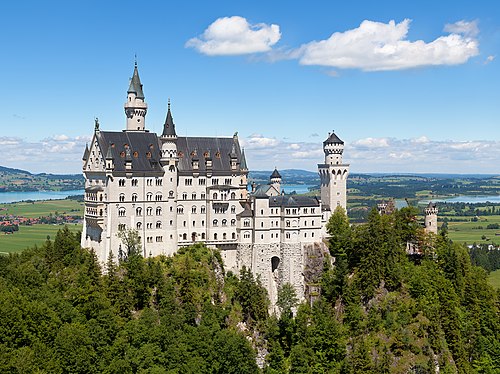 Neuschwanstein CastleStill standing · prime 1886
 Hohenzollern CastleRestored · prime 1867
 Eltz CastleStill standing · prime 1615
All castles in Germany → · Strongest castles in Germany → · Castles of Europe
Play As Your Clan
Hold a real castle against whatever you choose to send at it, take a ship out in her own service years, or stand at the shoulder of someone the record remembers. The chronicler sets the scene; the deeds are yours.