Lehmann
also Lehman, Lehnmann
The liegeman, and one of the great names of the diaspora.
- Origin
- German
- Register
- German family
The seat of Lehmann
Seat vacantChief
No one leads the Lehmann community yet. When the movement opens, you can stand for its leadership, or help elect whoever does.
Current mission
No shared goal set yet. Once Lehmann has leadership, it sets the public focus: a restoration, a gathering, a real-world project that helps its own.
The Lehmann clan is being rebuilt. Join the waiting list for the movement today, and you help decide who leads it and what it does.
Help rebuild the Lehmann clan →What does the Lehmann name mean?
From Middle High German lēhenman, the liegeman or vassal who held land in fief (Lehen) from a lord, a tenant of standing in the feudal order. One of the foremost of all German-Jewish surnames.
The history of Lehmann
Lehen: a name for the terms a man held his land on
The word behind the surname is Middle High German lehenman, and what it names is a relationship rather than a craft. The Meier ran another man's estate and the Bauer worked the ground; the Lehmann held a Lehen, land granted on conditions instead of owned outright. Medieval Europe set allodial possession, full and outright, against the conditional grant, the precaria or benefice that gave English the word precarious. A fief was of that second kind: it carried fealty owed upward, a tenant-in-chief could grant it on again to vassals beneath him, and it could be taken back.
German usage let the word slide the whole length of that ladder, covering the sworn liegeman at the top and, at the bottom, the farm-holder who held his ground of a lord and paid dues for it. What both ends shared was that the man was a holder of rights and could state whose land he stood on and on what terms, where a great many could not. Free tenants were a minority everywhere: in parts of eleventh-century England around a tenth of the peasant population.
The name that came out of all this stands thirty-first among German surnames and turns up in every part of the country. It was already widespread in German-speaking Switzerland before 1800, and 9,435 Swiss carried it in 2022, of whom 3,218 live in canton Bern, where it is the tenth commonest name of all. The Swiss spellings drifted off on their own, to Leemann around Zürich and Lechmann at Sumvitg in Graubünden.
Blasius Lehmann, who put organs into Wittenberg and Bautzen
The first Lehmann in the record with work still attached to his name was born before 1483 and learned organ building under Burkhard Dinstlinger. As a journeyman about 1495 he built a large organ and a small one with his master in the castle church at Wittenberg, and from 1499 to 1502 the two of them built the cathedral organ at Bautzen. Between them they carried south German and Italian influence into Saxon organ building.
Lehmann then set up on his own account at Bautzen, and his reputation travelled. In 1511 Johann Scharnagel of Wunsiedel, organist of the Thomaskirche at Leipzig, commissioned an organ from him; the fee of 500 gulden points to a new instrument of middling size with two manuals and an independent pedal. He served the Brandenburg elector Joachim I as court organist and court organ builder, staying at his court from 1516 to 1519, and afterwards moved to Leipzig. He died around 1543 at Bautzen, and after that year there is no further trace of him.
An Anton Lehmann of Bautzen, in all likelihood his son, was at the same trade a few years later: he repaired the organ at Danzig in 1547, and in 1548 the organ of the Leipzig Thomaskirche, which he also played himself, as well as one at Zwickau. Two generations of the name were keeping the organs of the principal churches of Saxony and the Baltic coast in order before the Reformation century was out.
The council bench at Dresden and the elector's bedside
Jakob Lehmann was born before 1558 into a Dresden burgher family and took up the freedom of the city himself in 1569. What he did for a living is simply not recorded, which is its own comment on how the civic record was kept: the offices survive and the trade does not. He married Maria Magdalena, daughter of the mayor of Torgau, and in 1608 bought the village judge's estate at Plauen, near Dresden. He entered the Dresden council in 1592, was first elected ruling mayor in 1603, and took the office again on the customary three-year rotation until 1618, appearing in the register for the last time in 1619. His daughter Anna Magdalena married into the same class of office, to the Freiberg town clerk Johann Drabitius.
The name turns up at Bautzen again in the next century. Elias Lehmann was born there on 28 September 1633, son of a mayor of Bautzen also called Elias, who died while the boy was young. Orphaned, he went to Leipzig to study medicine on a stipend from the Bautzen council and took his baccalaureate in 1654. After practising at home he travelled to Italy in 1663 and took his doctorate at Padua in 1665. Back in Bautzen his success brought him the post of town physician in 1667 and district physician shortly after, and in 1677 an edition of four alchemical writings of Roger Bacon was dedicated to him there.
That same year the elector Johann Georg II called him to court as personal physician, a place he kept under Johann Georg III, and in 1687 he was brought in to attend the dowager electress Magdalena Sibylla as she lay dying. By 1689, when his son Joachim Gottlob took his degree, he was styled hereditary landholder of Kayna, Zieschitz and Baschitz, and on 10 March 1690 the Leopoldina admitted him as member number 170 under the academic name ANTENOS I. He died on 2 April 1691 and was buried in the Sophienkirche at Dresden. His wife Anne Magdalena was a daughter of Joachim Westphal, lord of Nieder-Keyna and another Bautzen mayor.
The Erzgebirge pastors and the knight's estate at Löbitz
In the mining country of the Saxon Erzgebirge the name belonged to a line of Lutheran clergy three generations deep. The grandfather, Theodosius Lehmann, was pastor at Königswalde and Elterlein; his son Christian (1611–1688) was pastor at Scheibenberg and a chronicler of the region. Of Christian's sons, Christian the younger became pastor and superintendent at Annaberg and later at Freiberg, and Immanuel was deacon at Neustadt Wiesenthal and finally at Görlitz.
The eldest, baptised at Annaberg on 17 April 1641, was given his grandfather's name. Theodosius Lehmann's childhood fell in the closing years of the Thirty Years' War, when the Erzgebirge was harried and plundered almost without pause by Swedish and imperial mercenary bands. He did not go into the church. He read law, took his doctorate at Jena in 1670 with a dissertation on the rights and privileges of the old, served as chamber procurator at Bautzen from 1674 to 1678, and in 1679 entered the service of the Duke of Saxe-Merseburg, rising to court, justice and consistorial councillor.
Then he began buying land. In 1684 he acquired the knight's estate of Culm in Thuringia from his father-in-law, and in 1688 a third share of the knight's estate of Löbitz from the chapter councillor Hans Haubold von Kötteritz. That holding, in the district of Weissenfels, carried weight afterwards: on it rested the petition by which the Emperor Leopold, at Vienna in 1703, confirmed to his only son Christian Theodosius a grant of noble rank made in the sixteenth century and since lost. He had married the Merseburg chancellor's youngest daughter, Johanna Christina Wex, in 1677, and died at Merseburg on 27 August 1696. The family's rise is dated from him: a surname meaning the man who held a fief of somebody else was now on the deeds of two knight's estates.
Berend Lehmann buys a king his crown
Issachar Berend Lehmann was born at Essen in Westphalia on 23 April 1661. His father belonged to the Jewish upper class of the province, as did that father's brother-in-law Leffmann Behrens, later a court Jew at Hannover. He is first documented in business at the Leipzig trade fair of 1687, at twenty-six, and became a regular at all three of its annual seasons. He settled at Halberstadt, where from 1688 he is listed as married to Miriam, daughter of the deceased protected Jew Joel Alexander; it was through her that he held his own protected status. He built a modest first house in the Jewish quarter at Bakenstrasse 37, and in 1692 was at the imperial court in Vienna with Behrens, working to have Hannover raised to an electorate.
In 1694 he became mint and general business agent to his own sovereign, the Elector of Brandenburg, and a year later he was banking for the Saxon court at Dresden. Then came the commission that made him. In 1697 the young elector Augustus the Strong charged him with raising the money needed to buy the throne of Poland. Lehmann was given authority to sell or pawn Saxon lands lying outside the main territory, and collected loans worth millions of guilders from Christian and Jewish banking partners; on that money the Saxon field marshal Graf von Flemming persuaded a majority of the Polish nobility to elect Augustus their king. In return Augustus made him Resident of the King of Poland in the Lower Saxon Circle, close to a consul's privilege, which Lehmann invoked repeatedly afterwards with varying success.
What followed was war supply and treasure. Between 1700 and 1704 he furnished military equipment for Augustus in the Northern War against Sweden, and his surviving letters show him chasing fresh loans. He acted as mint agent for the Saxon and Polish state and bought jewels for the Grünes Gewölbe, Augustus's show collection. In 1708 that trade produced a Dresden branch of the Halberstadt house, run by Lehmann with his eighteen-year-old eldest son and his brother-in-law Jonas Meyer. Outside the Leipzig fairs those three were, strictly speaking, the only protected Jews in all of Saxony, yet the firm at Landhausstrasse 13 employed and housed as many as seventy Jewish staff who held no protection at all. The Saxon estates protested at exactly that, and Augustus held them off for years before giving way: in the mid-1720s the sale of merchandise had to stop, and only a reduced banking business went on.
The Talmud, the yeshiva, and the auction at Halberstadt
Lehmann's other career was as a benefactor of his own community, and it began with a book. The Dessau court Jew Wulff, who had set out to have the Babylonian Talmud printed, ran short of money; Lehmann took over both the project and the printing licence, made the gold flow from his pocket, and between 1697 and 1699 had two thousand copies of a twelve-volume edition produced at Frankfurt on the Oder. A large part of the run went free of charge to poor Jewish communities. A later Hebrew press of his in the Harz failed under Christian censorship.
At Halberstadt he built, and was fought at every step. The Elector of Brandenburg allowed him a second house, an exception to the rule forbidding Jews more than one; when he began a yeshiva building in its garden grounds, meant as the nucleus of a community campus with a large new synagogue, he was ordered to stop, and the ground was confiscated for French Reformed refugees. Augustus protested on his behalf and got nowhere. He built the complex out anyway around his first house, with offices, family quarters, a warehouse and a wine cellar, and sheltered six poor Jewish families so that they could keep up their divine service. As one of the three parnassim of a community of around a thousand Jews, more than Berlin then held, he had to apportion the extra contributions King Frederick William I levied on them, and took the largest share himself.
The end was ruin. He lost a great deal of capital when his son-in-law Isaac Behrends, court Jew at Hannover, went bankrupt and Lehmann was accused of holding back securities, jewels and money from the estate, an allegation never verified. Hannover wanted him tried there and the Prussian king refused to extradite his protected Jew, so the dispute over the proper venue dragged on for years while Lehmann tried to settle with the creditors by giving up part of his own claims. In 1727 his own insolvency was declared, and early in 1730 a claim for 6,000 talers dating back to 1699 held him under house arrest until he could borrow the sum. He died on 9 July 1730, and claims of several hundred thousand talers were only partly met by auctioning most of his property.
What survived him was the charity. Insolvent, he had still endowed foundations, one to pay for the marriages of poor orphans at Halberstadt, another to keep his yeshiva scholars fed, and the second served its purpose for the next two centuries. The Klaus he founded near the synagogue became a stronghold of neo-orthodox Judaism in the nineteenth century, survived Kristallnacht and the air raid of 1945, and now houses the Moses Mendelssohn Akademie, which in 2001 opened the Berend Lehmann Museum nearby. His gravestone stands in the oldest Israelitic cemetery at Halberstadt, praising the standing in Christian palaces that let him act as shtadlan, advocate, for his co-religionists. Set in the wall of the Bakenstrasse complex are the remains of a footbridge he built for the public over the Holtemme, then running open between the houses of the Jewish quarter.
Peter Ambrosius Lehmann tells Europe how to travel
Born at Döbeln in 1663, Peter Ambrosius Lehmann went to the princely school at nearby Meissen and read theology and history at Leipzig, where he was made master of philosophy in 1690 and lectured until he decided to move to Hamburg. The free imperial city was the centre of the rest of his life. Called in 1693 as one of the candidates of the ministry, he tutored privately, then left teaching for what he called his literary labours. The same prince who had made the Halberstadt banker his Resident in the Lower Saxon Circle appointed this Lehmann legation secretary for the same circle in 1708; nothing in the record connects the two beyond the patron.
He was a journalist before the trade had a name. From 1699 to 1704 he issued the annual Historische Remarques der neuesten Sachen in Europa, and with Gottfried Strasberg he ran the Nova litteraria Germaniae collecta Hamburgi from 1703 to 1706, an attempt at a scholars' journal on the model of the Acta Eruditorum: academic writings, honours and deaths, advances in medicine and natural science, compiled out of the journals coming from Leipzig, Halle, Wittenberg, Jena and Frankfurt.
His lasting book was Die vornehmsten europäischen Reisen. Sixteen editions are documented and there were probably more, a record no other German travel handbook came close to before the end of the eighteenth century. Its preface argues the necessity and usefulness of travel, which still needed arguing while the thing remained largely a privilege of the well-born. It covers how to prepare and why languages are worth having, and then the routes themselves, some known to Lehmann at first hand and some described to him by travellers, down to which inns a man could sleep in cheaply. Published at Hamburg, it kept being reissued after his death on 31 October 1729. From the eleventh edition, in 1767, Gottfried Friedrich Krebel took it over and revised each one for current postal connections, coinage and lodgings, dropping Lehmann's defence of travel because by then nobody needed convincing.
Rimpar to New York, and a name in the modern register
The name is also one of the great surnames of German Jewry, and no branch of it travelled further. Three brothers from Rimpar in Bavaria, Henry (about 1822–1855), Emanuel (1827–1907) and Mayer Lehman (1830–1897), reached Alabama in the 1840s as pedlars and cotton traders, moved on to New York, and built the house of Lehman Brothers, a pillar of American finance for a century and a half until its failure in 2008 made the family name shorthand for an entire crisis. The second n had gone somewhere in the crossing.
The name kept working in New York long after the counting house was established. Philip Lehman (1861–1947) and his son Robert (1891–1969) were bankers; Irving Lehman (1876–1945) was a lawyer and a judge there, and Herbert Henry Lehman a New York politician.
The name also went into the sciences and the concert hall: Johann Gottlob Lehmann (1719–1767) was a physician, mineralogist and geologist, Otto Lehmann (1855–1922) a physicist, Lotte Lehmann (1888–1976) a German-American soprano. Two Lehmanns have craters named for them, and not on the same world: the German astronomer Jacob Heinrich Wilhelm Lehmann (1800–1863) has one on the Moon, and the Danish seismologist Inge Lehmann (1888–1993) has one on Venus.
The name also became ordinary furniture of German-speaking life, in the way only a name near the top of the register can. The Austrian journalist Adolph Lehmann (1828–1904) compiled the Vienna address directory the city called simply der Lehmann, and the Ernst Paul Lehmann Patentwerk built the Lehmann Gross Bahn model railways. When Sven Regener wanted a title for his 2001 novel about a man of no particular distinction, he called it Herr Lehmann, and every German reader knew at once what was meant. The word began as a statement about the terms on which a man held his ground, and ended as the name for anybody at all.
The castles of the homeland
The great strongholds of the homeland, look one up, see what it looked like in its prime, and recreate it to explore.
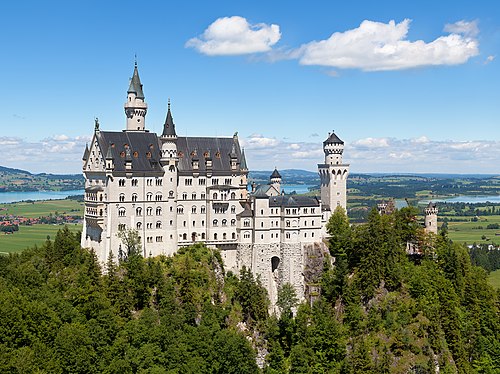 Neuschwanstein CastleStill standing · prime 1886
 Hohenzollern CastleRestored · prime 1867
 Eltz CastleStill standing · prime 1615
All castles in Germany → · Strongest castles in Germany → · Castles of Europe
Play As Your Clan
Hold a real castle against whatever you choose to send at it, take a ship out in her own service years, or stand at the shoulder of someone the record remembers. The chronicler sets the scene; the deeds are yours.