Clan Lennox
An ancient earldom that bred a king consort.
- Origin
- Argyll & the West Coast, Scotland
- Motto
- I'll defend
- Famous bearer
- Henry Stewart, Lord Darnley, King consort of Scots
- Register
- Scottish clan
The Lennox crest badge, tartan and country

Crest badgeClan member crest badge - Clan LennoxCeltus · CC BY-SA 3.0 
TartanTartan LennoxUnknown author Unknown author · OGL v1.0


- Crest badge: The chief's crest inside a belt and buckle: the badge a clansman wears to show whose following he is in.
- Tartan: The checked cloth the family is known by.
What is the Lennox clan tartan?
One Lennox sett is recorded, and it is the swatch above. A sett is the block of coloured bands the cloth is built from, repeated in both directions; the whole plaid is that one square enlarged.
Almost no clan tartan is medieval. Highland dress was proscribed from 1746 until 1782, and when it returned it returned as ceremony rather than everyday cloth, so the surname-to-sett map was fixed after the break, by the Bannockburn weavers’ pattern books, the royal visit to Edinburgh in 1822, and the Vestiarium Scoticum of 1842. The Lennoxes wore tartan long before any of that. What the registers fixed was which one. Nobody polices any of it. Wearing the Lennox sett declares allegiance to the name, not descent from any particular line of it.
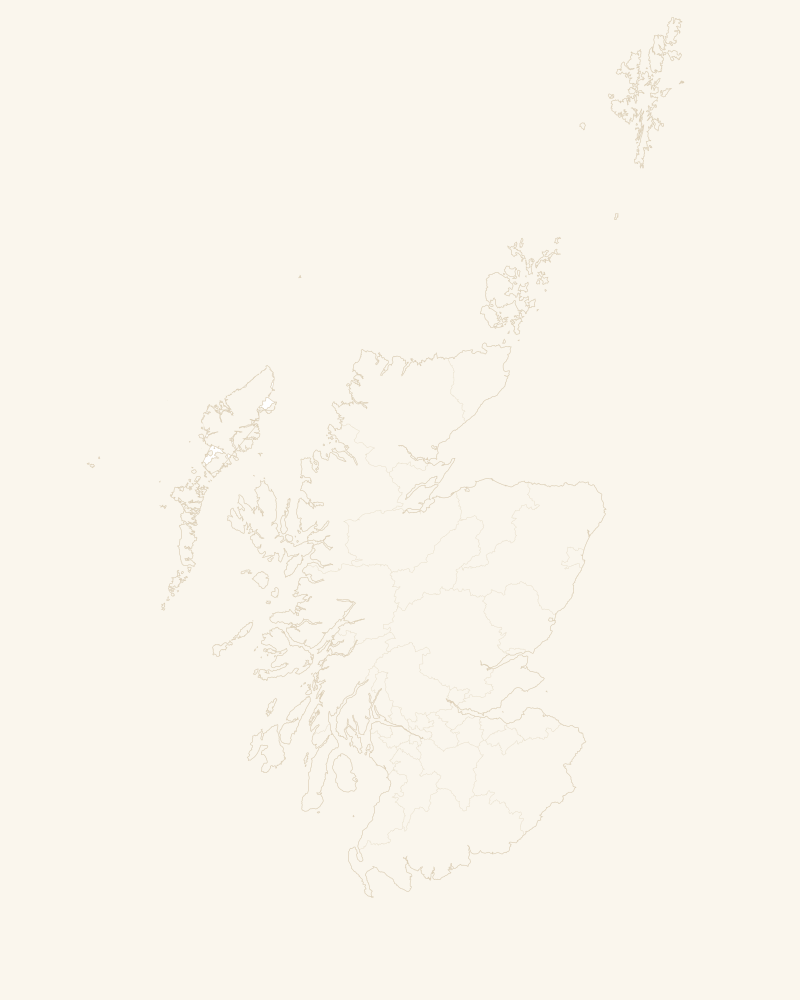
The seat of Clan Lennox
Seat vacantChief
No one leads the Clan Lennox community yet. When the movement opens, you can stand for its leadership, or help elect whoever does.
Current mission
No shared goal set yet. Once Clan Lennox has leadership, it sets the public focus: a restoration, a gathering, a real-world project that helps its own.
The Lennox clan is being rebuilt. Join the waiting list for the movement today, and you help decide who leads it and what it does.
Help rebuild the Lennox clan →Motto
I'll defend
What does the Lennox name mean?
From the ancient Scottish region of Lennox, covering modern Dunbartonshire, with parts of Stirling, Perth and Renfrew.
The history of Clan Lennox
The smooth stream that gave a country its name
Lennox is one of the few Scottish surnames that began as a country rather than as a man. The ancient earldom of Lennox covered the whole of Dunbartonshire together with large parts of Perthshire, Renfrewshire and Stirlingshire. In Scottish Gaelic, Leven-ach means a smooth stream, and the Celtic Mormaers of Levenax who ruled the district became the Earls of Lennox. A second reading of the name takes it from Leamhnach, elm-tree country.
The origins of the earldom are disputed. One account has a Saxon baron named Arkyll receiving lands in Dunbartonshire and Stirlingshire from Malcolm III of Scotland, marrying a Scottish heiress, and fathering the man who appears as Ailin I, Earl of Lennox. Other historians hold that the earldom was conferred on David, Earl of Huntingdon, by his older brother William the Lion, and that the Lennox family proper was not established until after William's reign. What is not disputed is that the earldom existed by the twelfth century, before the surname had settled on anyone.
Malcolm of Lennox at Carlisle, and after
By the end of the thirteenth century the Earls of Lennox were among the most powerful nobles in Scotland. Malcolm, 5th Earl of Lennox, supported Robert the Bruce's claim to the Scottish crown, and in 1296 he led his Lennox men south into England and laid siege to Carlisle.
The war then forced on him the choice every Scottish magnate faced. Malcolm swore fealty to Edward I of England and his name appears on the Ragman Rolls with the rest. He did not stay there: he returned to Bruce and became one of the mainstays of the struggle for independence.
The heiress, the resignation and the regrant
Malcolm's son was present at the coronation of Robert II of Scotland, and died two years later without male issue. The earldom therefore passed through his daughter, Margaret, Countess of Lennox, to her husband Walter de Fasselane. Margaret and Walter then did something technical that decided the family's whole future: they resigned the title to the Crown, and it was re-granted to their son, Duncan, Earl of Lennox.
The resignation put the earldom back through the king's hands and out again on the king's terms, The pattern of a title carried by daughters rather than sons then held: Duncan's own heir was a daughter, and the later claims to the earldom all descended through her sisters.
The eighty-year-old earl and the king's revenge
Duncan's daughter was Isabella, Countess of Lennox, who married Murdoch Stewart, Duke of Albany. It was the most dangerous marriage in Scotland. When James I of Scotland came home from his long captivity in England, he moved against everyone connected to Albany's father, who had murdered the king's brother and had presided over Scotland in disorder. The Earl of Lennox was caught in that reckoning and beheaded in May 1425, aged eighty.
The punishment ran on past the executions. The widowed Isabella was imprisoned in Tantallon Castle with her son, Walter de Levenax, who was afterwards moved to the Bass Rock. On her release she was allowed to return to her island residence of Inchmurrin on Loch Lomond, a curious kind of mercy for the countess of a western earldom.
The estates went with the title. Balloch Castle in Dunbartonshire, held by the original Earls of Lennox, passed in 1425 to the Stewarts of Darnley, who were made Earls of Lennox in their turn. From that year the earldom and the family are two different stories, and the surname survives in the branches rather than the coronet.
Two sisters, two claims and the Stewarts of Darnley
Isabella had two sisters, Margaret and Elizabeth, and both left descendants who claimed the vast Lennox estates. From Margaret descend the Menteiths of Rusky; from Elizabeth descend the Stewarts of Darnley. The succession was disputed and the title passed among several different noble families before the Darnley line took it: in 1488 John Stewart, Lord Darnley, assumed the title of Earl of Lennox. The sheriffdom of the district was granted to Matthew, Earl of Lennox, in 1511, which put the courts as well as the acres back under a single hand.
It did not hold for long. Matthew Stewart, the second Stewart Earl of Lennox, was killed at the Battle of Flodden in 1513. The title stayed with the Stewarts of Darnley until the killing of Henry Stuart, Lord Darnley, husband of Mary, Queen of Scots, in 1567, and Mary's own execution in 1587. Darnley's son was James VI and I, so the Lennox earldom sits directly behind the union of the Scottish and English crowns.
The title then went to the young James VI himself, who granted it to his uncle, Charles Stuart. It passed afterwards to Esme Stewart, created Duke of Lennox in 1581, and later to Charles II of England, who gave it to his illegitimate son Charles Lennox, 1st Duke of Richmond. That last step matters most for the name: it is where Lennox stops being a title held by Stewarts and becomes a surname borne by a family.
Aubigny, La Verrerie and the Lennoxes in France
The French thread starts in 1423, when Charles VII granted the Seigneurie d'Aubigny-sur-Nere in the old province of Berry to Sir John Stewart of Darnley, a fourth cousin of James I of Scotland. The lands carried the Chateau de la Verrerie at Oizon, which the Stewart Seigneurs d'Aubigny used as a demeure d'agrement, a secondary house for pleasure, some fourteen miles from their principal seat at the Chateau d'Aubigny.
When Charles Stewart, 3rd Duke of Richmond and 6th Duke of Lennox, died in 1672 as the last male of the Stewarts of Aubigny, the estate escheated to the French crown under the terms of the original grant. The following year, at Charles II of England's request, Louis XIV granted La Verrerie to Louise de Kerouaille. Her French title was heritable by her descendants by Charles II, and those descendants bore the surname Lennox. On her death in 1734 the estate passed to her grandson Charles Lennox, 2nd Duke of Richmond, of Goodwood House in Sussex, and the Lennox Dukes of Richmond held it until the 5th Duke sold it in 1842.
That Goodwood line put the name into the eighteenth-century record. Sarah Lennox, Duchess of Richmond (1706-1751), was Lady of the Bedchamber to Queen Caroline and mother of the Lennox sisters: Caroline Lennox (1723-1774), afterwards 1st Baroness Holland; Emily Lennox (1731-1814), afterwards Duchess of Leinster; Louisa Lennox (1743-1821); and Lady Sarah Lennox (1745-1826).
Woodhead, the Kincaid feud and the chiefs who came back
While the earldom travelled through Stewarts, Stuarts and dukes, the working Lennox families stayed on the old ground in Dunbartonshire and the Campsie country. Balcorrach Castle, near Milngavie, was held by a branch descended from Donald, son of Duncan, 8th Earl of Lennox, and Woodhead Castle, also near Milngavie, was held by that same Lennox of Balcorrach branch in 1572. Antermony Castle, near Milton of Campsie, had been the Flemmings' and passed later to the Lennoxes. They are where the surname actually lived.
The Lennoxes of Woodhead feuded with the Clan Kincaid through the 1570s. Historians have noted the irony: it was through a marriage with the Lennox family that the Kincaid name was later re-established as an independent clan in the twentieth century.
In the nineteenth century the Lennoxes of Woodhead, by then at Lennox Castle (built in 1840, which left Woodhead a ruin), claimed the right to succeed to the title and honours of the ancient Earls of Lennox. The peerage claim was not established, but they were officially recognised as chiefs of the family name of Lennox. Lennox Castle was sold to the city of Glasgow in 1927 and the family's seat became Downton Castle near Ludlow, sold to a Greek owner in 1979; the remaining ancestral lands went in the mid-1980s.
The chiefship did not go with the acres. Edward Lennox of that Ilk and Woodhead is Chief of the Name and Arms of Lennox, bearing Argent, a saltire between four roses Gules, under the motto I'll defend. By a constitution dated 31 May 2017 the chief organised the name into a society, Clan Lennox; its executive administrator is the Clan Chamberlain, the first of them Gordon Lennox, a solicitor from Glasgow.
The Aberdeen boilermaker's daughter
Ann Lennox was born in Aberdeen on Christmas Day 1954, the only daughter of a boilermaker at the Hall Russell shipyard and a school dinner-lady. She played flute and piano from the age of eight, went to the Aberdeen High School for Girls on a burgh scholarship, and at seventeen won the open piano scholarship to the Royal Academy of Music in London. She left in her final term, waited tables in Hampstead, and met the touring guitarist Dave Stewart there in 1976. Within eighteen months they had formed the Tourists, who ran from 1977 to 1980 and took a cover of Dusty Springfield's I Only Want to Be With You to UK number four.
Eurythmics released their second album, Sweet Dreams (Are Made of This), in January 1983. The title track reached UK number two and US number one, the album sold three and a half million copies in its first year, and Lennox, with the orange crop and the man's suit of the video, was on the cover of every UK and US pop magazine of the decade. The run to 1990 produced eight studio albums, nineteen UK top-forty singles and some seventy-five million copies sold; Diva followed in 1992 and sold seven million. Four Grammys, eight Brit Awards, a Golden Globe and an Academy Award nomination for Into the West, and the OBE in 2011 for founding the SING Campaign against HIV and AIDS in 2007.
Other bearers spread the name well beyond Dunbartonshire. Charlotte Lennox (1730-1804) was a British author; David Lennox (1788-1873) a stonemason and bridge-builder in Australia; E. J. Lennox (1844-1933) a Canadian architect; Dave Lennox (1855-1947) an American inventor and businessman; Robert Lenox (1759-1839) a Scottish-American merchant; and James Lenox (1800-1880) an American bibliophile and philanthropist. Lord George Lennox (1737-1805) and Bernard Gordon Lennox (1932-2017) were British Army generals, and John Lennox (born 1943) is a British mathematician.
Champions of the Lennox name
The bearers whose lives are inseparable from this surname. Each has their own page, biography, achievements, geography, connection to the family.
Castles the Lennox held
Strongholds this name held for a decade or more, look one up, or rebuild it to explore.
- Château de la Verrerie
Granted to Louise de Kérouaille in 1673; held by her Lennox descendants, Dukes of Richmond, until sold in 1842.
Castles that share the Lennox name
The same name on the map, look one up, see what it looked like in its prime, and recreate it to explore.

All castles in Scotland → · Strongest castles in Scotland → · Castles of Europe
Play As Your Clan
Hold a real castle against whatever you choose to send at it, take a ship out in her own service years, or stand at the shoulder of someone the record remembers. The chronicler sets the scene; the deeds are yours.
Notable bearers of the Lennox name
- Henry Stewart, Lord Darnley, King consort of Scots