Clan Buchanan
also Clan Buchanan
House of the canon, guardians of the Loch Lomond shore.
- Origin
- Argyll & the West Coast, Scotland
- Motto
- Clarior hinc honos
- Famous bearer
- George Buchanan (1506–1582), humanist scholar, tutor to James VI
- Register
- Scottish clan
Ranked of all time
The 10 Oldest Clans in Scotland
The Buchanan arms, tartan and country

TartanBuchanan tartanMicheletb · CC BY-SA 4.0 
TartanBuchanan 1907 tartanThe pattern as it was recorded in 1907.Micheletb · CC BY-SA 4.0 
Coat of armsBuchanan of that Ilk ArmsThe chief's own arms, borne by the head of the name alone; “of that Ilk” is the designation that says so.CC BY-SA 3.0 
Coat of armsBuchanan coat of arms 1455Scabd buchanan · CC BY-SA 4.0 
Clan plateBuchanan (R. R. McIan)Robert Ronald McIan (1803-1856). · Public domain


.jpg)
- Tartan: The checked cloth the family is known by.
- Coat of arms: Granted to an individual and inherited down that one documented line. These are the arms of particular families of the name, not of everyone who shares the surname.
- Clan plate: Period portrait art of the clan, from the great 19th-century illustrated surveys.
What is the Buchanan clan tartan?
Two Buchanan setts are shown above, one of them the sett as it was recorded in 1907. They are not rival claims to be picked between; they are different records, and different weaves, of the same family cloth. A sett is the block of coloured bands the cloth is built from, repeated in both directions; the whole plaid is that one square enlarged.
Almost no clan tartan is medieval. Highland dress was proscribed from 1746 until 1782, and when it returned it returned as ceremony rather than everyday cloth, so the surname-to-sett map was fixed after the break, by the Bannockburn weavers’ pattern books, the royal visit to Edinburgh in 1822, and the Vestiarium Scoticum of 1842. The Buchanans wore tartan long before any of that. What the registers fixed was which one. Nobody polices any of it. Wearing the Buchanan sett declares allegiance to the name, not descent from any particular line of it.
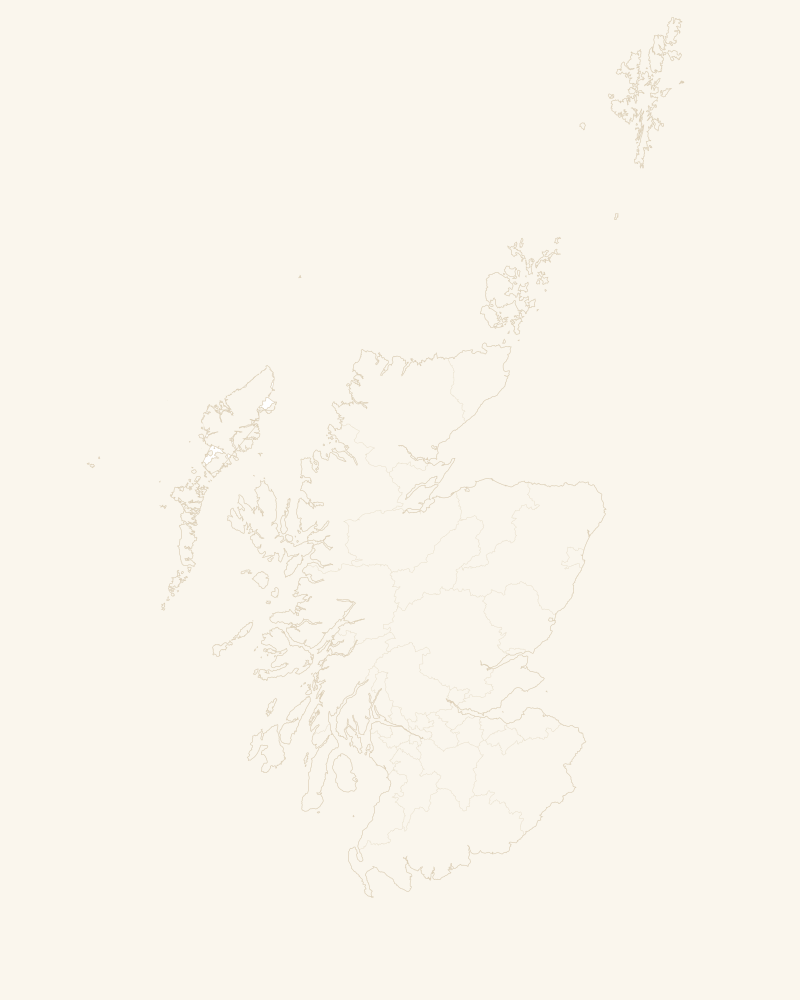
CoreHistoric reach
The seat of Clan Buchanan
Seat vacantChief
No one leads the Clan Buchanan community yet. When the movement opens, you can stand for its leadership, or help elect whoever does.
Current mission
No shared goal set yet. Once Clan Buchanan has leadership, it sets the public focus: a restoration, a gathering, a real-world project that helps its own.
The Buchanan clan is being rebuilt. Join the waiting list for the movement today, and you help decide who leads it and what it does.
Help rebuild the Buchanan clan →Motto
Clarior hinc honos
“Hence the brighter honour”
What does the Buchanan name mean?
From the Gaelic Buth-Chananaich, 'house of the canon', referring to the lands on the east shore of Loch Lomond, near Killearn, that were held by the chief in the 13th century. The Buchanans of Buchanan claim descent from Anselan O'Cathan, an Ulster prince said to have settled in the Lennox in the 11th century after the Battle of Clontarf; the more solidly documented chiefly line begins with Gilbert of Buchanan in the early 13th century. The clan's territory was the strategically vital strip of country between Loch Lomond and the river Forth, the doorway between the Highlands and the Lowlands.
The history of Clan Buchanan
The house of the canon on the Loch Lomond shore
The name was a place before it was a family: the country on the eastern shore of Loch Lomond around Killearn. The Gaelic points at a churchman (Buth Chanain, the house or seat of the canon, and Mac a Chanonaich, the son of the canon) and the clan's own Gaelic name, Na Cananaich, keeps the root. The first hard document is a grant made under Malduin, Mormaer of Lennox: in 1225 the earl gave the island of Clairinch to a clergyman he called in the charter clericus meus, my clergyman, afterwards recorded as Absalom de Buchanan.
Six years later the record hardens again. In 1231, under Alexander II, Gilbert de Buchanan, seneschal to the Earl of Lennox, received a charter confirming Clairinch and other lands in the parish of Buchanan. That is the hinge of the story: a household officer of the Lennox earls holding land in his own right, taking his designation from the ground and passing it to his sons as a surname. Scottish clanship ran on this double footing: the customary right of a kindred to its own country, set against the charter that made a chief a proprietor answerable to the Crown.
A far older origin was told for centuries and is now set aside. Tradition traced the chiefly line to Anselan O Kyan of the Irish Ó Catháin, a provincial king of north Ulster seated at Limavady, said to have landed in Argyll in 1016 and to have been given the Buchanan lands by Malcolm II for service against the Danes. That sits badly with the Irish records and with the clan's own DNA project, and is officially treated as little more than origin myth. What the testing did turn up was a strong link to Clan Gregor, indicating a common ancestor around the year 400.
Bruce's men and the carucate called Buchanan
In the Wars of Scottish Independence the Buchanans took the patriot side early. Maurice, ninth of Buchanan, refused to put his name to the Ragman Roll. The clan aided Robert the Bruce's escape in 1306, and the chief and lairds of the name served under Malcolm, Earl of Lennox, whose following they had belonged to since the Clairinch charter. Their presence at Bannockburn is tradition rather than record, though a likely one given the service documented on either side of it.
An awkward thread runs through the same generation. Sir Maurice Buchanan, tenth of Buchanan, married into the Menteiths of Rusky, the family of Sir John of Menteith, Sheriff of Dumbarton Castle, who is reputed to have handed Sir William Wallace to Edward I of England on 5 August 1305. Sir John was imprisoned by Robert I and in 1314 released through the influence of his sons-in-law, among them the Earl of Strathearn, Sir Archibald Campbell of Lochawe and Maurice Buchanan of Buchanan. He is recorded as bearing himself valiantly for the Scottish king at Bannockburn immediately afterwards, and signed the Declaration of Arbroath in 1320.
The lands come into focus in a charter of Donald, Mormaer of Lennox, confirmed by David II in 1370 or 1371. It made over to Maurice Buchanan, son and heir of the late Maurice Buchanan, "that carucate of land called Buchanan with Sallochy", running from Auchmar down below the water of Endrick and from Sallochy to Kelg and down to Loch Lomond, held in fee "with the freedom to hold as many courts with jurisdiction of life and limb as he may wish". That clause is the measure of the family: not a great earldom, but a lordship with power of life and death over its own ground.
Baugé, 1421, and the hand that holds a ducal cap
The Buchanans fought their most famous action in France. Sir Alexander Buchanan, second son of Walter Buchanan of Buchanan, led men of the clan with the Scots supporting the French against the English at the Battle of Baugé on 21 March 1421. The story told of him is that he came face to face with the Duke of Clarence, second son of Henry IV of England, escaped the duke's thrust and ran him through the left eye, killing him. Three years later Sir Alexander was himself killed leading the clan against the English at Verneuil.
What Baugé did to the family can be read in its heraldry. The Armorial de Berry of about 1445 records the chief, as "Le sire de bouguenal", bearing gold with a chevron chequy of blue and silver and three boars' heads erased and erect in red, a plain territorial coat with nothing royal about it. Within a decade it was replaced, and three events account for the change: Baugé in 1421; the execution by James I of Scotland in 1425 of his first cousin Murdoch Stewart, Duke of Albany, with Murdoch's two older sons; and the marriage in 1443 of Murdoch's daughter Isobel Stewart to Sir Walter Buchanan. The Scots Roll of about 1455 shows the result: gold, a lion rampant black dropped with gold tears, inside a black double tressure flory counter-flory. The tressure is a royal device, and taking it up advertised how close the Buchanan chiefs now stood to the Stewart line.
Those elements are the arms registered by John Buchanan in 1657 and recognised today, and the crest of that registration is a hand couped at the wrist holding a ducal cap: Sir Alexander and the Duke of Clarence, fixed permanently in heraldry, and the centrepiece of the badge worn by clan folk. The change was not instant everywhere. The seal of George Buchanan of about 1557 still shows three heads erased, closer to the old coat of 1445 than to the lion.
Strathyre, Kintail and the field at Flodden
The fifteenth century brought a feud between the Buchanans of Leny and Clan MacLaren that ended in a full battle. Word came on the day of a fair, while the MacLarens were buying and selling, that the Buchanans were marching up through Strathyre. Not all the MacLarens had come in, but they armed anyway, and at first the Buchanans drove them back. Then the MacLaren chief saw one of his sons cut down, raised the cry Creag An Tuirc and went at the Buchanan line. Two Buchanans escaped by swimming the River Balvaig; one was killed at Gartnafuaran, the other at the spot afterwards called Sron Laine.
The name turns up on the other side of a killing in 1497, when Kenneth Mackenzie, eighth of Kintail and chief of Clan Mackenzie, was killed by the Laird of Buchanan. Sixteen years later the clan was in the national disaster: the Buchanans fought the English at Flodden, and the chief's elder son Patrick was killed there. He had already married a daughter of the Earl of Argyll and left sons, so the succession survived the field, but it survived by skipping a generation.
That shaped the chiefly line for a century. Patrick's son George succeeded his grandfather, Sir Walter, fourteenth of Buchanan, in 1526 and held the chiefship until 1560; George's own grandson, another George, succeeded him in 1561 the same way, the heir apparent having again died first. Between those successions the clan was in the field once more against the English, at Pinkie Cleugh in 1547.
The King of Kippen and the Goodman of Ballengeich
John Buchanan, second son of Walter the fourteenth and uncle of George the fifteenth, became proprietor of Arnprior and got himself a nickname that outlived every charter he sealed. James V liked to travel in disguise under a name known only to some of his principal nobility: the Goodman (the tenant) of Ballengeich, after the steep pass that leads down behind the Castle of Stirling. Feasting at Stirling one day, the king sent to the neighbouring hills for venison, and the deer were killed and loaded on horseback for the journey back.
The road ran past the castle gates of Arnprior, where Buchanan had a houseful of guests, plenty of liquor and little food. He seized the venison, and when the keepers protested that it belonged to King James he answered that if James was King in Scotland, he, Buchanan, was King in Kippen. The king rode out from Stirling at once, found a fierce Highlander with an axe on the door who would not admit him because the Laird of Arnprior was at dinner, and sent up word that the Goodman of Ballengeich had come to feast with the King of Kippen. Buchanan knew at once who was outside, knelt and asked forgiveness, and was forgiven; the king went in and ate his own venison. Sir Walter Scott retold it, and the title stuck to the house of Arnprior.
The Killearn boy who taught a king his Latin
George Buchanan was born at The Moss near Killearn in southern Stirlingshire on 1 February 1506, fifth of the eight children of a small Stirlingshire laird's family. His father died young and an uncle, James Heriot, paid for him to read arts at Paris from 1520 to 1522. When the uncle died he came home, served with the Scots forces in the Borders campaign of 1523, took his BA at St Andrews under John Mair in 1525, and crossed back to France in 1526 to teach at the Collège de Sainte-Barbe and, from 1539, at the Collège de Guyenne in Bordeaux, where one pupil was the boy Michel de Montaigne.
His European standing was built on Latin verse. At Bordeaux in the 1540s he wrote four Latin tragedies (Jephthes, Baptistes, Medea and Alcestis) and in 1565 published in Paris the Psalmorum Davidis Paraphrasis Poetica, his verse paraphrase of the Psalms, which ran through some hundred and twenty editions across Europe by 1700 and sat on the Latin grammar-school curriculum from Bergen to Naples for two centuries. Henri Estienne, the Paris Hellenist, judged him the leading Latin poet of the age.
He came back to Scotland in 1561, in his fifty-fifth year, at the request of Mary Queen of Scots, who made him classical tutor to her court and in 1566 Principal of St Leonard's College, St Andrews. After the crisis of 1567 he took the Reformer side, served that year as Moderator of the General Assembly of the Kirk, was made Keeper of the Privy Seal in 1570, and from 1570 to 1578 was personal tutor to the boy King James VI at Stirling Castle, taking him through the whole Latin syllabus from Aesop to Tacitus. The discipline was severe (James said as a grown man that the trembling Buchanan put into him never left him) and it produced the most rigorously educated prince in sixteenth-century Europe.
In 1579, in his seventy-third year, he published De Jure Regni apud Scotos, arguing that the king of Scots held his authority by consent of the political community, and that the community kept the right to depose a tyrant. It was the foundational text of Scottish and English constitutional resistance theory for the next hundred years, placed on the Roman Index in 1584 and burnt at Oxford in 1683 by order of Charles II, both of which only spread its reputation. He finished his Latin history of Scotland, the Rerum Scoticarum Historia, on his deathbed, died at Edinburgh on 28 September 1582 and is buried in Greyfriars Kirkyard.
Dunbar, Inverkeithing and the ships out of Gravesend
In the Wars of the Three Kingdoms the clan went to war as a regiment. Sir George Buchanan, eighteenth of Buchanan, commanded the Stirlingshire Regiment and led his people at Dunbar in 1650 for the Scottish Covenanters. He led them again at Inverkeithing, where he was taken prisoner, and died in captivity in 1651. The regiment was a family affair in the literal sense: most of its officers and a good many of its soldiers are said to have been of the name, and a vast number of the name died at Inverkeithing.
Defeat put Buchanans on transport ships. David Buchanan and John Buchanan, Royalist soldiers taken at Worcester, were shipped on the John and Sarah out of Gravesend on 13 May 1652 for Boston. A generation later the traffic ran the other way politically and the same way geographically: Alexander Buchanan of Buchlivie and Andrew Buchanan of Shirgarton, Covenanters, were sent from the Tolbooth on 12 December 1678 aboard the St Michael of Scarborough for the American plantations, and Gilbert Buchanan of Glasgow was banished to the Indies that June.
Some Buchanans were out with the Covenanters at Bothwell Brig in 1679, among them George Buchanan (1657–1719), son of Andrew Buchanan of Gartacharne, a small farm in the Drymen country. He survived the rising and became a magistrate, a maltman and a successful Glasgow merchant, and his four sons carried the family into the commercial ruling class of the city. The clan's centre of gravity was sliding off the Loch Lomond shore towards the Clyde.
The estate that debt carried off
Sir John Buchanan, seventeenth of Buchanan, was known for frequent travels to foreign nations and other extravagances, and he put the estate deep into debt. On paper it was still substantial when his grandson took it up around 1652. William Buchanan of Auchmar reckoned that the most flourishing condition it had known in several ages: the Barony of Buchanan, lands in Killearn and Strathblane and others in the Lennox, the estate of Badindalloch in Stirlingshire and Craigmillar in Midlothian.
The debt came with it. John Buchanan would not take the inheritance at all until his brother-in-law to be, David Erskine, 2nd Lord Cardross, arranged a composition under which creditors accepted a portion of what they were owed. It did not hold. About 1680 John and his named successor sold Highland lands to James Graham, third Marquess of Montrose, and because other claimants existed John offered the Barony of Buchanan itself as security, an infeftment of real warrandice. The sale did not proceed; the Marquess took the barony instead, and the old Buchanan country became a seat of Clan Graham.
The named successor was a curiosity in his own right. Major George Grant, Governor of Dumbarton Castle and an old comrade of the chief, took a transfer of the estate under paperwork dated 9 April 1679, on condition that he marry John's eldest daughter Elizabeth and assume the name and arms of Buchanan. By late 1679 National Archives of Scotland records show him signing as George Buchanan, and by 28 August 1680 as Major George Buchanan of that Ilk. Elizabeth refused him, as she had refused an earlier arrangement with Robert Buchanan, advocate, son of John Buchanan of Arnprior. The major never married, and by his death had given up all Buchanan evidences, both the rights and the fortune.
John Buchanan died in 1681 leaving daughters and no male heir, and the direct chiefly line ended there. John Buchanan of Arnprior, who had managed the estate for him, was afterwards given a quarter of it by the Marquess for his services in evicting it. Buchanan Auld House remained the historic seat of the name, and Buchanan Castle was raised in the nineteenth century to replace it long after the lands had gone. The chiefs' reputed burial ground lies at the Old Buchanan Parish Church, the Chapel of St Mary and St Michael, which served the parish after Inchcailleach was abandoned in 1621 until a new church was built at Milton of Buchanan about 1764.
Carlisle, Culloden and the house at Drummakill
With no chief to call them out, Clan Buchanan took no part as a unified body in the Jacobite risings of 1715 or 1745; the leadership vacuum left by the last chief's death is the likeliest reason. Individual Buchanans chose for themselves, and the name appears on both sides. The most conspicuous was Francis Buchanan of Arnprior, of Leny House at Callander, arrested before Culloden for stockpiling weapons, tried for high treason and executed at Carlisle on 18 October 1746. Lord Milton, the Lord Justice Clerk, wrote to Philip Webb on 9 September 1746 that it would be of "more consequence to His Majesty's Service ... to get rid of such a person than to convict 99 of the lowest rank." His brother Patrick, a brewer from Kilmahog, had gone with the Jacobites to Crieff and was tried at Carlisle and acquitted on account of his youth, as was a second brother, Thomas.
Robert Buchanan, Jacobite captain in the Duke of Perth's Regiment and son of Baillie Buchanan in Boghastle, was killed at Culloden. Alexander Buchanan, born 1728, son of the Laird of Auchleishie, another captain in the same regiment, was held at Perth, the Canongate, Carlisle, on a ship and in London before transportation from Liverpool to Maryland on the Johnson on 22 April 1747; his servant John Buchanan went to the same colony on the Gildart that February. Duncan Buchanan, clerk to Aeneas MacDonald, the Paris banker to Charles Edward Stuart, was one of the Seven Men of Moidart.
The government Buchanans were as sharply drawn. Archibald Buchanan of Drummakill, magistrate and militia officer, sheltered the escaping William Murray, Marquis of Tullibardine, after Culloden, then, by most accounts, betrayed him to the garrison at Dumbarton Castle in defiance of Highland hospitality; Tullibardine died a prisoner in the Tower of London on 9 July 1746, and Drummakill was ostracised ever after. Andrew Buchanan of Drumpellier, Lord Provost of Glasgow, negotiated the Jacobite demand of £15,000 on the city down to £5,500, and when a levy of £500 was demanded of him personally in December 1745 under threat of military execution, replied that they might plunder his house if they pleased, for he would not pay one farthing.
Tobacco lords, and a charity founded in 1725
The four sons of George Buchanan of Gartacharne turned a farming family into Glasgow merchants inside one generation. George Buchanan of Moss and Auchentoshan was a maltman and served as city treasurer and bailie. Andrew Buchanan of Drumpellier was a Tobacco Lord and Lord Provost of Glasgow from 1740 to 1742. Archibald Buchanan of Silverbanks and Auchentortie was a Tobacco Lord. Neil Buchanan of Hillington was a Tobacco Lord and Member of Parliament for the Glasgow district of burghs.
In 1725 those four were among the founding members of the Buchanan Society, a purely charitable body established in Glasgow for the needy of the clan. Its funding came from an entry fee paid by every member, from gifts and from interest on investments, and its original charter set out what the money was for: to help boys of the name and its recognised septs into trades, and those of promising genius at their studies at university. The goals have scarcely changed, except that girls are now eligible too.
The Society became the clan's institutional memory through the long stretch when it had no chief. It owns the Buchanan Monument at Killearn and, fittingly, the island of Clairinch itself, the ground of the 1225 charter and the clan's call to war. Its membership handbook is a historical source in its own right: Francis Buchanan of Arnprior joined in 1727 as member 63, William Buchanan of Auchmar in 1726 as member 48 and again in 1730 as member 123. Each listed his estate; neither claimed any special status in the clan, and that silence was later used against their descendants.
The Society's charter recognised four names as entitled to its help: Buchanan, McAuslan, McWattie and Risk. That short list is worth setting beside the long sept rolls printed since, most of which date from the nineteenth century, when clan societies and tartan manufacturers tied as many surnames as possible to a clan regardless of historical connection. The genuine offshoots go back to Gilbert, the first of the line to use Buchanan as a surname, to his brothers Methlan and Coleman (reckoned ancestors of the MacMillans and MacColemans) and to the forenames of his grandson Maurice and great-grandson Walter, which stand behind MacMaurice, MacWattie, Watson and Watt.
The clan that waited, and the banner with five silver tears
The order in which the Buchanan cadets broke off from the chiefly line decided everything that followed: Leny first, then Arnprior, then Spittal, then Auchmar. Two families spent the next two centuries claiming what John Buchanan had lost. Alexander Nisbet's System of Heraldry of 1722 made Buchanan of Leny the representer of Buchanan of that Ilk; William Buchanan of Auchmar's clan history of 1723 argued instead that every cadet line from George the fifteenth to John the nineteenth had expired, so the chiefship fell to the most recently separated branch, his own. Nisbet's posthumous second volume of 1742 came round to Auchmar. The line ran out anyway: William died in 1747, his grandson sold the estate reserving a right of redemption and died at sea off America in 1797, and James sold that right and died without an heir in 1816.
The second claim was made by Dr Francis Buchanan-Hamilton of Spittal, Bardowie and Leny (1762–1829), a Scottish surgeon, geographer and naturalist, who inherited his mother's Bardowie estate in 1815 and took the additional surname, and who is said to have established his claim in 1828 through the Buchanan of Spittal line. It descended to John Buchanan-Hamilton (1822–1903) and then to John Hamilton Buchanan (1861–1919), who left no heir. Neither claim was ratified by the Court of the Lord Lyon; the last undifferenced arms of Buchanan, the chief's arms, were recorded in the Lyon Court register in 1675.
The clan meanwhile organised itself abroad. The Clan Buchanan Society International was founded in 1970 at the Grandfather Mountain Games in North Carolina, and its flag states the position plainly: the Black Lion Banner shows a black lion rampant on gold within a black double tressure, shedding five silver tears for the sadness of a clan with no chief. Then a petition was lodged with the Court of the Lord Lyon in December 2016, and in August 2018 the Lyon allowed it.
John Michael Baillie-Hamilton Buchanan, born 14 September 1958, son of John Neil Buchanan Baillie-Hamilton of Arnprior and the Hon. Caroline Barbara Barrie, was recognised as Chief of the Name and Arms of Buchanan. The Lyon was satisfied that he was the senior representative of Buchanan of Leny, that the remaining cadet branches, Auchmar and Spittall, were extinct in law and in fact (the descendants of Thomas Buchanan of Gartencaber having been excluded because the fifteenth-century documents linking them to the chiefly line were shown to be forgeries) and that the chiefly lands of Strathyre had come to him in an unbroken chain of inheritance. He manages the Cambusmore estate near Callander, now the clan's seat.
Where the name travelled
Transport ships, tacksmen priced off their leases and clearances that pushed whole townships to the coast put Buchanans wherever the Scots went, and the American record is the deepest. John Buchanan, who died in 1769, was a colonial Virginia magistrate, landowner and soldier; "Major" John Buchanan (1759–1832), an American frontiersman, founded present-day Nashville, Tennessee. James Buchanan (1791–1868) became the fifteenth president of the United States and John P. Buchanan (1847–1930) Governor of Tennessee; Franklin Buchanan (1800–1874) was a Confederate admiral and Robert C. Buchanan (1811–1878) an American soldier.
In the southern hemisphere the pattern was pastoral: Nathaniel Buchanan (1826–1901), Australian pioneer pastoralist, drover and explorer; William Buchanan (1824–1911), pastoralist and gold prospector; John Buchanan (1819–1898), Scottish-born, a botanist in New Zealand; Isaac Buchanan (1810–1883), a businessman and political figure in Canada West. At home the name kept to public life and the professions: Sir Andrew Buchanan, 1st Baronet (1807–1882), British diplomat; George Buchanan (1854–1924), ambassador in Russia from 1911 to 1919; James Buchanan, 1st Baron Woolavington (1849–1935), businessman and philanthropist; Janet May Buchanan (1866–1912), Egyptologist; Ken Buchanan (1945–2023), Scottish boxer. Over all of them stands the motto Clarior hinc honos, hence the brighter honour.
Champions of the Buchanan name
The bearers whose lives are inseparable from this surname. Each has their own page, biography, achievements, geography, connection to the family.
The castles of the homeland
The great strongholds of the homeland, look one up, see what it looked like in its prime, and recreate it to explore.
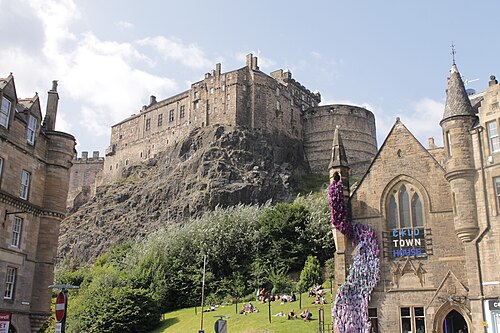 Edinburgh CastleRestored · prime 1520
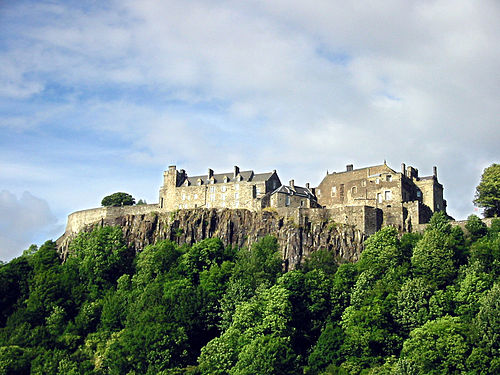 Stirling CastleRestored · prime 1542
 Glamis CastleStill standing · prime 1900
All castles in Scotland → · Strongest castles in Scotland → · Castles of Europe
Play As Your Clan
Hold a real castle against whatever you choose to send at it, take a ship out in her own service years, or stand at the shoulder of someone the record remembers. The chronicler sets the scene; the deeds are yours.
Notable bearers of the Buchanan name
- George Buchanan (1506–1582), humanist scholar, tutor to James VI
- James Buchanan (1791–1868), 15th President of the United States
- Jack Buchanan (1890–1957), musical-theatre star
- Pat Buchanan (b. 1938), American political commentator