
Scotland · Ruin
Lennox Castle
Lennox Castle is a 19th-century castellated mansion on the grounds of the Lennox of Woodhead estate near Lennoxtown, Scotland. Built 1837–1841, the building later became part of a large hospital complex and is now a fire-damaged ruin in its grounds near the town.
Its prime
1982
Today
Ruin
As it stood in 1982
What Lennox Castle looked like in its prime.
A large ashlar-sandstone castellated house with multiple rectangular towers and a prominent tall, narrow multi-storey tower with vertical arched window openings. The roofline is dominated by crenellated parapets and square turrets; wings link the towers into a compact, fortress-like silhouette. Stone is warm buff-brown sandstone with coursed masonry. The building sits on wooded, sloping grounds near Lennoxtown with arched retaining walls and a formal forecourt; at prime the roofs, windows and battlements were intact.
Its story
The story of Lennox Castle.
David Hamilton's Mansion for the Kincaids, 1837–1841
Lennox Castle was built between 1837 and 1841 by David Hamilton for John Lennox Kincaid, on the Lennox of Woodhead estate at Lennoxtown in East Dunbartonshire, about 12 miles north of Glasgow. It replaced the earlier Kincaid House. This was a 19th-century country mansion, not a fortress; its story belongs to the century that followed, and it is a hard one.
Lennox Castle Hospital, 1936–2002
In 1927 the castle and its land were purchased by the Glasgow Corporation and converted into a hospital for people with learning disabilities, which opened in 1936. It became Scotland's largest institution of its kind: the castle itself served as the nurses' home, while the grounds held accommodation for about 1,200 patients. Soon after opening the facilities were reported to be vastly overcrowded, understaffed and underfunded.
By 1982, 1,360 patients aged between 10 and 80 were looked after by around 500 staff, fewer than half of them trained nurses; the Scottish Hospitals Advisory Service had visited the year before and recommended a further 100 staff. The care provided was reported to be poor, with patients malnourished. A separate maternity unit operated between the 1940s and 1960s; the singer Lulu and the footballer John Brown were among the babies born there.
The hospital closed in 2002, reflecting the shift towards supporting people with learning disabilities in the community rather than in institutions; it was also noted that patients had been treated poorly by staff.
Fire, Celtic's Training Ground and Campsie View
The castle, Category A listed since the 1970s, has stood in ruins since a fire in 2008. Part of the grounds was converted into Celtic F.C.'s Lennoxtown Training Centre, opened in 2007, while land towards Lennoxtown village was earmarked for a phased residential development known as Campsie View; the first phase was completed in 2015, with further construction planned to begin by late 2026.
Step inside
7 places to explore in 1982.
The record describes 7 distinct spots at Lennox Castle, including 2 interiors: castle entrance hall (interior), nurses' accommodation corridor and rooms. Create your own photoreal reconstruction and explore every one, more scenes means more rooms, more angles, and more of the place to stand in.
Build Your Own Castle
Recreate Lennox Castle with AI to explore it.
The artist rebuilds it as it stood in 1982, a photoreal reconstruction that belongs to you alone. Pay with coins, no subscription needed.
Recreate this castle →Defend this castle →Whose castle
Clans who held Lennox Castle.
The families that held Lennox Castle for a decade or more across its history, follow a name to its clan.
Kincaid
Built 1837–41 by David Hamilton for John Lennox Kincaid on the Lennox of Woodhead estate; sold to Glasgow Corporation in 1927.
From the archive
Lennox Castle on paper: the measured plan and period views.
The survey plan and photographs below are the ground truth this page's reconstructions are checked against, drawn and photographed while the castle was still a working garrison. Every image is public-domain or openly licensed, with its source named.
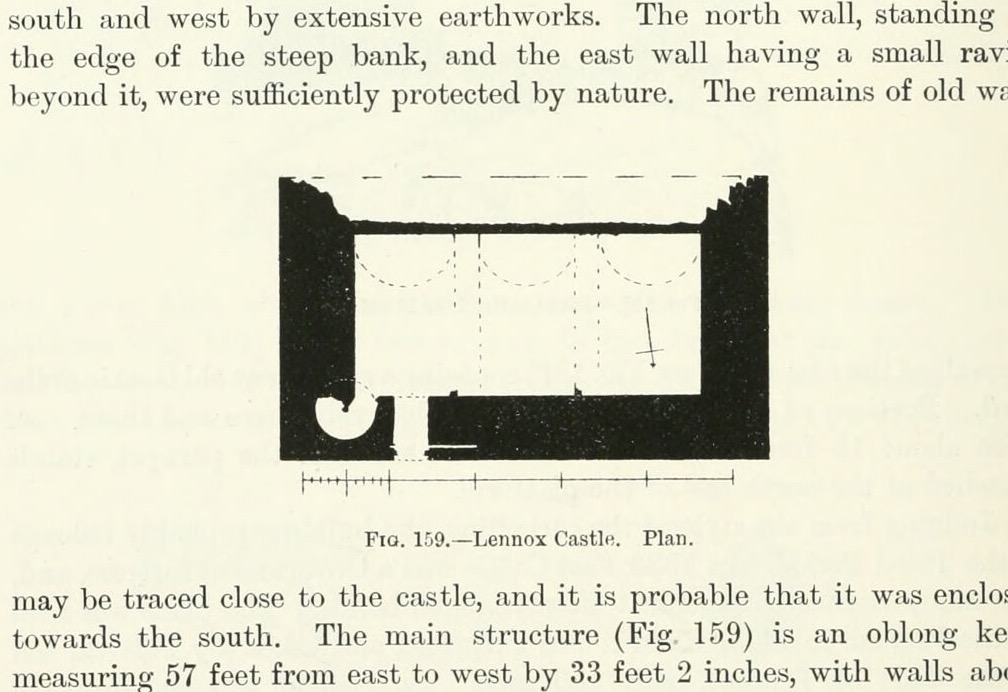
Fig. 159. Lennox Castle. Plan.
1889 · MacGibbon & Ross, vol. 3 (1889)
Public domain
Nearby
Landmarks within reach of Lennox Castle.


Questions about Lennox Castle
What is the history of Lennox Castle?
What is inside Lennox Castle?
Why was Lennox Castle built, and what was it used for?
Where is Lennox Castle?
When was Lennox Castle built?
Is Lennox Castle still standing, or is it a ruin?
Who built Lennox Castle?
What did Lennox Castle look like in its prime?
Which family or clan held Lennox Castle?
More castles of Scotland


Explore the city


