Meyer
also Meier, Mayer, Maier, Meir
The steward of the manor, and, in another branch, a name that shines.
- Origin
- German
- Register
- German family
The seat of Meyer
Seat vacantChief
No one leads the Meyer community yet. When the movement opens, you can stand for its leadership, or help elect whoever does.
Current mission
No shared goal set yet. Once Meyer has leadership, it sets the public focus: a restoration, a gathering, a real-world project that helps its own.
The Meyer clan is being rebuilt. Join the waiting list for the movement today, and you help decide who leads it and what it does.
Help rebuild the Meyer clan →What does the Meyer name mean?
From Middle High German meier (Latin maior, the 'greater' man), the steward or tenant who ran an estate for its lord, a figure of real standing in the village. The spelling is a near-perfect map of region and faith: Meyer in the north, Maier and Mayer in Bavaria and the south, and Meir/Meyer very widely among Ashkenazi Jews.
The history of Meyer
From maior to Meier: the greater man in the village
The name begins in a Latin phrase from the running of a great household: maior domus, the headman, the greater man. Out of maior came Middle High German mei(g)er, the manager of a lord's country estate; later the word meant the tenant of that estate, and later still simply a free farmer. The same office in England was the steward, which is why Meyer's closest English cousin is not a labourer's name but Steward, and the Scots surname Stuart, which traces back to the office of High Steward of Scotland.
That fixes where a Meier stood. A manor held serfs, villeins, cottars and bordars at one end and freeholders and copyholders at the other, with the lord above them all and often absent; the Meier was none of the first sort. He ran the lord's farm, answered for the estate and took his cut of the harvest for doing it, and the village knew exactly what he was. That is why the office-name became one of the commonest and most respectable surnames in the German lands rather than one people quietly dropped.
The estate he answered for
A manor was divided into up to three kinds of land: the demesne the lord farmed for his own household, usually about a third of the arable; villein holdings owing labour services or a share of output; and free peasant land paying money rent but still under manorial custom. The lord drew more income from charges for his mill, his bakery and his wine-press, from hunting rights and pannage in his woodland, and from a payment on every change of tenant. Somebody had to make all of that happen, household by household, and a steward of that world might earn three to four pounds a year for it and mind his lord's castle while the lord was away.
The farming was the open-field system and it was relentless. Two or three great fields of several hundred acres, unfenced, cut into long strips called selions; a family's holding might be some 70 strips totalling around 20 acres, scattered on purpose so everyone drew both good ground and poor. One field lay fallow each year, and grazing on the fallow and the stubble was common under rules against overgrazing. Few households owned enough beasts for a plough-team of six to eight oxen, so sharing was a necessity. An elaborate body of custom, set partly by the lord and partly by the tenants, governed planting, harvest and pasture, and it needed a man both sides could live with. Germany and northern Europe ran on the same open-field logic as England, and open fields lasted longer on the continent.
Why there are so many Meyers, and why they are not cousins
Surnames came into German-speaking Europe gradually across the Late Middle Ages, in four broad classes: from a father's given name, an occupation, a bodily attribute, or a place or building. Occupational names are the commonest of all, because anybody with a job worth remarking on was bound to be identified by it. Schmidt the smith, Müller the miller, Schneider the tailor, Schulze the constable, and Meier, the farm administrator, tenant, steward, sometimes bailiff.
That is the whole answer to the question a Meyer descendant usually arrives with. There is no single Meyer family and no lost seat to point at. Each of thousands of manors had its Meier, so the name is common precisely because the office was universal, and two Meyers three villages apart were never kin. Villages with more than one solved it by pinning the office to a place: Bachmeier, the Meier by the stream, Bergmair up on the hill, Niedermeier down below.
The spelling is a dialect map
Meyer, Meier, Mayer, Maier, Mayr, Mair, Meijer, Myer, Miers: the variants are geography. Broadly, Meyer belongs to the north, Maier and Mayer are the Bavarian and southern forms, and Meijer is Dutch. German surnames carry the marks of the dialect that made them, which is why one trade got different names in different places: a barrel-maker was a Böttcher in Hamburg and a Schäffler in Bavaria.
Cross a border and the office survives under another word: a schout in Holland and Antwerp, a drossate in Brabant, an amman in Brussels, an Amtmann or Ammann in Germany, Switzerland and Austria, the official a territorial lord appointed to run an estate's administration and jurisdiction. At Asse and Leuven the word for him was meier. It has stayed a German and Swiss name: in 2014 Meyer was found, as a share of population, most often in Germany, Switzerland, Luxembourg and South Africa, sixth in Germany and eighth in Switzerland.
The other Meyer: Me'ir, one who shines
There is a second Meyer and it has nothing to do with manors. The Hebrew given name Me'ir means shining, enlightened. Some German Jews took Meyer or one of its variants as a hereditary surname during the 18th century, as they assimilated into German life, precisely because it sat so close to a first name their families already carried. A Jewish Meyer is not a steward's descendant. He carries a Hebrew name that found a German spelling to live in, and it became one of the great Ashkenazi surnames.
German-Jewish surnames were a special case: introduced late, from the end of the 18th century into the early 19th, and introduced by decree rather than by drift. Prussia enacted the Hoym Ordinance at Breslau in 1790, mandating the adoption of Jewish surnames, and Napoleon insisted on fixed names in a decree of 1808. Where officials did the choosing the results could be invented and openly insulting, as with Waldlieferant, forest supplier, coined to mock a Jewish timber trader. Where families chose for themselves the results were quite different: the surnames most readily recognised as Jewish in origin tend to be poetical, ornamental ones like Rosenzweig, chosen by the families themselves. Meyer took a third path, the quiet one: an existing, unremarkable German surname that carried the Hebrew name inside it and drew no attention at all.
So a Meyer reader genuinely cannot tell which line is theirs from the spelling, and nobody should pretend otherwise. The same letters cover a manorial office in a Christian German village and a Hebrew given name registered under Prussian or Napoleonic law. What separates them is not the name but the paperwork: where and when the family first appears in a register, and which community's records hold it.
What the name carried into the modern world
Both lines ran into the twentieth century and one of them was hunted through it. European Jews who reached the United States after fleeing Nazi persecution sometimes anglicised their surnames to avoid discrimination, so an American Myer or Myers may be one deliberate spelling change from a Meyer, made under pressure, not the immigration clerk's error such variants are usually blamed on.
In the record the bearers run from scholarship to the concert hall. Ernst Heinrich Meier (1813–1866) was a German orientalist and Emerenz Meier (1874–1928) a German writer; Carl Alfred Meier (1905–1995) a Swiss psychiatrist; Hans Eduard Meier (1922–2014) a Swiss type designer. Waltraud Meier, born 1956, is a German mezzo-soprano, and Sid Meier, born 1954, made his name as a computer game programmer and designer. Stefan Meier (1889–1944) was a German politician; Wolfgang Meier (1878–1945), a German farmer, died an inmate of a concentration camp; Silvio Meier (1965–1992), an East German activist, was killed by neo-Nazis three years after the Wall came down.
If you carry this name you carry an office rather than a bloodline: the man the lord trusted with the farm and the village trusted to be fair about the strips, or else a Hebrew word for shining that a family kept when the law made them choose something. Neither is a small inheritance.
The castles of the homeland
The great strongholds of the homeland, look one up, see what it looked like in its prime, and recreate it to explore.
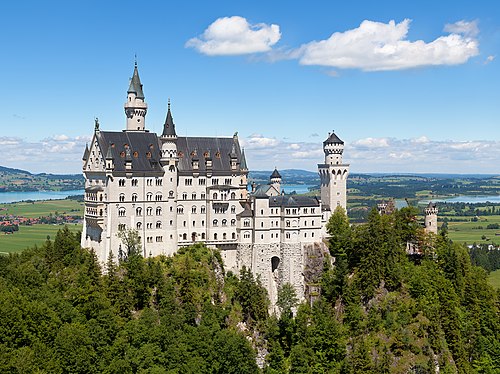 Neuschwanstein CastleStill standing · prime 1886
 Hohenzollern CastleRestored · prime 1867
 Eltz CastleStill standing · prime 1615
All castles in Germany → · Strongest castles in Germany → · Castles of Europe
Play As Your Clan
Hold a real castle against whatever you choose to send at it, take a ship out in her own service years, or stand at the shoulder of someone the record remembers. The chronicler sets the scene; the deeds are yours.