Neumann
also Naumann
'The new man', the stranger who stayed.
- Origin
- German
- Register
- German family
The seat of Neumann
Seat vacantChief
No one leads the Neumann community yet. When the movement opens, you can stand for its leadership, or help elect whoever does.
Current mission
No shared goal set yet. Once Neumann has leadership, it sets the public focus: a restoration, a gathering, a real-world project that helps its own.
The Neumann clan is being rebuilt. Join the waiting list for the movement today, and you help decide who leads it and what it does.
Help rebuild the Neumann clan →What does the Neumann name mean?
Descriptive, 'the new man', Middle High German niuwe + mann, the newcomer to a village or a freshly taken holding. Cognate of English Newman.
The history of Neumann
Herman Nyeman of Barth, 1325
The name enters the record as a description of a relationship rather than a job. Its first documented uses are Godwin Nieweman in Oxfordshire in 1169 and, in Germany, Herman Nyeman of Barth in 1325. The word is the ordinary one: Middle High German niuwe, modern neu, joined to mann, and it was applied to a recent arrival or a settler on freshly taken ground. A Schmidt was named for what he did with his hands and a Meyer for the size of the farm he ran; a Neumann was named for the one fact his neighbours could agree on, that he had not been there before.
Early German use clustered in West Prussia and Pomerelia, where people had been moving onto new ground for generations and a clerk needed a way to mark the household that had just come. Each dialect made its own version: Naumann in Central Germany, Niemann in the Low German north, with Neuman, Neiman and Nyeman all in the registers, and Newman as the English form. As of 2023 Neumann stands eighteenth among the commonest surnames in Germany, a striking rank for a word describing nobody's trade, nobody's father and nobody's land.
Berlin, 7 August 1728: a mason takes the citizenship
Christian August Naumann, born in 1705, served a mason's apprenticeship at Dresden from 1721 to 1723 and then went to Berlin, where on 7 August 1728 he was granted the Bürgerrecht, the town's citizenship. That date is the newcomer's whole story in one line of a register: the moment an arrival stopped being a resident and became a burgher, with standing to hold property and to be heard. By 1738 he was Altmeister of his guild, and from there he rose to Hofmaurermeister, court master mason.
The buildings followed. He worked on the Böhmische Kirche of 1735 to 1737 with the court carpenter Johann Andreas Büring, and on the Dreifaltigkeitskirche of 1737 to 1739, whose plans were probably his own though issued under the name of Titus de Favre. He built Johann Georg Wegely's house in 1747, raised the new Luisenstädtische Kirche from 1751 to 1753 to his own plans, and put up the workhouse on the Alexanderplatz from 1756 to 1758.
Almost none of it survives; of Naumann's Berlin only the Magnus-Haus of 1756 still stands, restored in 1994. He died in Berlin on 14 November 1766, and the trade stayed in the family: his son August Gotthilf Naumann held the offices of Hofbaugerichtdirektor and Schlossmeister.
The Eger foundry boy who walked into Würzburg
Johann Balthasar Neumann was born at Eger in the Kingdom of Bohemia, now Cheb, on or about 27 January 1687, the seventh of nine children of the cloth-maker Hans Christoph Neumann. He was apprenticed at a bell and gun foundry in the town, travelled as a journeyman, and in 1711 arrived at Würzburg, a Bohemian in a Franconian prince-bishopric with nothing behind him but a trade in metal. In 1712 he began studying geometry, architecture and land surveying and entered the Würzburg artillery, where he served until his death and reached the rank of colonel.
His first surviving work is technical: measuring instruments of 1712 and 1713 and a map of Würzburg from 1715. In 1717 he went to the Austro-Turkish war, advancing with his unit from Vienna to Belgrade; in 1718 he travelled through northern Italy, studying buildings and briefly working on civil projects in Milan. Then came the patron. Johann Philipp Franz von Schönborn, Prince-Bishop of Würzburg, asked the young engineer in 1719 to plan his new palace and in 1720 to lead its construction. Others worked on the Würzburg Residence, but Neumann stamped it with his own hand and it became his life's work; UNESCO describes it as one of the most important palaces of the High Baroque.
The Schönborn Chapel at the cathedral followed from 1721, and in 1723 he went to France to consult the royal architects Germain Boffrand and Robert de Cotte. Friedrich Karl von Schönborn, prince-bishop of Würzburg and Bamberg at once, made him director of all military, civil and ecclesiastical construction in both bishoprics, so that he answered for fortifications, transport and water engineering; from 1731 he also taught architecture at Würzburg University. His churches turned on centralised and rotunda plans that reached their fullest statement at Vierzehnheiligen, the Basilica of the Fourteen Holy Helpers, begun in 1743, and the abbey church at Neresheim, begun in 1747. He died at Würzburg on 19 August 1753.
Giovanni Battista Tiepolo painted him into the ceiling fresco above the Residence staircase, in a pseudo-military uniform, leaning on a cannon. The joke had a source: Neumann had said the vault was built so securely that firing a cannon under it would not bring it down. The final series of the fifty Deutsche Mark note, in circulation from 1991 to 2002, carried his portrait beside that staircase. A cloth-maker's seventh child, who reached the city as a foreign journeyman, ended on the currency.
The Breslau burial registers that reached the Royal Society
Caspar Neumann was born at Breslau on 14 September 1648, son of Martin Neumann, the city tax collector. He trained first as a pharmacist, went to Jena in 1667 to read theology and was ordained on 30 November 1673 as travelling chaplain to Prince Christian, son of Ernest I, Duke of Saxe-Gotha. Two years of travel took him home to a court chaplaincy at Altenburg, and he was made deacon of St Maria-Magdalen at Breslau in 1678 and pastor in 1689. His second wife, Christiana Greiffen, was granddaughter of the Scottish nobleman David Lindsay, Royal Saxon Privy Councillor and mill administrator at Annaberg im Erzgebirge: another new man in a German town who had stayed.
Neumann's interest was in the city's dead. He worked through the Breslau records of births and burials and wrote the result up as the Reflexionen über Leben und Tod bey denen in Breslau Gebornen und Gestorbenen, which he sent to Leibniz; the covering letter survives, the treatise does not. Leibniz appears to have told the Royal Society, whose secretary Henri Justel invited him in 1691 to supply his figures. Neumann sent two letters of data, in January and December 1692; Justel died in September 1693, and the second letter was read to the Society that November.
The arithmetic was Edmond Halley's, and his computations on the Breslau numbers were published in the Society's Philosophical Transactions for 1693. Neumann's own letters were presumed lost and turned up again in the Royal Society archives at the end of the nineteenth century. He was appointed inspector of the Protestant schools and churches of Breslau in 1697 and elected to the Berlin Academy of Sciences in 1706; his pupil Johann Christian Kundmann published the first German comparative study of mortality rates.
He remained a working churchman: more than thirty of his hymns were printed in Burg's Gesangbuch at Breslau in 1746. Around 1712 Isaac Newton wrote to acknowledge a copy of his Clavis Domus Heber, which argued that the individual Hebrew letters carried hieroglyphic meanings, congratulating him on the attempt and pleading too little Hebrew to judge it. Neumann died on 27 January 1715.
A Wittenberg pulpit, an Ansbach lawyer and a Jesuit in Mexico
Johann Georg Neumann, born at Mörz in 1661 and schooled at Zittau, enrolled at Wittenberg on 15 May 1680 and took his magister in under a year, on 25 April 1681. He joined the philosophical faculty in 1684, became full professor of poetics in 1690, then turned to theology, took his doctorate in 1692 and held the ordinary chair thereafter. He was a pronounced opponent of Pietism and an outspoken critic of Philipp Spener, and when he died in 1709 he was buried in Wittenberg's Schlosskirche, not far from Luther's grave.
Johann Friedrich Wilhelm von Neumann zu Wolfsfeld, born at Groß Salze on 20 April 1699, never met his father, a ducal Holstein-Glücksburg privy councillor who died before the birth. The boy was entered at Wittenberg in 1709 and read law at Leipzig, Jena and Erfurt, with a spell at Utrecht and further study travel in France and England. He took a post in 1735 as councillor at Ansbach, and Margrave Karl Wilhelm Friedrich sent him to Vienna, where he studied the imperial Aulic Council at close range and turned it into books, among them the nine volumes of Meditationes juris Principum privati, 1751 to 1756. He retired to the Wolfsfeld estate in Franconia and died there in 1768.
The German register carries others of those generations: Georg Neumann, 1634 to 1679, mathematician and civil engineer; Joachim Neumann, 1650 to 1680, pastor and hymn writer, entered under his other name of Joachim Neander; Joseph Neumann, 1648 to 1732, a Bohemian Jesuit who spent his working life as a missionary in Mexico; and a second Caspar Neumann, 1683 to 1737, chemist and apothecary.
1830 and 1913: a particle granted, not inherited
The preposition von before a name was the mark of nobility, and for a family named for having arrived it could only ever be a grant. Several Neumanns got one. Neumann-Cosel is recorded as an East Prussian noble house and produced August Wilhelm von Neumann-Cosel, 1786 to 1865, who reached General of the Infantry; Carl Samuel Neumann Edler von Buchholt, 1722 to 1782, was an Austrian noble and a politician in the Banat.
The best documented case is a Jewish family raised into the nobility of Austria-Hungary. In 1830 Francis II created the title Baron of Neumann for Philipp von Neumann, a diplomat who lived from 1781 to 1851. In 1913 Franz Joseph I elevated three branches at once: von Neumann de Végvár were made barons, the first of them Adolf and Dániel Neumann; Miksa von Neumann was raised to the landed nobility with the style von Neumann de Margitta; and the branch of Neumann von Héthárs was granted hereditary knighthood.
Those branches produced Heinrich Neumann Ritter von Héthárs, 1873 to 1939, an otorhinolaryngologist; John von Neumann, 1903 to 1957, the Hungarian-American mathematician, physicist, computer scientist and polymath; Klara Dan von Neumann, 1911 to 1963, a computer scientist; and Marina von Neumann Whitman, 1935 to 2025, an economist.
Mayors, ornithologists and a Berlin microphone works
The route Christian August Naumann took, from a workshop to a seat in the town's government, recurs in the register. Friedrich Neumann, 1744 to 1825, was a master locksmith who became a mayor and a politician; Samuel Traugott Neumann, 1759 to 1831, a jurist who served as mayor of Görlitz; Johann Martin Andreas Neumann, 1865 to 1928, a judge and mayor in Lübeck. The building trade kept the name too, in Franz Ignaz Michael Neumann, 1733 to 1785, engineer and master builder, and in Wilhelm Neumann, 1849 to 1919, a German-Baltic architect and art historian.
In the laboratories it attaches to the physicists Franz Ernst Neumann, 1798 to 1895, and Elsa Neumann, 1872 to 1902; the mathematician Carl Gottfried Neumann, 1832 to 1925; Ernst Neumann, 1834 to 1918, pathologist and haematologist; and the German-Australian mathematicians Bernhard Neumann, 1909 to 2002, and Hanna Neumann, 1914 to 1971.
The Naumann spelling produced a run of naturalists: Johann Andreas Naumann, a farmer and amateur naturalist, and Johann Friedrich Naumann, 1780 to 1857, the ornithologist; the geologist Karl Friedrich Naumann, 1797 to 1873, who has a lunar crater named after him. In music there are the composers Johann Gottlieb Naumann, 1741 to 1801, and Ernst Naumann, 1832 to 1910, and the Czech conductor Václav Neumann, 1920 to 1995. And in Berlin, Georg Neumann, 1898 to 1976, founded the firm that made professional microphones under the family name until Sennheiser bought it in 1991.
The Bishop of Philadelphia, and a name that came to mean anyone
The aptest career the name ever produced belongs to Johann Nepomuk Neumann, born in 1811 in the Habsburg lands and dead in 1860 as Bishop of Philadelphia, listed in English as Saint John Nepomucene Neumann. A man whose surname announced that he had just arrived crossed the Atlantic and arrived all over again, and the church he entered as a stranger made him its bishop. The name went out of Central Europe with the nineteenth-century migrations and now sits on Liselotte Neumann the Swedish golfer, Birthe Neumann the Danish actress and Kateřina Neumannová the Czech skier.
In Germany itself the name went the other way and became furniture. East German radio broadcast a serial called Neumann, zweimal klingeln and then built the television series Familie Neumann on it; the register of the name lists a fictional Sanitätsgefreiter Neumann, and the satirical magazine MAD supplies Alfred E. Neumann. Nobody picks a surname for a fictional everyman unless it has stopped pointing at anyone in particular.
Neumann began as the sharpest thing a village could say about a man, that he was not from here, and ended as the plainest name in the language. Between those two states sit a Bohemian journeyman who built the Würzburg Residence, a Breslau pastor whose burial lists gave Edmond Halley his numbers, a Dresden apprentice who bought Berlin citizenship in 1728 and rose to run its building trade, and a Hungarian mathematician whose name is on the architecture of every computer. The new men stayed, and the name kept the memory of the day they were not welcome yet.
The castles of the homeland
The great strongholds of the homeland, look one up, see what it looked like in its prime, and recreate it to explore.
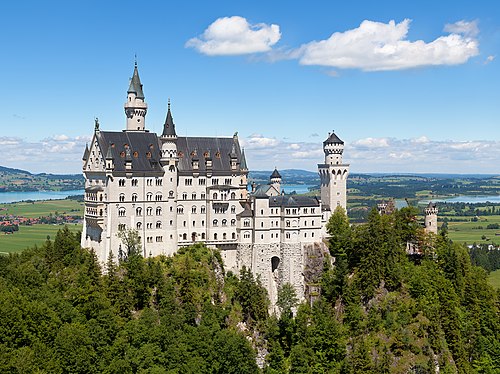 Neuschwanstein CastleStill standing · prime 1886
 Hohenzollern CastleRestored · prime 1867
 Eltz CastleStill standing · prime 1615
All castles in Germany → · Strongest castles in Germany → · Castles of Europe
Play As Your Clan
Hold a real castle against whatever you choose to send at it, take a ship out in her own service years, or stand at the shoulder of someone the record remembers. The chronicler sets the scene; the deeds are yours.