Richter
The judge, local justice, eastern roots.
- Origin
- German
- Famous bearer
- Gerhard Richter (b. 1932), painter
- Register
- German family
The seat of Richter
Seat vacantChief
No one leads the Richter community yet. When the movement opens, you can stand for its leadership, or help elect whoever does.
Current mission
No shared goal set yet. Once Richter has leadership, it sets the public focus: a restoration, a gathering, a real-world project that helps its own.
The Richter clan is being rebuilt. Join the waiting list for the movement today, and you help decide who leads it and what it does.
Help rebuild the Richter clan →What does the Richter name mean?
From Middle High German rihtære, a judge or local magistrate, the man who 'set things right' and held court for a village or district. Thickest in Saxony, Silesia and the German east.
The history of Richter
The man who set things right
In Middle High German he was the rihtære, the man who set things right. Not a lawyer and not a lord: he held court in his lord's name for a single village or small district, ruling on boundary stones, unpaid debts and the small crimes that never travelled further than the next field. He sat in a row of offices that all became heavy German surnames, and the row explains itself - the Schulze was the constable, the Meyer the farm steward who ran a landlord's estate and could act as his bailiff.
German surnames only hardened into heritable form with the beginning of central demographic records in the early modern period, around 1600. That date is the whole story. The ten most frequent surnames in Germany today are all occupational, and they arose independently in every corner of German-speaking Europe, because every settlement needed the same short list of men. There was never one Richter family and never a Richter seat. Each place that kept a court produced its own, and until the practice was abolished in the 18th and 19th centuries their daughters were entered in the parish registers under a female form of the name.
One in eighty, and all of them eastern
The name's map is unusually blunt. As of 2014, 71.2 per cent of all known Richters lived in Germany, at a national frequency of one in 350. In Saxony the rate is one in 80. Brandenburg runs at one in 121, Saxony-Anhalt one in 132, Thuringia one in 250, Mecklenburg-Vorpommern one in 279. Every state above the national average is an eastern one. The surname is thickest exactly where the record puts the office: Saxony, Silesia and the German east, the country where the village court was the working unit of local government rather than a memory of one.
The overspill sits next door in the same legal world - Austria with 1.8 per cent of bearers at one in 1,460, the Czech lands with 1.3 per cent at one in 2,621. Franz Xaver Richter, born in 1709, is filed as a Czech composer; Josef Karl Richter, born in 1880, as a Bohemian composer and military bandmaster.
The Richter who governed Stettin
The office kept producing office-holders long after it stopped producing surnames. Christoph Richter, born in 1596, served as mayor of Stettin in Swedish Pomerania from 1659 to 1669, the last decade of his life - a Baltic port run under a Swedish crown by a man whose name meant judge. Johann Gottfried Ohnefalsch Richter (1703-1765) was a German parson and natural theologian, holding the other authority a village recognised.
The nineteenth century turned the name back into law as a profession. Aemilius Ludwig Richter (1808-1864) was a German jurist; Eugen Richter (1838-1906) a German politician, a Richter in the parliamentary sense rather than the manorial one. In the United States, John C. Richter served as U.S. Attorney for the Western District of Oklahoma - as close as the modern world comes to a man named judge holding court for a district.
Leipzig, about 1661: the Richter who did not stay one
Johann Caspar Richter was a Saxon landowner and shipper-trader who moved during the Thirty Years' War of 1618 to 1648 to a village recorded as Kronenschieldt, near Leipzig, and married Maria Hahn of Annaburg in Saxony-Anhalt. His illegitimate son, born at Leipzig around 1661, took the village's name into his own as Johannes Caspar Richter von Kronenschieldt, and attached to it a coat of arms that was entirely spurious and canting - a claim in heraldry to a standing the birth record would not give him.
Briefly educated at the University of Leipzig, he sailed for Boston about 1688, anglicised himself to John Caspar Crowninshield, married Elizabeth Allen at Lynn, Massachusetts on 5 December 1694, and on 20 June 1700 bought an estate by Spring Pond with all its houses, buildings, waters and fishings from Elizabeth Allen, widow of Jacob Allen. He farmed it until his death on 19 December 1711. His children were born under the new name, and the Saxon one stopped there - a clean measure of what a name change costs a family's heritage.
Stoichiometry, the surgeon's table, the seismologist
Jeremias Benjamin Richter (1762-1807) was the German chemist who developed the theory of stoichiometry. August Gottlieb Richter (1742-1812) was a German surgeon of the same generation; Hieronymous Theodor Richter (1824-1898), another German chemist, came in the century after. Emma Richter (1888-1956) worked as a German palaeontologist and Michael M. Richter (1938-2020) as a German mathematician - a run through the exact sciences with no family tie behind it, only a dense eastern surname meeting an expanding university system.
The name emigrated into the sciences as well. Charles Francis Richter (1900-1985) was an American seismologist; Burton Richter (1931-2018) an American physicist and Nobel laureate. Ronald Richter (1909-1991), an Austrian scientist, ran the Argentine nuclear-fusion Huemul Project. Johan Richter (1901-1997) was a Norwegian-Swedish inventor and industrialist.
Organ lofts, two conductors, a pianist out of the Soviet Union
Music took the name harder than any other trade. Ferdinand Tobias Richter (1651-1711) was an Austrian baroque composer and organist, and his son Anton Karl Richter (1690-1763) an Austrian court organist after him - one of the few genuine Richter dynasties on record, and it is a musical one. Ernst Richter (1808-1879) was a German musical theorist and composer. Hans Richter (1843-1916) and Karl Richter (1926-1981) were both German conductors, born eight decades apart.
Sviatoslav Richter (1915-1997) was a Soviet pianist, the name carried east instead of west. Max Richter is a German-born British classical composer; Jascha Richter, born 1963, a Danish singer-songwriter of the band Michael Learns To Rock. Marion Morrey Richter (1900-1996) was an American composer and pianist.
Etchers, a Dadaist with a camera, and the first human cannonball
Johann Moritz Richter (1620-1667) was a German architect and engraver, working while the surname was still settling. Ludwig Richter (1803-1884), German painter and etcher, and Gustav Richter (1823-1884), German painter, held the name through the nineteenth century; Hans Richter (1888-1976) took it into the twentieth as a German Dada painter, film producer and art historian, and Gerhard Richter, born 1932, carried it on as one of the foremost painters of the modern age. Édouard Frédéric Wilhelm Richter (1844-1913) was a French painter, Henry Constantine Richter (1821-1902) a British zoological illustrator.
The stranger bearers sit alongside them. Rossa Matilda Richter (1860-1937) was an English aerialist and actress, and the first human cannonball. Dora Richter, a German transgender woman, was born in 1892; her date of death is not recorded, and the register simply stops. Twentieth-century Germany produced darker bearers under the same name: Gustav Richter (1913-1982), a Nazi official, and Karel Richard Richter (1912-1941), a German spy.
Thirteen per cent of the name lives in America
The diaspora numbers are the second half of the map. The United States holds 13.0 per cent of all Richters, Brazil 2.2 per cent, South Africa 2.2 per cent at one in 7,686, Australia 1.1 per cent at one in 6,626 - an eastern village-court name spread across four continents. Frank Richter Sr (1837-1910) left Bohemia to become a rancher and entrepreneur in the United States and Canada; his son Frank Richter Jr (1910-1977) became a Canadian politician. Roy Robert Richter (1915-2007) was an Australian oilman and a pilot in the Second World War.
American Richters put the name to work in print and on the field. Conrad Richter (1890-1968) won a Pulitzer Prize as a novelist of the West; Mischa Richter (1910-2001) was a Russian-born American cartoonist. Les Richter (1930-2010) and Pat Richter, born 1941, both played American football, Richter later serving as athletic director at the University of Wisconsin-Madison, and Mike Richter, born 1966, played ice hockey. Further out, Simona Richter, born 1972, is a Romanian judoka and Milan Richter, born 1948, a Slovak writer and playwright.
The castles of the homeland
The great strongholds of the homeland, look one up, see what it looked like in its prime, and recreate it to explore.
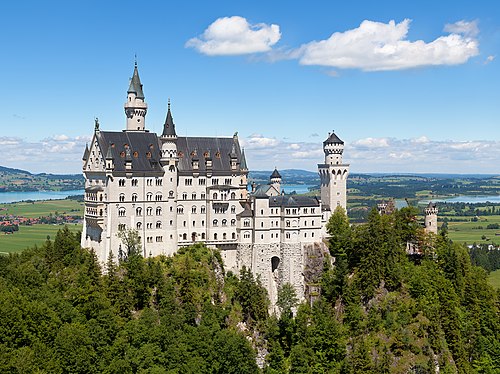 Neuschwanstein CastleStill standing · prime 1886
 Hohenzollern CastleRestored · prime 1867
 Eltz CastleStill standing · prime 1615
All castles in Germany → · Strongest castles in Germany → · Castles of Europe
Play As Your Clan
Hold a real castle against whatever you choose to send at it, take a ship out in her own service years, or stand at the shoulder of someone the record remembers. The chronicler sets the scene; the deeds are yours.
Notable bearers of the Richter name
- Gerhard Richter (b. 1932), painter