Schneider
The cutter of cloth, the needle that helped clothe a continent.
- Origin
- German
- Famous bearer
- Romy Schneider (1938–1982), actress
- Register
- German family
The Schneider arms

Coat of armsWappen der Schneider von Dillenburg von 1821The pattern as it was recorded in 1821.Siebmacher · Public domain

- Coat of arms: Granted to an individual and inherited down that one documented line. These are the arms of particular families of the name, not of everyone who shares the surname.
The seat of Schneider
Seat vacantChief
No one leads the Schneider community yet. When the movement opens, you can stand for its leadership, or help elect whoever does.
Current mission
No shared goal set yet. Once Schneider has leadership, it sets the public focus: a restoration, a gathering, a real-world project that helps its own.
The Schneider clan is being rebuilt. Join the waiting list for the movement today, and you help decide who leads it and what it does.
Help rebuild the Schneider clan →What does the Schneider name mean?
The tailor, literally 'the cutter', from Middle High German snīden, to cut cloth. One of the great guild trades of the German towns, and one of the most characteristic surnames carried by both German-Christian and German-Jewish families.
The history of Schneider
Schneiden, to cut, and the man trusted to do it
Schneider is not a family. It is a job description that hardened into a name, and the job it names is the sharpest part of the trade. Middle High German snīden means to cut, and a Schneider was the cutter, not the man who ran the seam but the man who looked at an expensive flat length of woven cloth and decided where the blade would go. Cloth was costly and a coat was expected to last a lifetime, so a bad cut was not an error, it was a ruined fortune.
The hierarchy inside the trade followed the knife: the most prestigious level was reserved for those who cut the cloth, and mere sewers ranked below the cutters. Padding the underlayers of a man's jacket became fashionable in Europe in the 14th century, and further areas were padded over the following centuries to build an understructure that made a garment sit neatly on the body. Even with modern machines, nearly 75 per cent of the stitching in a custom-tailored suit is still done by hand.
The Zunft and who was allowed to cut cloth in a free city
In the German towns the tailors' body was a Zunft, or elsewhere a Gilde (the word varied from town to town), and it is the reason a Schneider was somebody. A guild's key privilege, held under charter or letters patent, was that only its members were allowed to sell their goods or practise their skill within the city. It set minimum or maximum prices, the hours of trading and the number of apprentices a master might keep. Critics said such rules reduced free competition; the guilds answered that they protected professional standards.
In the German free cities guilds were not a club bolted onto civic life, they were civic life, running in dozens and sometimes in hundreds. Many exercised real influence inside municipal government, and in the prosperous cities of Germany, Italy and the Low Countries they sometimes challenged the patrician elites who had run the towns before them. A guild also kept welfare funds for members who fell sick or grew old and supported their widows and orphans. To be a Schneider on the roll was to hold a trade, a standing and a safety net at once.
Women were inside that world but rarely on equal terms, admitted mostly through marriage or as the widows and daughters of masters and generally excluded from guild office. Cologne is the German exception, where women held full master status in select guilds; elsewhere historians including Merry Wiesner and Sheilagh Ogilvie document a real decline, guilds narrowing women's roles and barring their employment.
The ladder, and the years on the road
Tailors' guilds instituted a system of master craftsmen, journeymen and apprentices, and transmitted the skill through that ladder of apprenticeship, journeymanship and mastery. An apprentice was often indentured to his master by his parents while still a young adolescent, and for a fee; his early years went on cleaning, errands, matching fabric and trims and managing the fires that heated the pressing-irons. Between apprenticeship and mastership stood the years on the road, which German craft tradition calls the Wanderjahre. A journeyman did not stay in the town that trained him; he carried the skill from workshop to workshop and arrived in each new place as his trade before he was anything else.
Enlightenment argument eventually killed the Zünfte: guild monopolies were held to inhibit free trade and innovation, the French Revolution abolished the guilds in 1791, and most of Europe followed as industrialisation made guild-based production less viable. Germany kept the vocabulary. No craft is reserved to a privileged corporation now, but the guilds survive under another old name as the Innungen, whose president comes from the master-craftsmen and is called the Obermeister, while the journeymen elect representatives under a president still titled Altgesell, senior journeyman. A German tailor today works inside the skeleton of the institution that named his ancestors.
Why Schneider sits near the top of the German tables
Counted with its spelling variants together, Schneider is borne by roughly 0.34 per cent of Germans: fifth in the country, behind the Schmidt group at 0.87, Müller and Möller at 0.83, the Meyer and Meier cluster at 0.73 and the Schulz group at 0.43. Count each spelling separately and Schneider rises to third, behind only Müller and Schmidt. Every one of the ten commonest German surnames is occupational: miller, smith, tailor, fisherman, weaver, farm steward, carter, constable, farmer, baker.
The reason is the moment they froze. These names designate common occupations around 1600, when German surnames became heritable, which is why they arose independently across Germany rather than radiating from one ancestor. There is no first Schneider. There were thousands, in thousands of towns, each named for the same obvious thing at about the same time. Some trades split along dialect lines (a barrel-maker was a Böttcher in Hamburg and could easily be a Schäffler in Bavaria), but Schneider held one shape across the German lands, which is exactly why it accumulated.
It is still not evenly spread. Against a national frequency of one German in 184, Schneider runs at one in 96 in Rhineland-Palatinate, one in 102 in the Saarland, one in 123 in Hesse and one in 151 in Baden-Württemberg: a west-and-centre weighting that points a diaspora reader at a region rather than at a country.
The second stream: the German-Jewish Schneiders
Two streams of Schneiders ran side by side in German-speaking Europe for centuries, the German-Christian and the German-Jewish, and the second reached the surname by a different road. Jewish families in the German lands were given hereditary surnames late and by fiat, in the late 18th to early 19th century: Prussia enacted the Hoym Ordinance at Breslau in 1790, mandating the adoption of Jewish surnames, and Napoleon insisted on fixed names in a decree of 1808.
Registration was not neutral. Prussian authorities imposed made-up and sometimes derogatory names: Waldlieferant, forest supplier, was created to ridicule a Jewish timber trader, and far worse expressions were in use. Against those stand the distinctly poetical names, Rosenzweig and its kind, the ones most quickly recognised as Jewish today and probably chosen by the families themselves. An occupational name belongs to neither group. Schneider simply recorded the work, and a Jewish family that cut cloth walked out of the registry with a name indistinguishable on paper from the Christian tailor's two streets away. That is why the surname carries both histories and can never be read as proof of either.
Across the borders the same name was written in the local hand: Sznajder and Szneider in Polish, Šnajder in Serbo-Croatian, Schnyder and Schnider in Swiss German, Snijder and Sneijder in Dutch, Snyder and Snider further west. European Jews arriving in the United States, particularly those who fled Nazi persecution, sometimes anglicised their surnames to avoid discrimination, so a branch could lose the German spelling in a single generation without losing a word of the family's history.
The needle carried west
Both streams carried the needle to the New World, and there it built something enormous. The skilled immigrant tailor, very often a Schneider, was the raw material of the American ready-to-wear industry: the cutting rooms and garment houses of New York and Chicago that clothed a nation off the peg for the first time. A trade that had dressed one German town at a time learned, in immigrant hands, to dress a continent.
The map that migration drew is still legible. As of 2014, 57.9 per cent of all known bearers lived in Germany, at a frequency of one in 184. The United States held 18.8 per cent, Brazil 6.1, Switzerland 3.6 at a dense one in 299, France 3.6, Austria 2.6, Canada 1.3 and Argentina 1.0: a chart of where German-speaking families went, and a line under the feet of every Schneider in Ohio, Rio Grande do Sul or Buenos Aires.
The Schneiders on the record
The name got out of the workshop early. Adolphe Schneider, born in 1802, was the French industrialist who founded Schneider-Creusot, the concern that in time became Schneider Electric; Eugène Schneider (1805–1875) was a French industrialist and politician, and Henry Schneider (1817–87) an industrialist and politician in Britain. Johann Rudolf Schneider (1804–1880), a Swiss doctor of medicine and politician, initiated the Jura water correction. Karl Schneider (1869–1945), a German ophthalmologist, spent his life as a pacifist and an anti-Nazi fighter.
Elsewhere the name is thick on the ground: Johann Gottlob Theaenus Schneider (1750–1822), classical scholar and naturalist; Reinhold Schneider (1903–1958), author; Hortense Schneider (1833–1920), French operetta soprano; Hannes Schneider (1890–1955), the Austrian skiing pioneer, and the Swiss racer Vreni Schneider. Magda Schneider (1909–1996) was a German actress and the mother of Romy Schneider (1938–1982), the best-known bearer of the name on any screen. Two German bands the world knows each carry a Schneider: Florian Schneider-Esleben (1947–2020) of Kraftwerk and Christoph Schneider (born 1966), the drummer in Rammstein. Under its eastern spellings the name runs on with Slobodan Šnajder (born 1948), the Croatian writer, and the Polish Olympic sabre fencer Rafał Sznajder (1972–2014).
None of that is a dynasty and it does not need to be. Schneider means the hand trusted with the first cut, in a town where the right to make that cut was granted, guarded and argued over in the council chamber, a better thing to inherit than a castle.
The castles of the homeland
The great strongholds of the homeland, look one up, see what it looked like in its prime, and recreate it to explore.
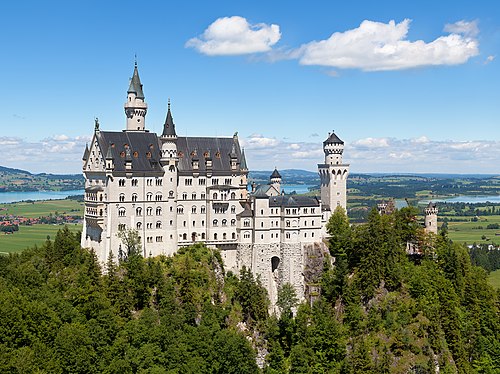 Neuschwanstein CastleStill standing · prime 1886
 Hohenzollern CastleRestored · prime 1867
 Eltz CastleStill standing · prime 1615
All castles in Germany → · Strongest castles in Germany → · Castles of Europe
Play As Your Clan
Hold a real castle against whatever you choose to send at it, take a ship out in her own service years, or stand at the shoulder of someone the record remembers. The chronicler sets the scene; the deeds are yours.
Notable bearers of the Schneider name
- Romy Schneider (1938–1982), actress