Schröder
also Schroeder, Schröter
The northern tailor, the cutter of the Low German plain.
- Origin
- German
- Famous bearer
- Gerhard Schröder (b. 1944), Chancellor of Germany 1998–2005
- Register
- German family
The Schröder arms

Coat of armsMausoleum von Schröder (Friedhof Hamburg-Ohlsdorf).Wappen.ajbAjepbah · CC BY-SA 3.0
.Wappen.ajb.jpg)
- Coat of arms: Granted to an individual and inherited down that one documented line. These are the arms of particular families of the name, not of everyone who shares the surname.
The seat of Schröder
Seat vacantChief
No one leads the Schröder community yet. When the movement opens, you can stand for its leadership, or help elect whoever does.
Current mission
No shared goal set yet. Once Schröder has leadership, it sets the public focus: a restoration, a gathering, a real-world project that helps its own.
The Schröder clan is being rebuilt. Join the waiting list for the movement today, and you help decide who leads it and what it does.
Help rebuild the Schröder clan →What does the Schröder name mean?
A Low German trade-name of the northern plain, in most districts a tailor (from schroden, to cut), the northern counterpart of the upper-German Schneider. The spelling Schroeder carries it into the diaspora.
The history of Schröder
Schroden, to cut, and the casks it also meant
The name is a northern verb with a blade in it. Middle Low German schroden, schraden meant to cut, and on the German plain that verb became an agent noun which different towns pinned to different men. The German record is blunt about the split: Schröder goes back either to the work of the Schneider or to that of the Schröter, and a Schröter was a Fasstransporteur, a cask man. The northern word stayed ambiguous, and it was still ambiguous on the day it froze into a heritable surname.
The Schröter is the half of the name that belongs to the ports. He was the drayman, the man who delivered beer and wine in bulk to the customer, and in a coastal town that was no errand: beer and wine came ashore by the cask, and somebody had to get them off the quay and into a cellar. Two further trades used the same word, a gristmiller in some districts and in others a shoemaker, whose work also began with a cut. Four occupations, one verb, and no way for a modern bearer to know which stood behind his line.
What the name does carry precisely is a map. Schröter, Schrödter and Schrötter belong to Silesia, Saxony and Thuringia; Schröer, Schrörs and Schreurs to the Lower Rhine; Schrader to Ostfalen. Over the Dutch border the same word is Schreuder, in Denmark and Norway Schrøder. Schroeder is the form that took it into the diaspora, the spelling that stuck in Minnesota, in Western Australia and in the Brazilian state of Santa Catarina, where a town of that name still stands.
The counting house that ran from Hamburg to Riga
The Schröders of Hamburg were a Hanseatic family in the strict sense: they belonged to the grand burghers, the historic ruling class of the city republic, and held that standing until the constitutional changes of 1918 and 1919 ended it. They were Lutheran, and they were not old Hamburg money. Christian Matthias Schröder (1742-1821) was a native of Quakenbrück who came to Hamburg as a merchant and acquired the hereditary grand burghership rather than inheriting it.
What he built had the shape of the old Hansa on it. Christ. Matthias Schröder & Co. ran branches in Bremen, Amsterdam, London, St Petersburg and Riga, a map of the Baltic and North Sea trade drawn in one family's ledgers. He married Luise Mutzenbecher (1754-1813) of another prominent Hamburg house, was elected a senator in 1799, and from 1816 until his death in 1821 served as First Mayor of Hamburg, which in a sovereign city republic meant head of state and head of government at once.
The office and the firm went down the same staircase. His son Christian Mathias Schröder (1778-1860) took over the house and sat as a Hamburg senator from 1821 to 1859, and the first mayor's grandson Carl August Schröder (1855-1945) reached the mayoralty in his turn. The firm did not outlast them: it went bankrupt in 1858, while the senator was still in the Rathaus.
The son who took the name to London
One of the first mayor's sons did not stay on the Elbe. Johann Heinrich Schröder (1784-1883) settled in London and founded the investment bank that still trades as Schroders, and in 1868 Prussia ennobled him and gave him the title of Freiherr. It is an unusual direction of travel for a Hanseatic house, whose foreign branches normally reported home; this one took root in the City and stayed. The name stayed on the firm: John Henry Schröder, born Johann Heinrich Wilhelm Schröder (1825-1910), is recorded as a German British merchant, banker and art patron, and in the twentieth century Bruno Schroder sat as a non-executive director of the firm.
Not every Schröder bank lasted. The Schröder-Bank was a private Bremen house, and it became known for the wrong reason: caught by the world economic crisis, it was forced to close in 1931. One surname on a London firm that is trading still, and on a Bremen one that the slump shut.
Rathaus and Ratsstube: the name in the northern councils
Hamburg was not the only council chamber the name reached. Gerhard Schröder (about 1530-1601) was Hauptpastor in Lübeck, the senior preaching office in that city, and the earliest bearer the records fix to a post. A later Gerhard Schröder (1659-1723) was a jurist who became burgomaster of Hamburg, and outside the Low German zone entirely Tilman Schroeder (1645-1706) served as Schöffe and then burgomaster of the free imperial city of Aachen.
Under the burgomasters sat the Rat, and the name is thick there too. Johann Christian Schröder (1760-1809) was a Ratsherr in Rostock, Johann Heinrich Schröder (1779-1848) a Ratsherr in Lübeck, and Anton Diedrich Schröder (1779-1855) a Hamburg merchant and an Oberalter, one of the college of elders that stood beside the senate in the city's constitution.
Behind them stand the men who paid for the offices: Friedrich Schröder (1775-1835), merchant and Reeder, the shipowning trade that makes a northern port a port, and Johann Lucas Schröder (1760-1813), a merchant who sat in the Westphalian assembly. The same career, repeated: cargo first, then the council.
The man at Leopold's court who signed himself Schrötter
Johann Wilhelm von Schröder, born at Königsberg in Bayern on 15 November 1640, wrote his own name four ways in his lifetime, as Schröder, Schroeder, Schröter and Schrötter, which is the variant map of the surname collapsed into one signature. His father had been a ducal Amtmann and, from 1660 to 1663, chancellor to Duke Ernst the Pious in Gotha.
He was a poor finisher and a formidable learner. He went up to Jena in 1659 to read law and abandoned it in 1660 to educate himself instead in the scientific and commercial centres of Holland and England, drawn to the new sciences of state and economy and to alchemy besides. The Royal Society elected him a member in 1662. When he tried to complete the Jena degree in 1663 his dissertation, on the philosophy of the state, was refused approval, and he never took it.
Conversion to Catholicism opened the door that mattered. From 1673 he offered his services to Emperor Leopold I, and between 1675 and 1677 he sent reports from London to Vienna on English economic innovations and how they might be transplanted into the Habsburg lands. In 1677 he took charge of the Wiener Kunst- und Werkhaus am Tabor, Johann Joachim Becher's state model works for wool and silk processing; legal difficulties closed it in 1681 and it burned during the second Turkish siege of Vienna in 1683. From 1687 until his death at Eperies in Hungary in October 1688 he served as chamber councillor at Kaschau and at Pressburg. His Fürstliche Schatz- und Rentkammer, published at Leipzig in 1686, ran to eight editions down to 1835 and counted among the classics of the political economy of its day.
Uetersen, and the king's instruction in the Rantzau case
Titus Schröder, also called Tietelo, was born in 1686 at Uetersen in Holstein, son of a trader named Jakob Schröder, and was brought up by Propst Hieronymus von Petkum at Itzehoe. He read theology at Jena from 1708 and at Leipzig from 1710 to 1712, and on Whit Monday 1717 was installed as preacher of the village church at Breitenberg. He married Anna Maria Stemann in September 1718 and in 1725 was chosen pastor of the convent church at Uetersen, the town he had been born in.
He was reckoned a wise man and unusually well read in the history of Holstein, and that got him noticed above his parish. Holstein lay under the Danish crown, and Schröder stood in the service of King Frederick IV of Denmark and Norway, who entrusted him with church business outside his own congregation. On 1 October 1725 the king instructed him not to award the right of church patronage to Count Wilhelm Adolf zu Rantzau before final judgment had been given in the murder of Reichsgraf Christian Detlev zu Rantzau; Rantzau was later fined 20,000 Reichstaler and held for the rest of his life in the fortress of Akershus by Oslo. Schröder died at Uetersen around midsummer 1726, aged forty.
The Marburg orientalist and the sons he sent to Groningen
Johann Joachim Schröder (1680-1756) was born at Neukirchen in the Knüll, son of a merchant, councillor and church elder, and he made the surname mean something in a field nobody in Germany was working. At Marburg from 1698 he read philosophy and theology, then went to Hiob Ludolf at Frankfurt am Main for Ethiopic and Armenian. A scholar's tour paid for by his prince took him to Utrecht and Amsterdam, where two Armenian bishops, Thomas Golthanensis and Lukas Nurigianides, let him push the language further. He set out for the East, waited in Moscow through 1707 for a companion who never came, and returned to Amsterdam in 1709 to write an Armenian grammar.
It appeared in 1711 as the Thesaurus linguae Armenicae, antiquae et hodiernae, covering the age, history and grammar of the language with extracts from Armenian literature, and it made him. In 1713 he was called to Marburg as professor of oriental languages and church history, adding the chair of Hebrew antiquities and the university librarianship; he was prorector in 1727 and from 1746 head of the Marburg Pädagogium. He was the first to recognise that Armenian belongs to the Indo-European family, and he is reckoned the founder of West European Armenology.
The learning went straight down the table. Nikolaus Wilhelm Schröder (1721-1798) became professor of oriental languages and Greek at Groningen, and university librarian there; Ludwig Konrad Schröder (1724-1801) took the chair of natural and international law at Groningen in 1761; Johann Wilhelm Schröder (1726-1793) held the oriental languages and Greek chairs at Marburg; and Philipp Georg Schröder (1729-1772) was professor of medicine at Rinteln, then Marburg, then Göttingen. Four sons, four professorships, one household.
Wittenberg, Delft and the lecture rooms after them
Ernst Christian Schröder (1675-1758) was born in Wittenberg to Christian Schröder, the university's printer, and spent nearly his whole life inside that one town. He took his master's degree there in April 1696, became adjunct in the philosophical faculty in 1702 and professor of lower mathematics in 1708, moved to the chair of logic and metaphysics in 1715 and held it until he died, and was rector of the Wittenberg academy in 1716 and 1740. His first published work, fittingly for a printer's son, was De Typographia in 1697.
The name belonged to the Dutch schoolrooms too. Johann Caspar Schröder (1695-1759) taught at the Latin school in Breda and was rector of the gymnasia at Middelburg, Utrecht and Delft, and he edited the authors his pupils would meet: Cicero's selected letters, the tragedies of Seneca, the Enchiridion of Epictetus. The academic line runs on with Ernst Schröder (1841-1902), logician and mathematician; Edward Schröder (1858-1942), Germanist and medievalist; Leopold von Schroeder (1851-1920), indologist; and Dominik Schröder (1910-1974), ethnologist.
The court painter Stockholm called home
Georg Engelhard Schröder (1684-1750) was a Swede by birth and a German by descent. His father Veit Engelhard Schröder, a goldsmith from Nuremberg, emigrated with his wife Lucia Lindemeyer to Stockholm in 1670, and Georg was born there fourteen years later. He trained under the court painter David von Krafft and left his studio in 1703 for twenty-one years abroad: northern Germany first, then five years in Venice copying old masters and falling in with the pastellist Rosalba Carriera; then Rome, under Carlo Dolci, Carlo Maratta and Francesco Trevisani; then Paris and Noël-Nicolas Coypel; then seven years in London, where Godfrey Kneller and Michael Dahl marked his work.
In December 1724 Krafft died and Schröder was ordered back to Sweden to take his old master's place as court portraitist. He married Anna Birgitta Spöring in 1727. Frederick I valued him highly and sat to him repeatedly, as did Queen Ulrika Eleonora, and in the same years he painted two Ottoman ambassadors to the Swedish court: Mustapha Aga in 1727 and, in 1733, Yirmisekizzade Mehmed Said Efendi, later Grand Vizier.
His altarpieces are still where he put them: a Crucifixion of 1738 in the Hedwig Eleonora Church in Stockholm, Last Suppers in the Drottningholm Palace church and the church at Norrtälje, an altarpiece of 1736 at Överenhörna and one of 1733 for Växjö Cathedral. When Gustaf Lundberg brought a French-influenced manner to Sweden in the 1740s, demand for his work fell away, leaving him one of the last Swedish painters of his century whose formation was principally Italian. Alexander Roslin was his pupil.
The captain of the St Louis, and the name in uniform
The bearer who ought to be best known is Gustav Schröder (1885-1959), a German sea captain who in 1939 tried to save the 937 German Jewish passengers aboard his ship, the MS St Louis, from the Nazis; he is honoured as one of the Righteous Among the Nations. He was not alone in the name. Adolf Schröder (1885-1945) and Georg Schröder (1904-1944) are both recorded as German resistance fighters, Heinz Schröder (1910-1997) as an anti-fascist, and Johannes Schröder (1909-1990) as a pastor who was one too.
The sea and the services took the name repeatedly. Ludwig von Schröder (1854-1933) rose to admiral, Wilhelm Schröder (1842-1908) to vice admiral and naval attaché, and Hermann Schröder (1868-1946) to rear admiral in the Imperial Navy; Jan Schröder (1800-1885) served as a Dutch naval officer and a German admiral. Across the Atlantic, Henry F. Schroeder (1874-1959) was a United States Army soldier and a Medal of Honor recipient, and Leonard T. Schroeder (1918-2009), a US Army colonel, was the first American soldier ashore on D-Day.
There is a long civilian tail, and much of it is on stage. Friedrich Ludwig Schröder (1744-1816) was an actor, dramatist and freemason; Sophie Schröder (1781-1868) an actress and singer; Wilhelmine Schröder-Devrient (1804-1860) among the great German singers of her century; Karl Schröder II (1848-1935) a cellist and conductor; Rudolf Alexander Schröder (1878-1962) a poet and interior designer. Abroad the name runs on with Andreas Schroeder, born 1946, the German-born Canadian poet and novelist, the Dutch violinist Jaap Schröder (1925-2020), and, on courts a long way from the Elbe, the German basketball player Dennis Schröder, born 1993.
The castles of the homeland
The great strongholds of the homeland, look one up, see what it looked like in its prime, and recreate it to explore.
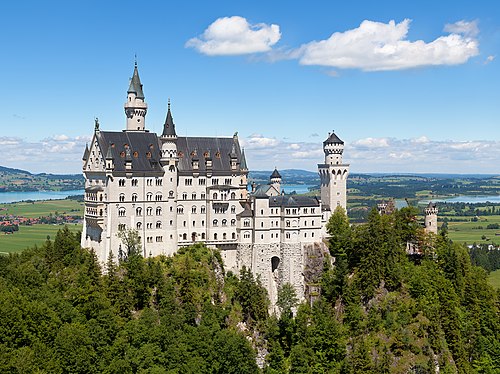 Neuschwanstein CastleStill standing · prime 1886
 Hohenzollern CastleRestored · prime 1867
 Eltz CastleStill standing · prime 1615
All castles in Germany → · Strongest castles in Germany → · Castles of Europe
Play As Your Clan
Hold a real castle against whatever you choose to send at it, take a ship out in her own service years, or stand at the shoulder of someone the record remembers. The chronicler sets the scene; the deeds are yours.
Notable bearers of the Schröder name
- Gerhard Schröder (b. 1944), Chancellor of Germany 1998–2005