Schulz
also Schulze, Scholz, Schultz
The village headman, small-town authority, eastern roots.
- Origin
- German
- Famous bearer
- Martin Schulz (b. 1955), President of the European Parliament 2012–2017
- Register
- German family
The seat of Schulz
Seat vacantChief
No one leads the Schulz community yet. When the movement opens, you can stand for its leadership, or help elect whoever does.
Current mission
No shared goal set yet. Once Schulz has leadership, it sets the public focus: a restoration, a gathering, a real-world project that helps its own.
The Schulz clan is being rebuilt. Join the waiting list for the movement today, and you help decide who leads it and what it does.
Help rebuild the Schulz clan →What does the Schulz name mean?
Worn down from Schultheiss, the village headman who collected the lord's dues and kept order (the one who 'orders the debt'). Surviving as Schulz, Schulze and Scholz, it is one of the great surnames of the German east: Brandenburg, Saxony, Silesia.
The history of Schulz
The man who ordered the debt
Schulz is what a long word became in a hurry. Behind it stands Schultheiss, an office title built out of two plain ideas, the debt owed to the lord and the order to pay it: the man who called in what a village owed and kept order while he did it. In practice he was the head of a village or small town, the nearest thing the countryside had to a mayor, and in many places its judge as well. He was not a tradesman. Nobody trained as a Schultheiss; he was set over his neighbours, and the byname stuck because there was only ever one of him in the place.
The word wore down as fast as it was used. The final e of Schulze was being dropped as early as the 15th century, leaving Schulz. In East Central Germany and Silesia the u went over to o, which is why Scholz and Scholtz are the same office in a different vowel. Clerks writing Latin turned him back into Scultetus, and over the eastern language line he became Šulc in Czech and Szulc in Polish. Counted as one family of spellings, Schulz, Schulze, Schultze, Schulte, Schultheiss and Scholz are carried by 0.43 per cent of Germans.
Großglogau, about 1460: a village Schulze's son
The best evidence of what the office was worth is a boy who started underneath it. Hieronymus Schulz was born around 1460 at Großglogau in the Duchy of Glogau, the son of a Dorfschulze, a village Schulze. How he climbed is almost unrecorded, which is itself the point: no chronicler thought a headman's son worth following until he was already high.
By 1504 he was a much travelled man holding three positions at once, parish priest at Cottbus, canon at Brandenburg, and an influential councillor of the Elector Joachim of Brandenburg. In 1505 he stood beside the elector at the baptism of his son, the future Joachim II. Contemporaries rated him an outstanding rhetorician. He was made provost at Salzwedel in 1506 and Bishop of Brandenburg in 1507. In the scholar's Latin he used and was given, he is Hieronymus Scultetus: the name of his father's village office, promoted into a bishop's title.
The bishop who was sent the ninety-five theses first
The cradle of the Reformation lay inside his diocese, and it was the grief of his life. As Martin Luther's bishop, Schulz was the first man to be sent the ninety-five theses. His instinct was not to crush the argument but to damp it down; he went to Wittenberg himself and forbade Luther's printer to distribute the counter-disputation on indulgences.
Luther complied at first. When Johann Tetzel and Konrad Wimpina would not stop attacking him, Luther broke his word, and on 22 May 1518 drew up a justification of his position addressed to his bishop. After Luther appeared at the Leipzig Disputation, Schulz turned into a decided opponent. Even then he would not publish the bull of excommunication, Decet Romanum Pontificem, in his own diocese, because he feared it would raise a revolt.
At the Diet of Worms in 1521 he tried in person to move Luther to abjure. Luther would not. His own lord rewarded him anyway, against papal objection, with the vacant bishopric of Havelberg, where he was installed on 9 August 1521. He held it barely a year, dying on 29 October 1522, and was buried at Wittstock. A village headman's son had spent his last years arguing, at close range and without success, with the man who split Western Christendom.
Why the name lies thickest in the German east
Schulz is one of the great surnames of the German east: Brandenburg, Saxony, Silesia, Pomerania. That is not an accident of dialect, it is a record of how those villages were made. The east was settled village by village under the great German push eastward, and every new place put in a headman to gather the dues and hold order. The office was minted again and again in country founded fast, and the surname map still shows it.
The name went over the language line with the settlement. Antonín Schulz (1852-1922) was a Bohemian judge and author, holding in a Habsburg courtroom the second half of what his surname had meant in a village; Adolf Schulz-Evler (1852-1905) was a Polish pianist and composer, and Karel Schulz a Czech novelist. The Silesian vowel shift gave that whole country its Scholzes. Later, and by imposition rather than by descent from any headman, the name was among those forced on Ashkenazi Jewish families in the German lands.
Dreysee to the consistory at Königsberg
Johann Ernst Schulz was born on 20 December 1742 at Dreysee in East Prussia and taken to Königsberg in his tenth year. He went through the Altstädter school, entered the university in 1759, and found his formative teacher in Theodor Christoph Lilienthal (1717-1781), whose household he joined as a tutor in 1760. He taught at the Königsberg orphanage from 1767 and held a preacher's post there from 1771.
Books of his own carried him the rest of the way. In 1778 he took his doctorate in theology and a full professorship at Königsberg, and with the chair came the offices: royal Prussian consistorial councillor, court preacher, and Generalsuperintendent of East Prussia in succession to Johann August von Starck. That last post put him at the head of the Lutheran Prussian Consistory at Königsberg, the regional authority under the Oberkonsistorium in Berlin. He moved up to the second theological chair in 1783 and the first in 1799, and held it until he died on 9 April 1806. He preached the homage sermon in the Königsberg castle church when Friedrich Wilhelm II came to the throne, and had it printed in 1786.
Dresden, 1816: mayor, town judge and tax collector at once
Now and then the name landed back on the job it was named for. Gottlob Heinrich Schulz was born at Meißen on 28 January 1764, read law, and became a Dresden councilman in 1799. In 1804 the council made him assessor of the town court and its deputy on the water commission; in 1809 he was appointed town judge, town tax collector, and deputy to the tax credit fund at Leipzig, set up in 1763 to pay off the state debts left by the Seven Years War. The village Schultheiss had gathered the dues and heard the small cases; his namesake in Dresden was doing both, under a Saxon crown, with a salary.
In 1815 the Dresden magistracy named him one of the city's three mayors, alongside Johann August Beck and Carl Christian Pohland. He sat as assessor mayor in the first year and ruling mayor in 1816, ruling again in 1819, and in between he carried a stack of side offices that shows how much of a city one man then ran: administrator of the ecclesiastical bridge office and poor chest, inspector of the Kreuzkirche, the Frauenkirche and the Sophienkirche, inspector of the Bohemian free writing school, deputy at the municipal pawnhouse, and collector of the drink tax. He was knighted in the Royal Saxon Civil Merit Order in 1816 and died at Dresden on 26 February 1821.
The office ran on into the family by marriage. His daughter Anne Marie, born at Dresden in 1816, married the jurist Theodor Julius Hertel (1807-1880) in 1835; Hertel became a Dresden councillor and, in his turn, mayor of the city.
Songs in the folk tone, and a Kapellmeister's circuit
Johann Abraham Peter Schulz was born at Lüneburg on 31 March 1747, schooled at St Michaelis from 1757 and at the Johanneum from 1759 to 1764. In 1765 he went to Berlin as the pupil of Johann Kirnberger, himself a pupil of Bach. It was Kirnberger who in 1768 recommended him as music teacher and accompanist to the Polish princess Sapieha, Woiwodin von Smolensk; three years of travel across Europe in her service did the rest of his education.
After that he moved between posts the way a court musician had to: conductor of the French Theatre in Berlin from 1776 to 1780, Kapellmeister to Prince Henry at Rheinsberg from 1780 to 1787, court Kapellmeister at Copenhagen from 1787 to 1795, then back to Berlin. He wrote the music for Racine's Athalie at Rheinsberg in 1785, the opera Aline, reine de Golconde there in 1787, and three Danish Syngespil at Copenhagen: Høstgildet in 1790, Indtoget and Peters bryllup in 1793.
What outlived all of it was the plainest thing he did. His Gesänge im Volkston of 1779 and the Lieder im Volkston of 1782, 1785 and 1790 set out to write songs that sounded as though nobody had composed them. He gave Matthias Claudius the melodies for Der Mond ist aufgegangen and Wir pflügen und wir streuen, and he wrote the tune of the carol Ihr Kinderlein kommet. A name out of the village ended up supplying Germany with the songs it sings without knowing who wrote them.
Berlin to Oslo, and the name that kept leaving
Carl Theodor Schulz was born in Berlin on 5 April 1835, the son of Christian Schulz, a tailor. He worked the market gardens of Berlin and Potsdam through the 1850s and a botanical garden at Hamburg through the decade after, and in March 1865, after five years there, he was hired by the University Botanical Garden in Oslo. The man who fetched him north was Frederik Schübeler, whose adopted daughter Ingeborg Strengberg (1853-1918) he married at Østre Aker in February 1875. He was appointed head gardener in 1893, on the death of Nils Green, and stayed in the post until his own death on 16 August 1914. He published Om botaniske haver in 1895, was founding chairman of the Christiania Gardener Association, and sat on the board of the Norwegian Horticulture Society from 1892 to 1902.
The name travelled twice: first eastward with the settlement that made it common, then across the Atlantic and the equator with the emigration out of those same eastern provinces, very often respelled Schultz or Shultz on arrival. Wilhelm Philipp Daniel Schulz (1805-1877) went the other way and became Guillermo Schulz, a mining engineer and geologist in Spain. Argentina took a cluster of its own: the painter, sculptor and writer Oscar Agustín Alejandro Schulz Solari (1887-1963), the handball goalkeeper Matías Schulz, the rugby player Germán Schulz. In the United States the old spelling held for the most famous bearer of all, Charles M. Schulz (1922-2000), who drew Peanuts.
The office itself never quite let go either. Wilhelm Schulz (1797-1860) sat as a deputy in the Frankfurt National Assembly of the 1848 revolution; Berta Schulz (1878-1950) went into the Reichstag for the Social Democrats at a time when very few women did; and Martin Schulz, born in 1955, was President of the European Parliament from 2012 to 2017. A word that began as an order to pay the lord what a village owed had finished up in the chair of a parliament for the continent.
The castles of the homeland
The great strongholds of the homeland, look one up, see what it looked like in its prime, and recreate it to explore.
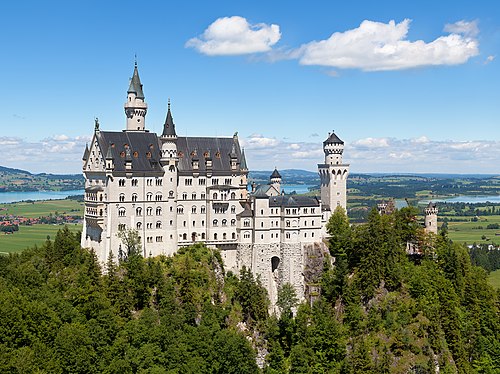 Neuschwanstein CastleStill standing · prime 1886
 Hohenzollern CastleRestored · prime 1867
 Eltz CastleStill standing · prime 1615
All castles in Germany → · Strongest castles in Germany → · Castles of Europe
Play As Your Clan
Hold a real castle against whatever you choose to send at it, take a ship out in her own service years, or stand at the shoulder of someone the record remembers. The chronicler sets the scene; the deeds are yours.
Notable bearers of the Schulz name
- Martin Schulz (b. 1955), President of the European Parliament 2012–2017