Schwarz
also Schwartz
'The dark one', the German Black, and a great Jewish name.
- Origin
- German
- Register
- German family
The seat of Schwarz
Seat vacantChief
No one leads the Schwarz community yet. When the movement opens, you can stand for its leadership, or help elect whoever does.
Current mission
No shared goal set yet. Once Schwarz has leadership, it sets the public focus: a restoration, a gathering, a real-world project that helps its own.
The Schwarz clan is being rebuilt. Join the waiting list for the movement today, and you help decide who leads it and what it does.
Help rebuild the Schwarz clan →What does the Schwarz name mean?
Descriptive, Middle High German swarz, black, for dark hair or a dark complexion. Common across the German lands and one of the most frequent of Ashkenazi surnames; abroad, almost always spelled Schwartz.
The history of Schwarz
The man the clerk picked out by his hair
Schwarz is Middle High German swarz, black, fastened onto a man for dark hair or a dark complexion. German family names divide into four groups by derivation: given names, occupations, bodily attributes, and toponyms. Schwarz sits in the third and smallest, alongside Krause (curly), Klein (small), Groß (big) and Schwarzkopf (black head). Its natural opposite is Weiss, and its Czech female form is Schwarzová.
The habit was not German property. English threw up the same class of nickname surname in Brown, Short and Thin, Spanish in Moreno (dark) beside Delgado (thin). German occupational names arose independently across the German lands because every village needed a miller; a dark-haired man was needed nowhere and turned up everywhere, so no single kindred stands behind any of them. Nor is every schwarz a Schwarz: Schwarzenegger is a toponym, from Schwarzenegg or Schwarzeneck.
The register that froze a nickname in place
Surnames came in gradually across German-speaking Europe during the Late Middle Ages and became heritable once central demographic records began in the early modern period. That moment matters for a name like this. A trade name was renewed in each generation by the son who kept the forge; a descriptive name could not be. Once written into a register, Schwarz stopped describing anybody and went on being inherited by the fair-haired as readily as the dark.
The registers did the rest. Church books carried regionally typical female variants, so a south German Peter Huber had an Anna Huberin entered beside him, a practice abolished in the 18th and 19th centuries as official registration took hold. The same reform fixed spelling, which had varied even from entry to entry, to the recorded form.
Berthold's powder and Matthäus Schwarz's ledgers
The earliest bearer the name carries is half legend: Berthold Schwarz, a Franciscan friar remembered as a German alchemist of the 14th century and credited by tradition with the invention of gunpowder. The first securely dated one is a different sort of man entirely. Matthäus Schwarz (1497–c. 1574) was a German accountant, a professional of the counting house at the height of the age when merchant houses and craft guilds between them ran the German cities.
Those guilds are the machinery behind the German surname stock. Their authority rested on charters granting monopolies on production within their locality and the right to enforce professional standards; they passed on skills through apprenticeship, journeymanship and mastery, and kept welfare funds for widows and orphans. In the prosperous German cities they held real weight in municipal government and sometimes challenged the patrician elites outright. It was in that world, around 1600, that German names hardened into the forms carried today. Christoph Schwarz (c. 1545–1592) was a German court painter, and Sibylla Schwarz a German poet of the 17th century.
The Hoym Ordinance, and a name that needed no inventing
In 1790 Prussia enacted the Hoym Ordinance at Breslau, mandating the adoption of Jewish surnames; Napoleon insisted on the same by decree in 1808. Where the Prussian authorities did the choosing the results could be made up and openly derogatory, Waldlieferant (forest supplier) coined to ridicule a Jewish timber trader. Where families chose for themselves, the names that came out are the distinctly poetical ones, Rosenzweig among them.
Schwarz belongs to neither category, and that is the point of it: already an ordinary German word and an ordinary German surname, it was available, unremarkable and safe. That is a large part of why it stands with Klein and Wolf among the characteristic surnames of Ashkenazi Jewry. From that branch came Isaïe Schwartz (1876–1952), great rabbi of France; Béla Schwartz (born 1891), a Hungarian Jewish leader; and Lavoslav Schwarz (1837–1906), a Croatian merchant of Zagreb.
Two letters and an ocean: how Schwarz became Schwartz
The name moved inside Europe before it crossed anything: François Xavier de Schwarz (1762–1826) was a Badener who rose to be a French general. Abroad it almost always gave up the German spelling for the t. The 19th century sent Charles Henry Schwarz (1825–1903), a German-American businessman, and Eugene Amandus Schwarz (1844–1928), a German-American entomologist; later arrivals came from further east, among them Ernő Schwarz (1902–1977), the Hungarian American soccer player, coach and promoter.
In America the Schwartz spelling settled into popular culture. Isadore Schwartz (1900–1988) took the world flyweight title boxing as The Ghetto Midget; Julius Schwartz (1915–2004) edited comic books; and Morrie Schwartz (1916–1995) was the academic who became the subject of Tuesdays with Morrie.
The blackboard and the Dutch elm
The hardest single result under the name belongs to Marie Beatrice Schol-Schwarz (1898–1969), the Dutch phytopathologist who identified the causal agent of Dutch elm disease. In mathematics it runs through two countries at once: Laurent Schwartz (1915–2002) and Marie-Hélène Schwartz (1913–2013), who worked on characteristic numbers of spaces with singularities, were French; Jack Schwartz (1930–2009) was an American mathematician and computer scientist.
Playbills, and a pulpit in Scotland
The name is thick on German and Austrian playbills without being tied to any one family: Bertha Schwarz (1855–1947) was a coloratura soprano, Vera Schwarz (1888–1964) an Austrian soprano, and Walter Andreas Schwarz (1913–1992) singer, songwriter, Kabarettist and translator at once. The oddest turn it takes is Carl Schwartz (1817–1870), a Hebrew Christian clergyman who served as a minister of the Free Church of Scotland.
The board and the pitch
Austrian chess produced two of the name: Adolf Schwarz (1836–1910), the Austrian-Hungarian master, and Jacques Schwarz (1856–1921). Reggie Schwarz (1875–1918) was an Anglo-South African who played both cricket and rugby.
One bearer carried the name into a harder arena. Harry Schwarz (1924–2010) was a South African lawyer, politician and diplomat who stood among the leaders of the opposition to apartheid, still spelling it the German way, still the same Middle High German adjective a clerk once wrote beside a dark-haired man's given name.
The castles of the homeland
The great strongholds of the homeland, look one up, see what it looked like in its prime, and recreate it to explore.
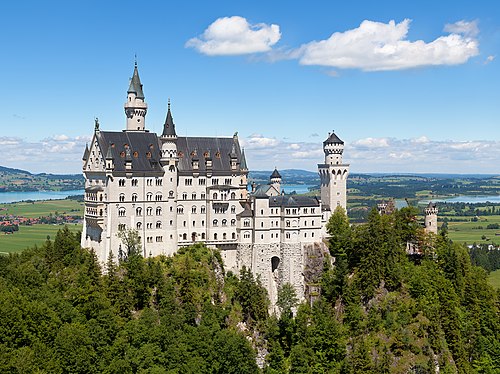 Neuschwanstein CastleStill standing · prime 1886
 Hohenzollern CastleRestored · prime 1867
 Eltz CastleStill standing · prime 1615
All castles in Germany → · Strongest castles in Germany → · Castles of Europe
Play As Your Clan
Hold a real castle against whatever you choose to send at it, take a ship out in her own service years, or stand at the shoulder of someone the record remembers. The chronicler sets the scene; the deeds are yours.