Weber
also Webber
The weaver, from the loom-towns that clothed Europe.
- Origin
- German
- Famous bearer
- Max Weber (1864–1920), founding sociologist
- Register
- German family
The seat of Weber
Seat vacantChief
No one leads the Weber community yet. When the movement opens, you can stand for its leadership, or help elect whoever does.
Current mission
No shared goal set yet. Once Weber has leadership, it sets the public focus: a restoration, a gathering, a real-world project that helps its own.
The Weber clan is being rebuilt. Join the waiting list for the movement today, and you help decide who leads it and what it does.
Help rebuild the Weber clan →What does the Weber name mean?
The weaver, Middle High German wëber. The weaver stood at the centre of the German textile economy, and especially of the great weaving districts of Silesia, Saxony and Swabia. Cognate of English Weaver.
The history of Weber
Wëber, the man at the loom
Weber is the Middle High German wëber, the weaver. German family names divide into four kinds (from a father's given name, from a bodily attribute, from a place or named building, and from a job) and the occupational ones are the largest class of the four. Anyone with an unusual trade was bound to be identified by it, and a man at a loom was identified by the loom. Weber stands in the same rank as Schmidt the smith, Müller the miller and Schneider the tailor.
The name became inherited property late. Surnames spread through German-speaking Europe across the Late Middle Ages and only turned heritable with the start of central demographic records in the early modern period, the point at which a clerk wrote a household down as Weber whether or not anyone in it still owned a loom. Dialect fixed the form as firmly as the trade did: a barrel-maker in Hamburg was a Böttcher, a Bavarian at the same bench a Schäffler. Migration anglicised it again, to Webber and to Weaver.
Who was allowed to call himself a weaver
Warp-weighted looms gave way to horizontal looms in the 10th and 11th centuries and weaving became an urban craft, at which point the craftsmen applied to establish a guild. Merchant guilds split into separate trade guilds for each skill, and the weavers' guild controlled the two things that mattered: the quality of the cloth, and the training an artisan had to finish before he could call himself a weaver. The cloth merchant who held guild membership was the one allowed to sell.
In the German free cities, as in Florence and Barcelona, guilds ran to dozens or hundreds and sat at the centre of civic life, their authority resting on charters granting monopolies within the locality. They kept welfare funds for sick and elderly members, supported widows and orphans, and in Germany and the Low Countries were strong enough to challenge the patrician elites. Women entered by marriage or widowhood and were kept from office, though in Cologne some held full master status.
The merchant bought the wool, and the weaver owned nothing
Wool was the predominant fibre of medieval Europe, with linen and nettlecloth for poorer households, and at first the weaver worked at home and marketed his own cloth at the fairs. By the 13th century that independence was gone: under the putting-out system the merchant bought the wool, handed it out, took the finished piece back, set the rates of pay and dominated the industry. Output stayed capped by the supply of thread until the great wheel and then the treadle wheel let the unchanged loom run continuously.
The 14th century broke the arrangement again. Failed harvests, starvation and the losses of the Hundred Years War were followed in 1346 by the Black Death, which cut the population by up to half. Arable land could not be staffed, prices fell, and fields went to sheep. Traders from Florence and Bruges bought the wool, and sheep-owning landlords had it woven beyond the reach of the city and trade guilds, first in weavers' homes, then in purpose-built buildings with regulated hours.
The flying shuttle, and what the mill left behind
John Kay's flying shuttle of 1733 ended the need for the expensive assistant a broad loom had required. Edmund Cartwright proposed a weaving machine in 1784 and was told weaving was too nuanced to automate; he built a factory at Doncaster, patented between 1785 and 1792, and took £10,000 from Parliament in 1809. Power-weaving only took hold after about 1805, when 250,000 hand weavers were still working in the United Kingdom, and the Lancashire Loom made it semi-automatic in 1842.
Richard Guest put numbers on the collapse in 1823: a very good hand weaver of thirty wove two pieces of shirting a week, a steam-loom weaver of fifteen wove seven. Piece rates fell, and handloom weavers were among the leaders of both the Luddites and the Chartists. The guilds went with the trade, abolished in France in 1791 and across most of Europe after it. Skilled weavers of both sexes emigrated and carried the knowledge to New England, to Pawtucket and Lowell.
The Weber sisters, and the cousin who composed
The surname walked into the Mozart household through four sisters and their mother. Cäcilia Weber's daughters were Josepha (1758–1819), a German soprano; Aloysia; Sophie; and Constanze, who married Wolfgang Amadeus Mozart and is remembered under his surname rather than her own. Carl Maria von Weber (1786–1826), the composer, was the sisters' cousin, and his son Max Maria von Weber became a civil engineer.
Music stayed with the name long after. Ludwig Weber (1899–1974) was an Austrian singer, Joseph Miroslav Weber (1854–1906) a Czech composer and violinist, Eberhard Weber (born 1940) a German musician and Joan Weber (1935–1981) an American popular singer. The name went into the instruments too: Albert Weber Sr. (1829–1879), a musician, founded the Weber Piano Company, and his son Albert Weber Jr. (1858–1908) became its second president.
A unit of magnetic flux, and a dermatologist's German father
Wilhelm Eduard Weber (1804–1891), physicist and pioneer of telegraphy, is the reason the SI unit of magnetic flux is called the weber: a loom-town trade name ended up on the instrument panel. Heinrich Friedrich Weber (1843–1912) was another German physicist and Eduard Ritter von Weber (1870–1934) a German mathematician. In field science the name runs from Georg Heinrich Weber (1752–1828), German botanist, to William Alfred Weber (1918–2020), the American botanist who originated the herbarium acronyms.
Medicine shows the migration in a single household: Hermann David Weber (1823–1918) was a German physician who practised in England and collected coins, and his son Frederick Parkes Weber (1863–1962) was an English dermatologist: one generation German, the next English, the surname unchanged. Annemarie Weber (1923–2012) was a German-born American physiologist; Joseph Weber (1919–2000) developed the laser and the gravitational wave detector, and Mary Ellen Weber (born 1963) flew as an American astronaut.
Max, Marianne and Alfred, in one generation of one discipline
Three Webers were doing sociology at once, which marks how far the loom-name had travelled from the loom. Max Weber (1864–1920) is one of the founders of the discipline; Marianne Weber (1870–1954) was a sociologist and women's rights activist; Alfred Weber (1868–1958) was a German economist, sociologist and theoretician of culture. Axel A. Weber (born 1957), a German economist, was president of the Deutsche Bundesbank.
The scholarly spread is wide: Albrecht Weber (1825–1901), German Indologist and historian; Beda Weber (1798–1859), professor, author and politician; Eugen Weber (1925–2007), French historian. Ingeborg Weber-Kellermann (1918–1993) was a German folklorist, anthropologist and ethnologist. Ludwig Weber (1846–1922) was a German pastor and social reformer.
Where the loom-name travelled
Anna Weber (1814–1888) worked as a Canadian Mennonite Fraktur artist. In Chile the name reached the presidential household: Carmen Weber (1945–2007) was the first wife of President Ricardo Lagos, and their son Ricardo Lagos Weber (born 1962) became a Chilean lawyer and politician. Rosa Weber sits as a Brazilian judge; Michael Weber (1966–1999) played guitar for the Australian band Seminal Rats; Darren Weber (born 1972) was a Zimbabwean cricketer.
In the United States the name went into the courts and the Capitol: Vin Weber of Minnesota, Randy Weber of Texas and Ed Weber (1931–2023) of Ohio in the House of Representatives, and Albert J. Weber (1859–1925) as Chief Justice of the Utah Supreme Court. In Europe it settled in no one country: Helene Weber (1891–1962) and Manfred Weber (born 1972), German; Henri Weber (1944–2020), French; Renate Weber, a Romanian lawyer and human rights activist. Gerhard Weber (1941–2020), a German fashion designer, put the name back beside cloth.
The same name across Europe
Weber shares its meaning, not its bloodline, with these names from other corners of Europe: cognates, the same word for the same thing, formed independently in each language. Cousins by meaning, with separate ancestral stories a search box flattens into near-twins.
The castles of the homeland
The great strongholds of the homeland, look one up, see what it looked like in its prime, and recreate it to explore.
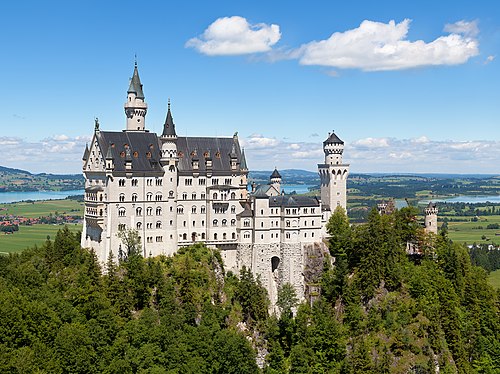 Neuschwanstein CastleStill standing · prime 1886
 Hohenzollern CastleRestored · prime 1867
 Eltz CastleStill standing · prime 1615
All castles in Germany → · Strongest castles in Germany → · Castles of Europe
Play As Your Clan
Hold a real castle against whatever you choose to send at it, take a ship out in her own service years, or stand at the shoulder of someone the record remembers. The chronicler sets the scene; the deeds are yours.
Notable bearers of the Weber name
- Max Weber (1864–1920), founding sociologist
- Carl Maria von Weber (1786–1826), composer