Werner
also Wörner
'The defending warrior', a name from the age of knights.
- Origin
- German
- Register
- German family
The seat of Werner
Seat vacantChief
No one leads the Werner community yet. When the movement opens, you can stand for its leadership, or help elect whoever does.
Current mission
No shared goal set yet. Once Werner has leadership, it sets the public focus: a restoration, a gathering, a real-world project that helps its own.
The Werner clan is being rebuilt. Join the waiting list for the movement today, and you help decide who leads it and what it does.
Help rebuild the Werner clan →What does the Werner name mean?
From the Germanic given name Werner, Warinheri, 'defending warrior' (warin, protection, plus heri, army), a hugely popular medieval Christian name that became a surname across the German lands.
The history of Werner
Warinheri, a man's own name before it was a family's
The second element of Wern(h)er is Old High German heri, a host or an army. The first is disputed. Most readings take it from warōn, to guard or keep watch, or from the related warnōn, to take heed; another line derives it instead from werren and werien, to defend. Early medieval name-makers combined such elements freely, so the compound need not have carried any coherent sense at all. What matters for the surname is the category it sits in. Werner is not a trade like Schmidt, not a remark about a man's body, not the village he walked in from. It is a person's own name, worn afterwards by his descendants.
A given name turned into a family name when a man was identified by his father's, sometimes with a genitive ending, the way Ahrend produced Ahrends. Werner froze without any suffix at all, the bare personal name standing on the son. That is why there is no Werner homeland and no single Werner kindred: any parish with a Werner in it could mint the surname on its own account.
The personal name itself travelled and was reshaped as it went: Wernher and Frisian Warner, Low German Warn, English Warren and Vern, Verner in Scandinavia and Bohemia, Garnier, Vernier and Grenier in France, Guarniero and Guarnieri in Italy, Verneri in Finland. Nor did it fall out of use once it had done its work. Werner stood among the ten most-given boys' names in Germany from the early 1910s to the end of the 1930s and again at the turn of the 1950s, reaching second place in 1918, and it held the Swiss top ten from 1930 to 1954.
Goslar, 25 July 1087: Wernerus de Velthem witnesses a charter
The earliest member of the Lower Saxon house of von Veltheim who can be traced in a document is a Werner, and he appears as a witness. At Goslar on 25 July 1087, Bishop Burchard II of Halberstadt confirmed the rights of the abbey of Ilsenburg, and the witness list carries the name Wernerus de Velthem. The bishop's text does more than record him. It adds that Werner is filius fratris mei Adelgoti, the son of my brother Adelgot, so the kinship here is written down at the time rather than reconstructed later.
Where his own name came from is part of the same story. He is thought to have been named after Archbishop Werner of Magdeburg, who is said in turn to have been an uncle of Adelgot and of Burchard. A single personal name circulating inside one kindred, handed down from a great-uncle at the font, is precisely the machinery that would later leave such names fixed on whole families instead of individual men.
In a charter of the abbey of Lippoldsberg drawn up between 1095 and 1101 he is styled Werenherus comes, Werner the count. The other half of his name shows the rival route: a man who held the village of Veltheim was set down as von Veltheim, and the place then stuck to his line while the personal name stayed free to be given again to the next boy in it.
The count who sold Liestal and swore with Schwyz
Werner von Homberg, born in 1283 and also written Wernher von Hohenberg, belonged to the counts of Frohburg, whose country lay not far from Olten. His father was Count Ludwig I von Homberg of the Frohburg-Homberg line, on record from 1268 and dead by 1289; his mother was Elisabeth von Rapperswil. When Elisabeth divided the Rapperswil lordship that had fallen to her among her children, Werner's portion was holdings in what is now the canton of Schwyz, among them the March and the Wägital.
King Albrecht I moved against that portion around 1302. He and his sons leaned on the abbots of Reichenau, Einsiedeln, St Gallen and Pfäfers, from whom Werner held numerous fiefs in the March, to cancel them. The attempt broke on a point of law: the fiefs were hereditary and could not be cancelled. Kinship did not repair the quarrel, and Werner turned instead to the men of Schwyz, concluding with them in 1302 a mutual defence pact for ten years.
By 1303 he had had enough of the running dispute with Albrecht and his sons. He sold his inherited county of Homburg, together with his castle and the town of Liestal, to the bishop of Basel, and cut himself loose from the argument. In 1304 he rode east with the Teutonic Order on its campaign into Lithuania.
Reichsvogt at Stans, lieutenant general in Lombardy
In 1309 King Henry VII appointed him Reichsvogt over the forest cantons of Uri, Schwyz and Unterwalden. A source preserves the objection to it: he was not a Landmann, which was a plain breach of the article governing who might judge there, an offence considerably softened by how firmly the Homberger stood against the Habsburgs. At the end of June 1309 the founders of the eternal league of 1291 assembled around him at Stans, Landammann Konrad ab Iberg and Konrad Hunn of Schwyz, Landammann Wernher von Attinghusen and the knight Arnold der Meier von Silenen of Uri, with the most respected men of Unterwalden, both to settle a boundary dispute between Uri and the abbey of Engelberg and to weigh what the hostility of their Austrian neighbours now demanded.
In October 1310, with the pope's agreement, Henry VII crossed the Alps by the Mont Cenis with an army of five thousand men. Werner went with him on the Italian expedition until 1313 and was made lieutenant general of Lombardy, and in 1313 the emperor granted him the toll at Flüelen. Between 1317 and 1320 he endowed the Lady chapel of the convent of Oetenbach, where his sister Cäcilia had been made prioress, and in 1319 Habsburg-Austria pledged him the advocacy over Einsiedeln. He died on 21 March 1320 near Genoa, on a mercenary campaign at the siege of the city.
He also wrote Minnelieder, which survive in the Codex Manesse and have him counted among the minnesingers of Switzerland. On folio 43v the songbook gives him the most crowded miniature in the whole manuscript, and its subject is not courtship but his deeds in war: a fight before the gates of a town, the count riding up with his army from the right, the enemy waiting on the left, and in the foreground foot soldiers drawn far smaller than the knights, four of them marked out as non-noble by their short tunics, behind them a press of round helmets under a shield bearing a red lily.
Gardelegen, the Order of the Swan, and a year in Saxon hands
Werner II von Alvensleben, born before 1429 and dead between 1472 and 1477, came of the Low German noble family of von Alvensleben. His father Gebhard XIV was Landeshauptmann of the Altmark, on record from 1392 to 1425; his sister Sophie was abbess of the convent of Neuendorf. By 1429 Werner had already succeeded his father as master of the castle at Gardelegen, and in that year he stood surety for Elector Friedrich I before the duke of Brunswick-Lüneburg over the marriage portion of the elector's daughter Magdalene.
He served for many years as an electoral Brandenburg councillor and went on diplomatic missions in that office. When Elector Friedrich II founded the Order of the Swan in 1443, Werner and his wife Elisabeth were among its first members. He held the post of court marshal in 1447, and in 1448 Gardelegen, until then only a pledge, was granted to him as a hereditary fief; he added considerably to his holdings afterwards. In 1450 he rode with the Brandenburg army in the war against Saxony, was taken at the battle of Beelitz along with twenty other Brandenburg knights, and was only freed a year later once peace was made.
He died at a great age and was buried in the Alvensleben vault at Neuendorf. A memorial stone to him still stands in the Nicolaikirche at Gardelegen, cut with the Alvensleben arms and crest and judged an impressive piece of engraved work; whether it always stood there or came in later from Neuendorf is unsettled. It carries the year 1484 at the top and, at the foot, five words of Low German: werner son gert fan alfeslefen, a Werner set down as the son of a Gert of Alvensleben. That is the patronymic habit that turned given names into family names, cut into stone.
The Bremgarten chronicler who was thrown out and voted back
Werner Schodoler, born at Bremgarten in 1490, shows the personal name still being handed to a boy at the top of a Swiss town at the very moment such names were settling into surnames. He was the eldest son of the Bremgarten Schultheiss Heinrich Schodoler and went to the town's Latin school, but his parents died early and the money for a university was not there. At thirteen he moved to Bern instead and trained in the town chancery as a scribe and clerk, and it was there that he met the Swiss illustrated chronicles, among them the Bern chronicle of Diebold Schilling the Elder.
He came home in 1508 and at nineteen was made town clerk of Bremgarten; in 1520 he rose to Schultheiss himself. When the upheavals of the Reformation reached the town in 1525 he held to the old faith but took the part of a mediator, which did not save his office: the reformed party came to power in 1529 and put him out. After the Second Kappel War of 1531 Bremgarten returned to the Catholic camp and elected him Schultheiss again. He died of plague in 1541, on 15 October, in the town he had been born in.
Between 1510 and 1535, out of private interest and with no commission from any authority, he wrote the Eidgenössische Chronik and published it at his own expense in three volumes, the youngest of the Swiss illustrated chronicles. He commissioned the illustrations rather than drawing them, and took his account of older events from earlier chronicles, but the recent events he wrote himself, at times critically, and he condemned the great-power politics the Confederates were pursuing in Lombardy. He was probably an eyewitness at the battle of Marignano. A lane in the lower town of Bremgarten still carries his name.
The ore mountains, the organ lofts and a syndrome
Once the surname was fixed, it turns up wherever German technical work was done. Christoph Werner, dead in 1595, was electoral Saxon Oberbergmeister of the Erzgebirge in Meissen, the man over the ore mountains. Abraham Gottlob Werner (1749-1817) came at the same rock from the other side as a mineralogist. Johannes Werner (1468-1522) was a parish priest and a universal scholar, above all a mathematician and astronomer, and Georg Werner (about 1490-1556) was a Hungarian humanist, a financial councillor, administrator of the castle of Scharosch and a hydrographer.
The name sits oddly thick in the organ workshops. Andreas Werner, on record before 1617 and dead in 1662, built organs in Leipzig and Berlin; Johann Werner, still alive after 1660, built them at Elbing; Christoph Werner (1633-1706) and, in Austria, Cyriakus Werner, dead in 1747, and Friedrich Werner (1818-1887) did the same. Nothing in the record makes them one workshop or one family, and that is the whole point of a name that came out of the font rather than out of a guild: it can cluster in a trade without any of the men in it being kin.
Medicine kept its own line of them. Abraham Werner (1519/20-1589) was a physician and a university teacher; Paul Christian Friedrich Werner (1751-1785) was a physician and parasitologist; Heinrich Werner (1874-1946) worked in tropical medicine. Otto Werner (1879-1936) is the one whose name outlived him in the clinic, because the condition he described is still called Werner syndrome.
Painters, a poet, and the name past the German border
A long file of Werners went into paint and print. Joseph Werner (1637-1710) was a Swiss miniaturist, etcher and painter of the baroque; Anna Maria Werner (1688-1753) was a painter in Germany; Friedrich Bernhard Werner (1690-1776) drew and engraved topographical views; Hermann Werner (1816-1905) painted genre scenes in the Düsseldorf school; Anton von Werner (1843-1915) and Selmar Werner (1864-1953), the latter a sculptor and graphic artist as well, carried the name into the imperial and Weimar art world.
Others turned it to words and to public work. Friedrich Ludwig Zacharias Werner (1768-1823), known simply as Zacharias Werner, was a poet and dramatist. Gustav Werner (1809-1887) was a Protestant pastor and the founder of the Gustav Werner foundation. Sidonie Werner (1860-1932) was a co-founder of the Jewish Women's League, the Jüdischer Frauenbund. The entrepreneur Götz Werner (1944-2022) took the name into German retail with dm-drogerie markt.
It crossed borders as readily as the emigrants who carried it. Alfred Werner (1866-1919) was a Swiss chemist and Pierre Werner (1913-2002) a Luxembourgish politician. Edward Theodore Chalmers Werner (1864-1954) was a British sinologist, Karel Werner (1925-2019) a Czech indologist and scholar of religion, Gösta Werner (1908-2009) a Swedish film director, Sidse Werner (1931-1989) a Danish architect and industrial designer, Yehudah L. Werner (1931-2026) an Israeli zoologist. In America the name belonged to the developmental psychologist Emmy Werner (1929-2017) and to the ski racer Buddy Werner (1936-1964), in France to the mathematician Wendelin Werner, and on the modern German football pitch to Timo Werner.
The castles of the homeland
The great strongholds of the homeland, look one up, see what it looked like in its prime, and recreate it to explore.
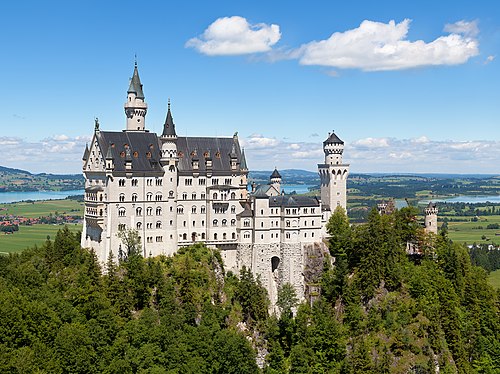 Neuschwanstein CastleStill standing · prime 1886
 Hohenzollern CastleRestored · prime 1867
 Eltz CastleStill standing · prime 1615
All castles in Germany → · Strongest castles in Germany → · Castles of Europe
Play As Your Clan
Hold a real castle against whatever you choose to send at it, take a ship out in her own service years, or stand at the shoulder of someone the record remembers. The chronicler sets the scene; the deeds are yours.