Wolf
also Wolff, Wolfe
The wolf, a Germanic name-word with a Hebrew twin.
- Origin
- German
- Famous bearer
- Christa Wolf (1929–2011), novelist
- Register
- German family
The Wolf arms

Coat of armsCoat of arms of De Wolf familyPerry, Calbraith B. (Calbraith Bourn), 1846-1914 · Public domain

- Coat of arms: Granted to an individual and inherited down that one documented line. These are the arms of particular families of the name, not of everyone who shares the surname.
The seat of Wolf
Seat vacantChief
No one leads the Wolf community yet. When the movement opens, you can stand for its leadership, or help elect whoever does.
Current mission
No shared goal set yet. Once Wolf has leadership, it sets the public focus: a restoration, a gathering, a real-world project that helps its own.
The Wolf clan is being rebuilt. Join the waiting list for the movement today, and you help decide who leads it and what it does.
Help rebuild the Wolf clan →What does the Wolf name mean?
From the old Germanic name-word wolf, borne in given names like Wolfgang and standing alone as a name in its own right. Among Ashkenazi Jews it renders the Hebrew Ze'ev, also 'wolf'.
The history of Wolf
The one name in the German top table that was never a job
Wolf is a given name and a surname at the same time, common among Germanic-speaking peoples alongside the variant Wulf. It comes out of the old stock of fierce-animal name-words, the element that supplies the first half of Wolfgang, and unlike most such elements it also stood alone as a name a man was called by. The Norse cousin of the word took a different road: in the given name Liulfr, in which ulfr is the wolf, it reached Scotland with Viking settlement and was worn down by the local languages into the surname Lyall.
Counted with Wolff, the name carries 0.1918 per cent of the German population, thirteenth on the list of the country's commonest surnames, immediately behind Lange and Lang. Almost everything above it is a job: Schmidt the smith at 0.87 per cent, Müller the miller at 0.83, then Meyer the farm steward, Schulz the constable, Schneider the tailor, Becker the baker, Fischer, Weber, Wagner. Those names arose independently all over Germany because every settlement had the work in it around 1600, when surnames were becoming heritable. Wolf did not. Nobody's occupation was wolf.
The estate, the house sign, and the clerk who fixed the spelling
Surnames came into German-speaking Europe gradually through the Late Middle Ages, sorting into four groups: given names, occupations, bodily attributes, and toponyms, the last of which includes named buildings. Wolf belongs squarely to the first and can belong to the last. Before streets had names and houses had numbers, what needed identifying were inns, mills and farmsteads, and they were given house names: Rothschild from a red sign, Bär from a bear, Lachs from the sign of the salmon. A wolf painted over a door did the same work.
In the countryside the Hofname, the name of the farm itself, was the first commoners' family name to become heritable, in the 14th and 15th centuries, because impartible inheritance tied one estate to one patrilineal line for generations. Ulrich Zwingli, born in 1484, bore a surname that had begun as a Hofname even though he never inherited the estate behind it. Where farm name and family name had parted company, documents joined them back up with genannt, as in Amann gen. Behmann, or in Austria with vulgo.
The spelling froze last of all. Before general official registration it varied from author to author and even from entry to entry in the same parish book, which is the whole reason Wolf, Wolff and Wolfe are one name written by three clerks. Those registers also entered women under regionally typical feminine forms, so that Peter Huber's sister was written down in the south as Anna Huberin.
Ze'ev's twin and the year the registers arrived
The name has a second life entirely. By the old practice of pairing a Hebrew name with a vernacular one of matching meaning, the Hebrew Ze'ev, wolf, travelled beside the German Wolf, and the German word became one of the standard Ashkenazi names. A single spelling ends up carrying two descents, Germanic in one branch and Hebrew in the other, with nothing on the page to tell them apart.
German-Jewish surnames are a special case because they were introduced late and by order, across the late 18th and early 19th centuries. Prussia enacted the Hoym Ordinance at Breslau in 1790, requiring Jewish families to take fixed surnames; Napoleon insisted on the same by decree in 1808. Where the authorities did the choosing the results could be invented and spiteful, as with Waldlieferant, forest supplier, coined to ridicule a Jewish timber trader. Where families chose for themselves the names are markedly poetical, Rosenzweig among them, and such ornamental surnames spread among Eastern Ashkenazi Jews in Germany and Austria in those same decades.
Wolf fits neither half of the pattern. It was not manufactured at a registry desk and it was not chosen as decoration. It was already in daily use as the vernacular partner of Ze'ev, so when the clerk asked for a surname there was nothing to invent.
One German in 413, one Saxon in 214
As of 2014, 53.2 per cent of the world's known Wolfs still lived in Germany, where the name is borne by one resident in 413. The United States held 27.4 per cent (one in 3,608), Austria 3.9 per cent (one in 596), Brazil 2.5 per cent, Switzerland 1.4 per cent, the Netherlands 1.2 per cent and France 1.0 per cent. That American quarter is the emigration record.
Inside Germany the name runs thickest in the east and the south-west. Saxony leads at one bearer in 214, then Rhineland-Palatinate at one in 292, Hesse and Thuringia both at one in 297, Bavaria at one in 337, Brandenburg at one in 365, Baden-Württemberg at one in 368 and Saxony-Anhalt at one in 394. All of those beat the national rate, which is another way of saying the flat north is where the Wolfs are scarce. Further out, the name belonged in Croatia to the industrialist Dragutin Wolf (1866-1927) and to Slavko Wolf (1862-1936), lawyer and writer.
Three Wolfs under the same sky
For a name with no trade behind it, Wolf produced a startling concentration of astronomers. Max Wolf (1863-1932) was a German astronomer, Rudolf Wolf (1816-1893) a Swiss astronomer and mathematician, and Marek Wolf a Czech one. Nothing on record connects them; three countries put three men under the same sky.
The mathematical and physical sciences kept the pattern going. Emil Wolf (1922-2018) was an American physicist, František Wolf (1904-1989) a Czech mathematician and Joseph A. Wolf (1936-2023) an American one, and Julia Wolf is a British mathematician. Jack Keil Wolf (1935-2011) worked as an American computer scientist, and Eric Wolf (1923-1999) was an American anthropologist.
The Austrian composer and the German novelist
Hugo Wolf (1860-1903) is the composer the name is best known for, an Austrian; Ernst Wilhelm Wolf (1735-1792) was a German composer of the century before, and Hanns Wolf (1894-1968) was a German composer and pianist. Music kept the name well past the concert hall: Kate Wolf (1942-1986) was an American folk singer and songwriter and Kati Wolf, born 1974, is a Hungarian singer.
In letters the anchor is Christa Wolf (1929-2011), the German writer who took the division of her own country as her subject and is the name's best-known modern bearer. Emma Wolf (1865-1932) was an American novelist and Joan Wolf, born 1951, an American writer. The name also belongs to Konrad Wolf (1925-1982), German film director, and to Joseph Wolf (1820-1899), the German illustrator whose subject was natural history, animals included.
A Hebraist, a rabbi and a Benedictine monk
The double descent shows up plainly among the scholars. Johann Christoph Wolf (1683-1739) was a German Hebraist and book collector. Abraham Wolf (1876-1948) was a Russian-born English historian, writer, philosopher and rabbi, holding all four at once, and Simon Wolf (1826-1923) an American businessman, lawyer, diplomat and Jewish activist. On the Christian side the religious line ran on too: Notker Wolf (1940-2024) was a German Benedictine monk and priest, and a musician and author besides.
The name in front, and the name on the shirt
Wolf never stopped being a forename either, which is unusual for a word that has also done duty as a surname since the late Middle Ages. Wolf Curt von Schierbrand (1807-1888) was a German zoologist and Wolf Hilbertz (1938-2007) a German architect. Wolf Mankowitz (1924-1988) was an English writer and Wolf Kahn (1927-2020) a German-born American painter, and Wolf Biermann, born 1936, is a German singer-songwriter.
Sport carried the surname wherever the emigrants went. Jenny Wolf, born 1979, is a German ice speed skater and Dustin Wolf, born 2001, an American ice hockey goaltender. Marius Wolf (born 1995) and Andreas Wolf (born 1982) are German footballers, and Wolfgang Wolf, born 1957, a German player and coach whose forename and surname are the same word twice. Wally Wolf (1930-1997) was an American swimmer and water polo player who came home an Olympic champion.
The castles of the homeland
The great strongholds of the homeland, look one up, see what it looked like in its prime, and recreate it to explore.
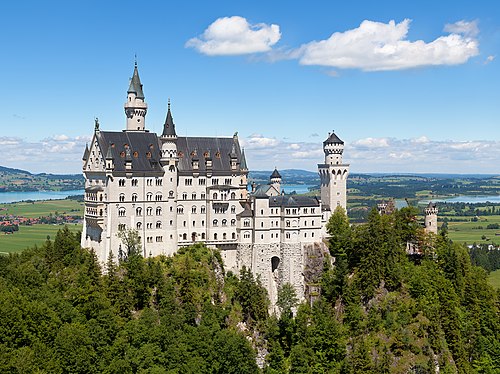 Neuschwanstein CastleStill standing · prime 1886
 Hohenzollern CastleRestored · prime 1867
 Eltz CastleStill standing · prime 1615
All castles in Germany → · Strongest castles in Germany → · Castles of Europe
Play As Your Clan
Hold a real castle against whatever you choose to send at it, take a ship out in her own service years, or stand at the shoulder of someone the record remembers. The chronicler sets the scene; the deeds are yours.
Notable bearers of the Wolf name
- Christa Wolf (1929–2011), novelist