Museum · England · Restored
Bletchley Park
Bletchley Park is a Victorian country house and estate in Buckinghamshire that became the principal British centre for wartime code-breaking during the Second World War. The site comprises the central red-brick mansion and a dispersed set of wooden huts and ancillary buildings; it now operates as a museum preserving the wartime sites and rooms.
First raised
1877
Its prime
1945
Today
Restored
As it stood in 1945
What Bletchley Park looked like in its prime.
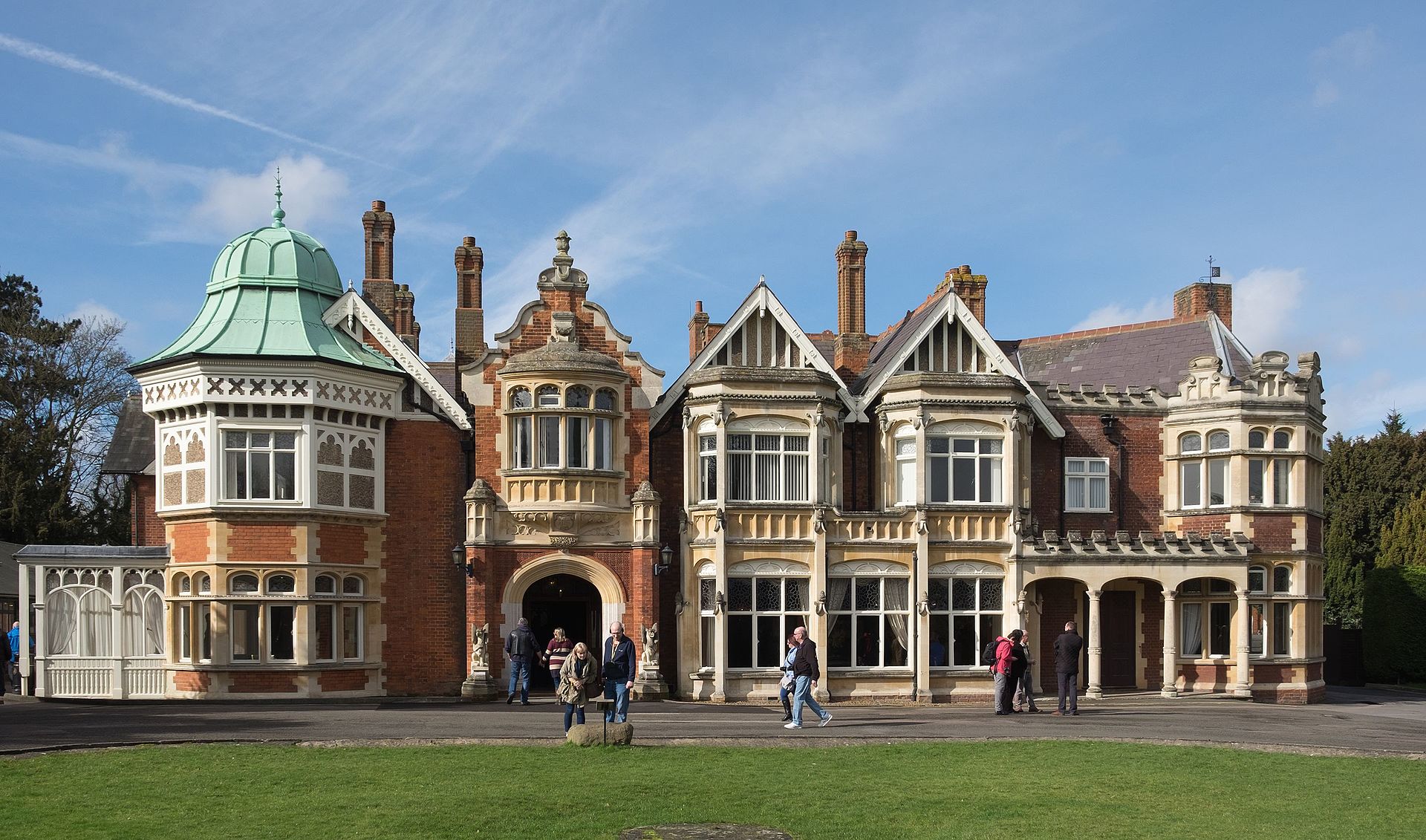
A broad, asymmetrical red-brick Victorian country house combining Gothic, Tudor and Dutch Baroque details: a central arched stone entrance flanked by projecting gabled bays with stone mullioned windows, tall clustered red-brick chimneys, and carved stone dressings. At the left is an octagonal pavilion capped by a low green copper dome and a white timbered veranda; the façade sits behind a clipped grass forecourt. Rooflines are steep and varied, window bays project on multiple levels, and the exterior shows intact stone ornament and brickwork.
Its story
The story of Bletchley Park.
A Country House Bought for a Coming War, 1877-1938
The architect Samuel Lipscomb Seckham bought the land in 1877 and built a house on it; the 581-acre estate was bought in 1883 by Sir Herbert Samuel Leon, who expanded the house. In May 1938 Admiral Sir Hugh Sinclair, head of the Secret Intelligence Service, bought the mansion and 58 acres for use in the event of war, paying £6,000 of his own money because the government said it had no budget. Sinclair's party inspected the place under the cover of "Captain Ridley's shooting party", and valued its position beside Bletchley station, where the Varsity Line between Oxford and Cambridge, whose universities were expected to supply many of the codebreakers, met the West Coast main line.
GC&CS Moves In, 1939-1940
An SIS sabotage school was testing explosives on the site from 15 June 1939; the codebreakers complained that the noise made them lose their concentration, and the testing was moved to Aston House in November. Five weeks before the outbreak of war, Warsaw's Cipher Bureau had revealed to French and British personnel what it had achieved against Enigma, and the Polish techniques and an Enigma clone sent over in August 1939 greatly increased a previously very limited British success. The first Government Code and Cypher School staff moved in on 15 August 1939 and the wooden huts went up from late that year. The only direct enemy damage came on 20-21 November 1940, from three bombs probably intended for the railway station; Hut 4 was shifted two feet off its foundation and winched back into place as work inside continued.
The Bombe, Tunny and Colossus, 1941-1945
The bombe, an electromechanical machine built to discover some of the daily settings of the German Enigma networks, was designed by Alan Turing and engineered by Harold 'Doc' Keen. When the German navy introduced a four-rotor Enigma for its Atlantic U-boats in February 1942, that traffic became unreadable for ten months. Mavis Lever, in Dilwyn Knox's section, solved the signals revealing the Italian Navy's operational plans before the Battle of Cape Matapan in 1941.
The Lorenz machine carrying German high-command messages was codenamed Tunny. Cryptanalysts in the Testery, named after its head Ralph Tester, worked out its logical structure without knowing its physical form, and the automatic machinery they devised culminated in Colossus, the world's first programmable digital electronic computer, built by Tommy Flowers and his team at the Post Office Research Station at Dollis Hill. It first worked operationally on 5 February 1944, and a Mark 2 was running on the morning of 1 June, in time for D-Day. The Colossus machines were operated mainly by Wrens in the Newmanry, named after its head Max Newman.
Nearly Nine Thousand Staff Under the Ultra Secret, 1941-1945
Six weeks after Churchill's visit of 9 September 1941, Turing, Welchman, Alexander and Milner-Barry, having failed to get enough staff, wrote to him directly; his response was "Action this day make sure they have all they want on extreme priority …". In January 1945, at the peak of the effort, 8,995 personnel were working at Bletchley and its outstations, about three-quarters of them women.
The intelligence was classified above Most Secret as the "Ultra secret". All staff signed the Official Secrets Act, and a 1942 security warning pressed discretion even within the park: "Do not talk at meals. Do not talk in the transport. Do not talk travelling. Do not talk in the billet." The Soviet mole John Cairncross, of the Cambridge Spy Ring, leaked Ultra material to Moscow.
Silence, Decay and the Bletchley Park Trust, 1946-2014
Codebreaking ended in 1946, and GC&CS, renamed the Government Communications Headquarters, moved to Eastcote that year and to Cheltenham in 1951. The thirty-year rule meant there was no official mention of the work until the mid-1970s; public discussion became accepted with the publication of F. W. Winterbotham's The Ultra Secret in 1974. Not until July 2009 did the British government fully acknowledge the contribution of those who worked there, with a commemorative medal.
The site passed through a succession of uses, among them a teacher-training college; Block F was demolished in 1987. The Bletchley Park Trust was set up in 1991, while the site was at risk of being sold off for housing, and in February 1992 Milton Keynes Borough Council declared most of the park a conservation area. It opened to visitors in 1993, and a 1999 lease gave the Trust control of most of the site. An £8 million restoration was completed in June 2014. The National Museum of Computing, opened in 2007, rents Block H and holds a rebuilt Colossus and a working bombe reconstruction.
From the sea
Ships that came to Bletchley Park.
- German cruiser Prinz Eugen: Bletchley Park confirmed her May 1941 sortie with Bismarck was imminent
Step inside
10 places to explore in 1945.
The record describes 10 distinct spots at Bletchley Park, including 8 interiors: central arched entrance and porch, ground-floor working rooms (naval, military, air sections), teleprinter room and more. Create your own photoreal reconstruction and explore every one, more scenes means more photos, more angles and more of the immersive experience.
Build Your Own Castle
Recreate Bletchley Park with AI to explore it.
The artist rebuilds it as it stood in 1945, a photoreal reconstruction that belongs to you alone. Pay with coins, no subscription needed.
Recreate Museum to Explore →Whose seat
Families who held Bletchley Park.
The families tied to Bletchley Park across its history, follow a name to its page.
Leon
Held by Sir Herbert Samuel Leon and his family from 1883 until 1937.
Nearby


