Ancient site · Scotland · Partial ruin
Skara Brae
Skara Brae is a stone-built Neolithic settlement on Mainland, Orkney consisting of a compact cluster of drystone houses linked by low passages. The site preserves ten houses with built-in stone furniture and simple drains and is interpreted as a domestic village occupied in the 4th–3rd millennia BCE. It is part of the Heart of Neolithic Orkney UNESCO property and is accessible to visitors today.
First raised
3179 BC
Its prime
3000 BC
Today
Partial ruin
As it stood in 3000 BC
What Skara Brae looked like in its prime.
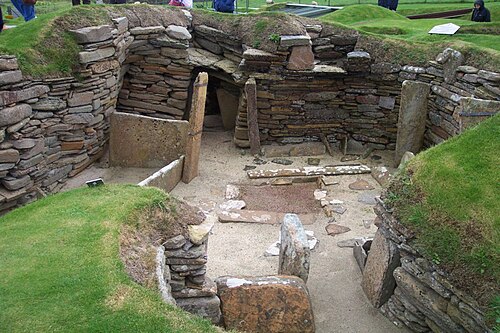
A low, compact group of drystone houses set into a grassy bank on a windswept coast. Thick flat sandstone slabs form walls, lintels and built-in furniture; internal floors are sand or packed earth. Interiors show fixed stone dressers and raised stone beds with short pillar stumps; narrow low doorways and short covered passages link houses. The palette is pale brown, grey and green from lichen and turf, and the cluster sits immediately above coastal sands and the bay.
Its story
The story of Skara Brae.
Uncovered by Storm, Dug by Watt and Childe
A severe storm in the winter of 1850 caused widespread damage across Scotland and more than 200 deaths. At the Bay of Skaill on Orkney's Mainland it stripped the earth from a large irregular knoll, and local villagers found the outline of a village of small roofless houses. William Graham Watt of Skaill House, son of the local laird and a self-taught geologist, dug there as an amateur; four houses were uncovered before the work was abandoned in 1868.
The site lay undisturbed until 1913, when a party with shovels plundered it over a single weekend, taking an unknown quantity of artefacts. After a storm swept away part of one house in 1924 it was determined that the site should be secured and properly investigated, and the job went to Professor V. Gordon Childe of the University of Edinburgh, who first travelled to Skara Brae in mid-1927. Photographs of Childe with four women at the dig were long read as showing tourists or local visitors; re-examined in 2019, a note on the back names them as four of his lady students, apparently active participants, tentatively identified as Margaret Simpson, Margaret Mitchell, Mary Kennedy and Margaret Cole.
Grooved Ware Houses: Hearths, Beds and Bone-Barred Doors
The inhabitants made and used grooved ware, a pottery style that had recently appeared in northern Scotland. The structures, once thought to be underground, are now understood as free-standing stone houses insulated and stabilised with midden. Each has a central hearth, beds on either side of it and a dresser against the wall facing the low doorway, which was closed by a stone slab and barred with bone sliding in holes cut into the jambs. Drains run beneath at least five of the houses, though the system has never been fully mapped.
Seven houses share the same furniture in the same positions, the larger bed to the right of the door and the smaller to the left. Lloyd Laing noted that this matched Hebridean custom into the early 20th century, suggesting the husband's bed was the larger; beads and paint pots in some of the smaller beds may support the reading. House 8 has no storage boxes or dresser, stands clear of the midden with walls over two metres thick, and its fragments of stone, bone and antler, with heat-damaged volcanic rock and an apparent flue, suggest tool-making.
Cattle, Barley and a Brew Laced with Henbane
The Grooved Ware people here were primarily pastoralists raising cattle, pigs and sheep. Childe believed they did not farm; excavations in 1972 unearthed seed grains from a midden, suggesting that barley was cultivated. Fish bones and shells are common in the midden, and limpets may have served as bait, kept in stone boxes of thin slabs sealed with clay. What burned in the hearths is unsettled: Childe was sure of peat, but analysis of vegetation trends suggests thick peat beds formed in this part of Orkney only after the village was abandoned; driftwood, dung and dried seaweed are other candidates.
Jars holding up to 30 litres were found in several dwellings; residue in one was analysed as an alcoholic drink of oats and barley seasoned with hemlock, deadly nightshade and henbane.
Redated to 3180 BC, Abandoned Around 2500 BC
Childe originally believed the settlement dated from around 500 BC. That reading was under increasing challenge by the time excavations in 1972–73 settled the question: radiocarbon samples put occupation from about 3180 BC, continuing for some six hundred years. Around 2500 BC, after the climate changed and became much colder and wetter, the village may have been abandoned.
Popular accounts favour a single catastrophic storm; Evan Hadingham pictured inhabitants taken by surprise, fleeing and leaving walrus-ivory pins and joints of meat behind. Anna Ritchie strongly disagrees, holding that the burial by sand was gradual and that the village had already been abandoned, for a reason no one can tell.
Seawall, Scheduling and the Heart of Neolithic Orkney
An unknown quantity of buildings had been lost to sea erosion before a seawall was raised. The site was scheduled as a monument on 27 March 1928, and in December 1999 was inscribed alongside Maeshowe, the Ring of Brodgar and the Standing Stones of Stenness as "The Heart of Neolithic Orkney". Care rests with Historic Environment Scotland, working with Orkney Islands Council, NatureScot and the Royal Society for the Protection of Birds; visitors are welcome year-round.
A 2019 risk assessment by Historic Environment Scotland, Orkney Islands Council and others judged the whole World Heritage Site, and Skara Brae in particular, "extremely vulnerable" to climate change, warning that the village could be partly destroyed by one unusually severe storm.
Step inside
9 places to explore in 3000 BC.
The record describes 9 distinct spots at Skara Brae, including 6 interiors: house interior: central hearth and dresser, house 8 workshop area and porch, low doorway with stone slab door and bar-holes and more. Create your own photoreal reconstruction and explore every one, more scenes means more photos, more angles and more of the immersive experience.
Build Your Own Castle
Recreate Skara Brae with AI to explore it.
The artist rebuilds it as it stood in 3000 BC, a photoreal reconstruction that belongs to you alone. Pay with coins, no subscription needed.
Recreate Ancient site to Explore →Nearby