
Austria · Partial ruin
Landskron Castle
Burg Landskron
Landskron Castle is a medieval hill castle on a rocky cone northeast of Villach in the Austrian state of Carinthia. Rebuilt and remodelled in a Renaissance manner in the mid-16th century, it was largely destroyed by lightning in 1812 and today survives as conserved, partly ruined walls which are a local tourist site with a falconry centre and visitor facilities.
First raised
1028
Its prime
1552
Today
Partial ruin
Ranked among Europe’s castles
As it stood in 1552
What Landskron Castle looked like in its prime.
Perched on a steep rocky cone, the castle forms a layered silhouette of concentric pale-grey stone curtain walls and terraces stepping down the slope. A prominent round tower with a conical roof rises from the inner ward, surrounded by a compact cluster of multi-storey stone residential ranges with pitched slate roofs and rectilinear windows. Crenellated parapets, rectangular corner towers and a fortified gate on the approach form an enclosed courtyard above a densely forested valley.
Its story
The story of Landskron Castle.
Carloman's Deed to the Ortenburg Purchase, 878–1330
The hill was occupied long before any castle stood on it: burial mounds, inscribed stones and swords of around 800 BC were recovered from the site, some of them later set into the walls of the castle's Kronensaal. The estates around Lake Ossiach appear in an 878 deed of the East Frankish king Carloman of Bavaria, who granted them to the monastery of Altötting he had founded shortly before. In the 1020s the lands were held by Count Ozi of the Chiemgau, probably a scion of the Otakar dynasty, who founded Ossiach Abbey nearby; a castle was raised here under the Counts of Sternberg, and one already stood on the rock cone when the Counts of Ortenburg bought the lordship in 1330.
The Habsburg Purchase and the Pawn Years, 1351–1511
Landskron itself is first named in a deed of 25 July 1351. The Habsburg duke Albert II of Austria, Carinthian duke since 1335, bought the fortress and had it rebuilt as an important stronghold within the Carinthian possessions of the Bamberg prince-bishops. The Habsburg rulers then pawned it out in turn: to the Counts of Celje, heirs of the Ortenburg line, whose burgrave at Landskron was named in 1423 as Andreas von Graben zu Sommeregg, and to the Lords of Stubenberg, who held it from 1436 to 1447. In 1511 Emperor Maximilian I bestowed the estate on the Knightly Order of Saint George at Millstatt, and the fortress decayed.
The Khevenhüller Seat and the Confiscation of 1628
No rebuilding followed the fire that struck the castle in 1542. In the same year Emperor Ferdinand I sold Landskron to the Ortenburg castellan Christoph von Khevenhüller, who made it his main residence and had it rebuilt in a lavish Renaissance style; from 1543 the family carried the style 'von Landskron'. In 1552 Khevenhüller received Emperor Charles V, who had fled to Carinthia before the Protestant troops of Elector Maurice of Saxony. By about 1600 the castle was a showpiece Renaissance seat with a double ring wall and seven towers, reckoned a centre of the province's social life.
Being Protestants themselves, the Khevenhüllers were stripped of Landskron during the Thirty Years' War, by order of Emperor Ferdinand II in 1628, in the expropriation of the Protestant nobility.
Dietrichstein Absence and the Lightning Fires, 1639–1914
In 1639 the castle passed to the Dietrichstein comital dynasty. After the Peace of Westphalia in 1648 the Khevenhüllers claimed it back and pressed a lawsuit for decades, without success. The Dietrichstein owners mostly resided on their Nikolsburg (Mikulov) estates in Moravia, and the castle decayed. Its exposed position brought repeated fires from lightning strikes: in the early 16th century, in 1542, in 1585, and finally in 1812, when a blaze devastated Landskron. The roof was not made good again and the building was left to fall in; the watchtower collapsed in 1914.
Conservation, the Adlerarena and the 2023 Vote
From 1953 the remains were conserved in a revitalisation led by Hans Maresch, and parts of the complex have been used as a restaurant since. The ruins stand at 658 metres on the Ossiach Tauern range northeast of Villach and are a listed monument under Austrian heritage protection. The Adlerarena falconry centre here holds public birds-of-prey displays through the summer half of the year, and a macaque enclosure sits nearby; in 2023 Landskron was voted the most beautiful place in Austria on the ORF programme 9 Plätze – 9 Schätze.
Step inside
8 places to explore in 1552.
The record describes 8 distinct spots at Landskron Castle, including 2 interiors: inner courtyard and residential range, inner gatehouse and passage to the upper ward. Create your own photoreal reconstruction and explore every one, more scenes means more rooms, more angles, and more of the place to stand in.
Build Your Own Castle
Recreate Landskron Castle with AI to explore it.
The artist rebuilds it as it stood in 1552, a photoreal reconstruction that belongs to you alone. Pay with coins, no subscription needed.
Recreate this castle →Defend this castle →Whose castle
Clans who held Landskron Castle.
The families that held Landskron Castle for a decade or more across its history, follow a name to its clan.
Ortenburg
Acquired the estates in 1330; the castle already stood when they took possession.
Habsburg
Purchased by Duke Albert II in 1351 and rebuilt as a stronghold; sold by Emperor Ferdinand I in 1542.
Khevenhüller
Bought by Christoph von Khevenhüller in 1542, who made it his main residence and rebuilt it in Renaissance style.
Dietrichstein
Passed to the Dietrichstein comital dynasty in 1639.
From the archive
Landskron Castle on paper: the measured plan and period views.
The survey plan and photographs below are the ground truth this page's reconstructions are checked against, drawn and photographed while the castle was still a working garrison. Every image is public-domain or openly licensed, with its source named.
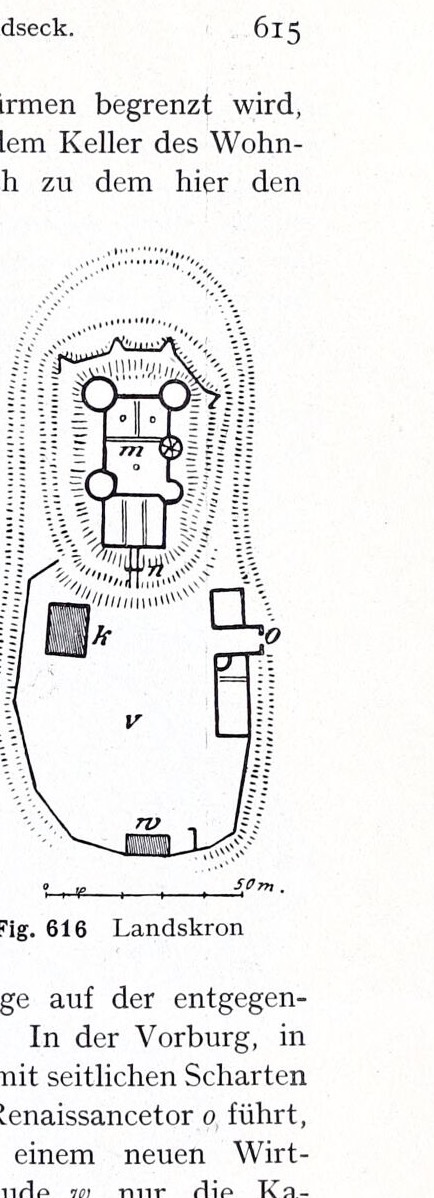
Fig. 616 Landskron
1912 · Otto Piper, Burgenkunde (1912)
Public domain


