
Austria · Restored
Schallaburg
Schallaburg is a Renaissance castle in Lower Austria near the Wachau valley, whose central Renaissance rebuilding began around 1540 under the Losenstein family. Today it houses a regional museum and is noted for its decorated arcaded court, patterned tower and historic gardens.
Its prime
1574
Today
Restored
As it stood in 1574
What Schallaburg looked like in its prime.
A long, pale plastered main range with two squarish corner towers and a steep red-brown tiled roof faces outward from a wooded hill; rows of rectangular windows punctuate the façade. Behind and above the main block rises a tall, cylindrical patterned tower with white panels, dark framing and a red domed cap. Remnants of older stone curtain walls sit behind the Renaissance range; formal gardens lie beside the castle.
Its story
The story of Schallaburg.
Schallaburg, near the Wachau valley in Lower Austria, was owned from the 13th to the 15th century by the lords of Zelking, and from 1456 until 1614 by the family von Losenstein, who began the central German-Renaissance rebuilding around 1540. In 1614 George von Stubenberg, father-in-law of George Christoph auf Losensteinleithen, bought the castle.
The castle combines a Romanesque residential castle and a Gothic chapel, patterned in the Italian Renaissance style, with a well-decorated two-storey arcaded court whose terracotta mosaics depict mythological figures, gods, masks, humans and animals, among them the legendary Hundefräulein, a female figure with a dog's head. Its Mannerist gardens hold roses, ornamental trees, herbs and two Renaissance apple orchards.
In 1967 the government of Lower Austria bought the castle from the Austrian state, and it now houses a regional museum. At the gate entrance stand two large 'smoke-spewing dragons', each thirty metres long and six metres high, a favourite entertainment spot for children, who slide down from the top of the mouth.
Step inside
8 places to explore in 1574.
The record describes 8 distinct spots at Schallaburg, including 4 interiors: two-storied arcaded court, cantilevered staircases in the courtyard, gothic chapel and more. Create your own photoreal reconstruction and explore every one, more scenes means more rooms, more angles, and more of the place to stand in.
Build Your Own Castle
Recreate Schallaburg with AI to explore it.
The artist rebuilds it as it stood in 1574, a photoreal reconstruction that belongs to you alone. Pay with coins, no subscription needed.
Recreate this castle →Defend this castle →Whose castle
Clans who held Schallaburg.
The families that held Schallaburg for a decade or more across its history, follow a name to its clan.
Zelking
Owned by the lords of Zelking from the 13th to the 15th century.
Losenstein
Held by the von Losenstein family, 1456–1614; builders of the Renaissance castle from around 1540.
Stubenberg
Bought by George von Stubenberg in 1614.
From the archive
Schallaburg on paper: the measured plan and period views.
The survey plan and photographs below are the ground truth this page's reconstructions are checked against, drawn and photographed while the castle was still a working garrison. Every image is public-domain or openly licensed, with its source named.
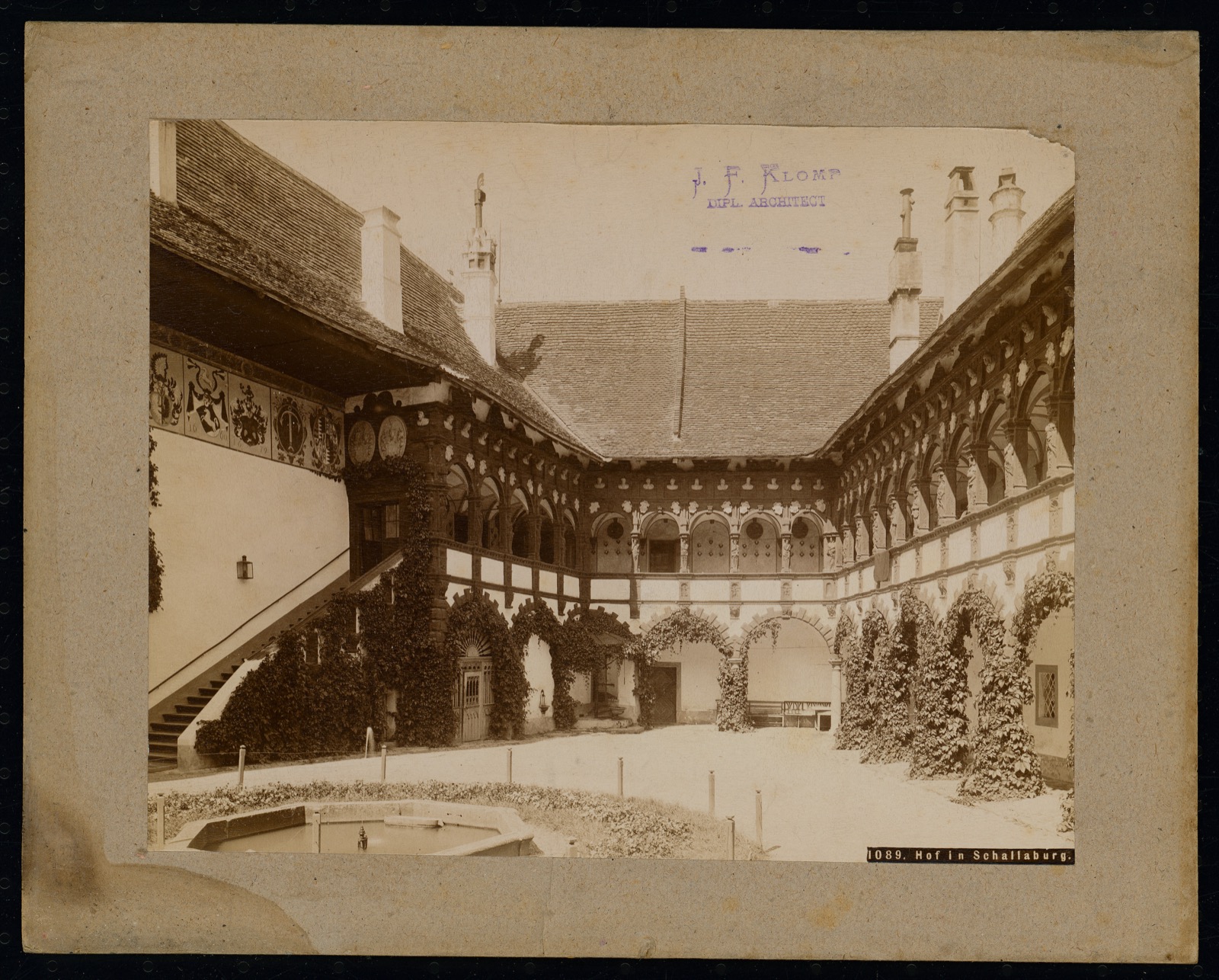
Schallaburg, Schallaburg: Burghof
· Museum of Architecture at Berlin Institute of Technology (via Europeana)
CC0 (no rights reserved)
Nearby


