
Czechia · Restored
Český Šternberk Castle
Hrad Český Šternberk
Český Šternberk Castle is a mid-13th-century Gothic castle perched on a steep granite cliff above the Sázava river in the Central Bohemian Region of the Czech Republic. Founded by Zdeslav of Sternberg, it retains medieval fortifications alongside later Baroque and Rococo interiors and remains owned by the Sternberg family. The castle functions as a restored residence and is open to the public as a historical site.
First raised
1241
Its prime
1760
Today
Restored
As it stood in 1760
What Český Šternberk Castle looked like in its prime.
Perched on a steep granite cliff on the west bank of the Sázava, the castle appears as a compact cluster of stone structures enclosed by a surrounding curtain wall and ramparts. A three‑storey northern tower is joined to the main circuit by a rampart; a cylindrical tower rises to the south; a named Dungeon sits in the northern sector. A lower palace adjoins the curtain wall. At the prime state (1760) the roofs, towers and defensive wall are complete and interiors show Baroque/Rococo finishing.
Its story
The story of Český Šternberk Castle.
Zdeslav of Divišov and the Golden Star, 1241
The castle was founded in 1241 by the Bohemian nobleman Zdeslav z Divišova (d. 1265) on a sharp rock above the middle Sázava, at about 350 metres. Its name came from his arms, a golden eight-pointed star (Stern and Berg, star and mountain), and he took the name Sternberg himself, under the motto "The star that never falls down". The early Gothic core is still the heart of the building, which is reckoned one of the best preserved Gothic castles in Bohemia.
Firearms and the Royal Siege, 14th Century to 1479
Long-range firearms found the castle unready in the 14th century: its 13th-century builders had not foreseen them, and the defences were strengthened with a three-storey tower to the north, linked to the castle by a rampart. The castle changed hands for the first time in the 15th century, passing to the Holický branch of the Sternbergs. In 1467 it was taken by the royal army of George of Poděbrady, the blame falling on Zdeněk Konopišťský of Sternberg (d. 1476), guardian of the young Petr II Holický (d. 1514) a member of the Zelená Hora League who had taken part in the revolt against the king. King Vladislaus Jagiellon returned castle and estate to the Sternbergs in 1479, and by the turn of the 15th and 16th centuries the ruined castle had been rebuilt and its defensive system renewed.
The Forward Bastion and the Siege Works on the Ridge
The forward bastion on the ridge south of the castle was built after the siege of 1467, or, by another reading, stood there already, with the battery tower inserted into it later in place of an older timber structure that Tomáš Durdík took for the garrison's cabin. The tower is polygonal, with a pronounced prow turned south, a spiral stair at the back, a cellar store that was probably the powder magazine, and five short passages running from a central round room to gun loops, one of them replaced by a portal through which cannon could be hauled up. Below it, against the wall, stood a log building with a tiled stove where the garrison lived.
The narrow passages left no room for carriage-mounted guns and gave hand weapons poor angles, and since similarly ineffective defences occur at other castles it is possible that the tower was only meant to demonstrate that the place could be defended, or that the weight of its defence rested on a lost top storey. Further south, earthworks that Dobroslava Menclová read as the siege camp of 1467–68 include a neck ditch up to seven metres deep, now partly filled, with a rampart along its outer side; their character and sheer bulk point rather to an extensive forward fortification of the castle's own, most likely stormed during the royal siege and turned to the besiegers' use.
The Holický Extinction and the Baroque Rooms, 1627–1760
The castle came through the looting of rebels in 1627, during the Thirty Years' War. When Imperial Count Jan Václav, High Burgrave of Moravia, died in 1712 the male line of the Holický branch ended and the castle passed by inheritance and sale to owners outside the family; in 1751 the lower palace was built against the surrounding wall, the last major work on the site. The stair holds 545 engravings, mostly scenes of the Thirty Years' War from the chronicle Theatrum Europaeum, among the largest single-subject collections of their kind in Europe. Rebuilding in Baroque and Rococo taste partly concealed the Gothic, above all indoors, where the Italian stuccoist Carlo Brentano decorated the halls and salons, dated to the 17th century by some accounts, to 1760 by others.
Expropriation, Restitution and the Sternbergs, 1841–2021
Zdeněk of Sternberg, of the Konopiště branch, bought the castle back in 1841, and his family held it until the state expropriated it in 1949. The Sternbergs moved to a small flat in Prague, and Jiří Sternberg (1888–1965) took the post of castellan on what had been his own property, showing visitors round; he compiled an inventory of the castle and so saved many of its original furnishings. Restitution returned Český Šternberk in 1992 to his son, Count Zdeněk Sternberg, and since Zdeněk's death in 2021 it has been administered by his son Filip Sternberg, born in 1956. It is protected as a cultural monument and, since 2008, as a national cultural monument, and is open to the public on a tour route of sixteen rooms.
Step inside
11 places to explore in 1760.
The record describes 11 distinct spots at Český Šternberk Castle, including 4 interiors: northern dungeon, lower palace (1751 addition), baroque/rococo stuccoed hall and more. Create your own photoreal reconstruction and explore every one, more scenes means more rooms, more angles, and more of the place to stand in.
Build Your Own Castle
Recreate Český Šternberk Castle with AI to explore it.
The artist rebuilds it as it stood in 1760, a photoreal reconstruction that belongs to you alone. Pay with coins, no subscription needed.
Recreate this castle →Defend this castle →Whose castle
Clans who held Český Šternberk Castle.
The families that held Český Šternberk Castle for a decade or more across its history, follow a name to its clan.
Sternberg
Constructed and named by the Sternbergs from 1241; bought back by the Konopiště branch in 1841 and restored to the family by restitution in 1992.
From the archive
Český Šternberk Castle on paper: the measured plan and period views.
The survey plan and photographs below are the ground truth this page's reconstructions are checked against, drawn and photographed while the castle was still a working garrison. Every image is public-domain or openly licensed, with its source named.
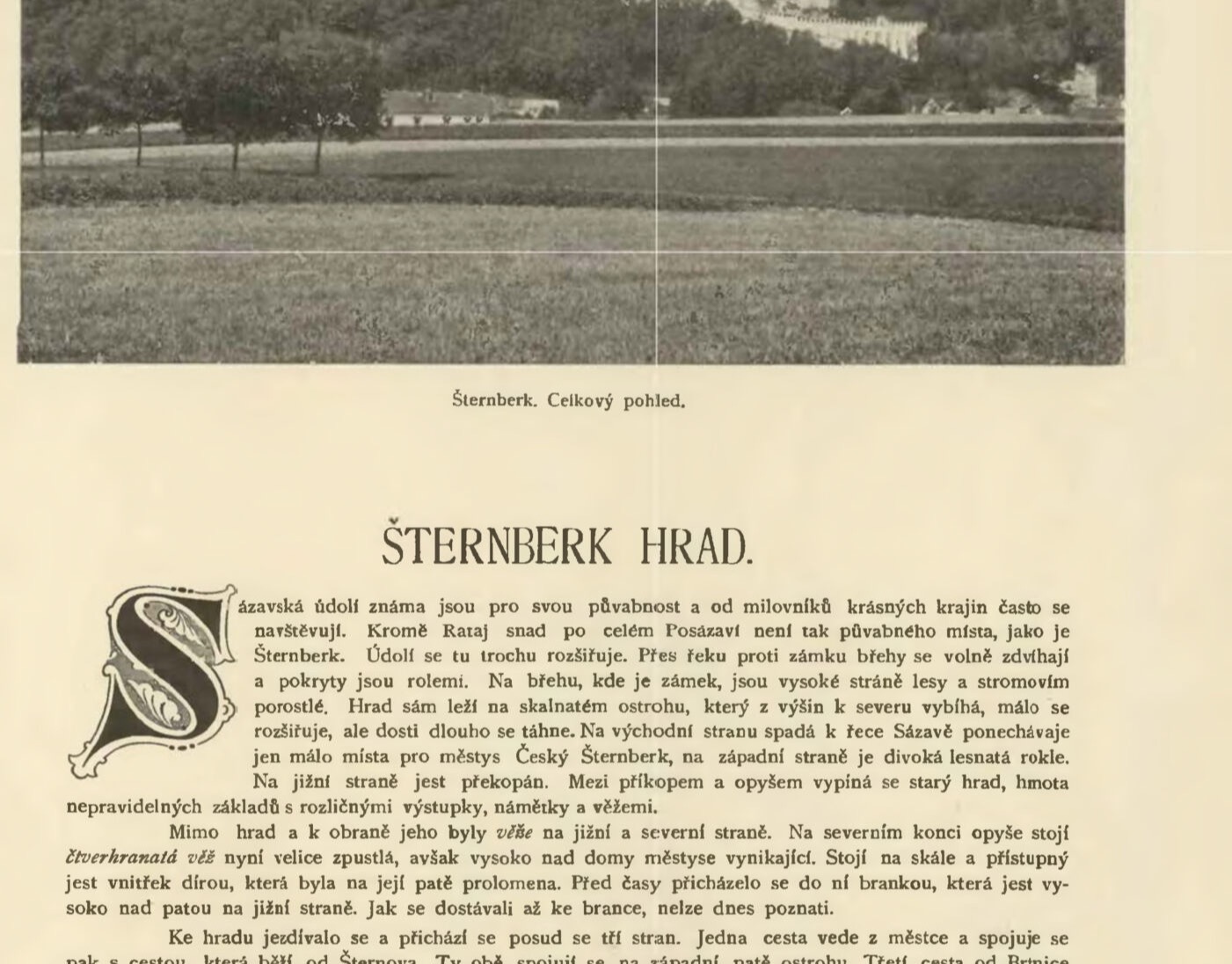
Šternberk. Celkový pohled.
1890s · A. Sedláček, Hrady, zámky a tvrze Království českého, díl 15 (1882–1927)
Public domain
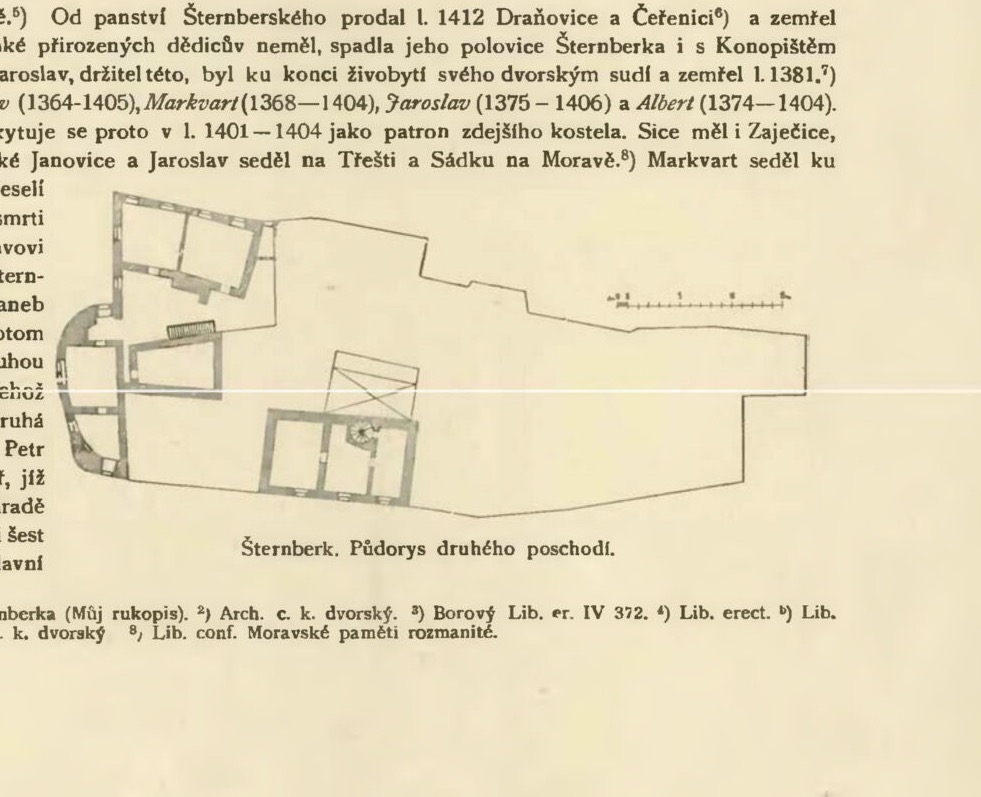
Šternberk. Půdorys přízemí.
1890s · A. Sedláček, Hrady, zámky a tvrze Království českého, díl 15 (1882–1927)
Public domain
Šternberk. Půdorys prvního poschodí.
1890s · A. Sedláček, Hrady, zámky a tvrze Království českého, díl 15 (1882–1927)
Public domain


