England · Ruin
Berwick Castle
Berwick Castle is a medieval fortress on a prominent mound at Berwick-upon-Tweed in Northumberland, England. Once a royal stronghold contested between England and Scotland, it survives today as fragmentary stone ruins integrated into the town's later defences and landscape.
Its prime
1483
Today
Ruin
As it stood in 1483
What Berwick Castle looked like in its prime.
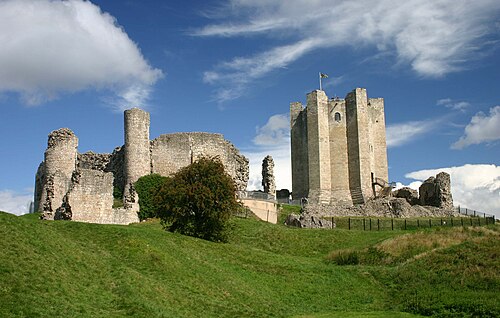
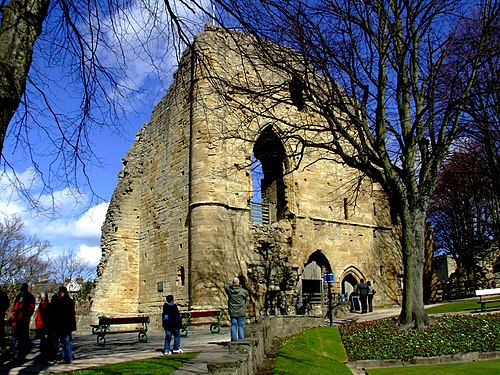
Berwick Castle sits atop a steep grassy mound above the river/shore, a long grey-brown rubble-stone curtain wall running along the slope with stepped crenellations and the broken silhouettes of towers at the skyline. Much of the castle is roofless masonry with thick wall faces, narrow window and arrow-slit openings, and terraces/platforms where a long gallery and walkways once ran; the footprint reads as a compact medieval enceinte with exposed inner courts and retaining banks.
Its story
The story of Berwick Castle.
David I's Castle and a Border Bought Back, 1120s–1292
Berwick Castle was commissioned by King David I of Scotland in the 1120s, and from the start it changed hands with the border itself. English forces took it under the terms of the Treaty of Falaise in 1175, but around 1190 Richard I of England sold it back to Scotland to fund the Third Crusade.
In November 1292 the castle briefly held the fate of a kingdom. Representatives of Edward I of England arrived in Berwick and announced, in the castle's great hall, Edward's adjudication of the disputed Scottish succession, in favour of John Balliol, over Robert the Bruce and the count of Holland.
The Wars of Independence and the Castle's Keepers, 1296–1435
Edward I's forces retook the castle in March 1296, at the opening of the First War of Scottish Independence; its keeper Sir William Douglas surrendered to the king following the Massacre of Berwick. English governors followed, among them Maurice de Berkeley and the Gascon Edmond de Caillou, who was killed at the Battle of Skaithmuir in 1316. In April 1318 the forces of Robert the Bruce recovered the castle for Scotland.
In 1330 Robert de Lawedre of the Bass, described as Custodian of the Marches and the Castle of Berwick, received £33 6s 8d from the Scottish Exchequer, apparently on leaving the office. By 1435, when Robert Ogle was captain, the castle was reckoned worth some £194 in peacetime, with another £200 to be paid in time of war.
Gloucester's Capture, August 1482
The Exchequer Rolls of Scotland record £20 paid to Robert Lauder of Edrington in 1464 for repairs to the castle, but Scotland's hold was nearly done. In the last week of August 1482, Richard, Duke of Gloucester captured Berwick Castle from Sir Patrick Hepburn, 1st Lord Hailes, the last Scottish governor, during his invasion of Scotland, and it never returned. Repairs planned in 1483 were entrusted to Alexander Lee, a royal chaplain, while the master carpenter of Berwick, George Porter, was ordered to build 120 houses in the town and chambers, a hall and a lodging in the castle.
Obsolete Behind the Elizabethan Ramparts
The modern ramparts thrown around Berwick in the late sixteenth century, under Elizabeth I, made the old castle obsolete, and it declined steadily. In August 1590 John Selby reported that a round tower serving as its only gun emplacement had collapsed in wet weather; repairs were costed at £200 in 1597, John Carey warning that the gap lay wide open to Scotland. The governor, Peregrine Bertie, 13th Baron Willoughby de Eresby, judged the place "scarcely defended with so good a wall as an ancient monastery's orchard"; it was patrolled by old veteran soldiers, and the surveyor of fortifications recommended demolition. In October 1600 Bertie was said to have rebuilt some structures for his own use and pleasure.
Dunbar's Unfinished Mansion and the Railway, 1603–1847
After the Union of the Crowns in 1603 the garrison town was run down, and the Scottish courtier George Home, 1st Earl of Dunbar began a great house on the castle site, with James Murray of Kilbaberton, master of royal building work in Scotland, involved in the construction. The mansion was never finished but was widely rumoured to be magnificent: George Chaworth wrote in 1607 of its size, height and views, and that its long gallery would make Worksop Manor's look like a garret; the gallery had a mantlepiece five yards long and a flat roof for promenaders to view the landscape. William Brereton, visiting in 1633, recorded that the work had ended at the Earl's death in 1611.
The castle was then quarried rather than kept. Large parts of its structure were reused as masonry in the seventeenth century, including in the building of the parish church of Holy Trinity during the Commonwealth, and in 1847 the great hall itself (where a king of Scots had been named) was demolished to make way for Berwick-upon-Tweed railway station on the North British Railway.
Step inside
7 places to explore in 1483.
The record describes 7 distinct spots at Berwick Castle, including 2 interiors: great hall (interior), long gallery and roof platform. Create your own photoreal reconstruction and explore every one, more scenes means more rooms, more angles, and more of the place to stand in.
Build Your Own Castle
Recreate Berwick Castle with AI to explore it.
The artist rebuilds it as it stood in 1483, a photoreal reconstruction that belongs to you alone. Pay with coins, no subscription needed.
Recreate this castle →Defend this castle →From the archive
Berwick Castle on paper: the measured plan and period views.
The survey plan and photographs below are the ground truth this page's reconstructions are checked against, drawn and photographed while the castle was still a working garrison. Every image is public-domain or openly licensed, with its source named.
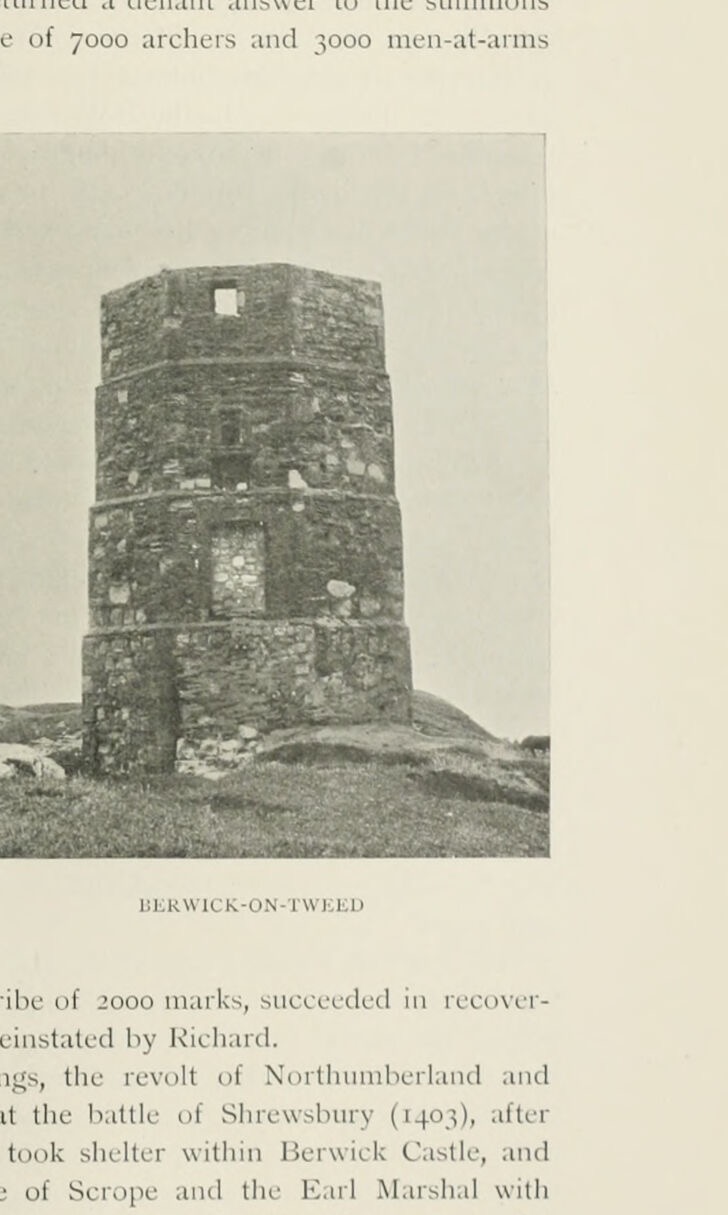
BERWICK-ON-TWEED
1897 · J. D. Mackenzie, The Castles of England, vol. 2 (1897)
Public domain