England · Ruin
Dudley Castle
Dudley Castle is a medieval castle sited on Castle Hill in Dudley, West Midlands, England. The surviving remains include a motte with the ruined keep, long ranges of stone buildings within the bailey and a large main gatehouse, all set on an outcrop of limestone.
First raised
1070
Its prime
1550
Today
Ruin
As it stood in 1550
What Dudley Castle looked like in its prime.
Perched on a limestone motte and set within an oval bailey, the castle presents a long stone curtain with a three-storey domestic range to one side (the Sharington Range) featuring tall rectangular mullioned windows and steep gabled roofs, and a rectangular keep with four drum towers atop the motte; grey local limestone walls and arched gateways connect the keep and the main gatehouse, while grassy courtyard and a surrounding dry moat define the forecourt.
Its story
The story of Dudley Castle.
Fitz-Ansculf's Castle in Domesday, 1086
The antiquarian William Camden claimed a castle stood at Dudley around the year 700, built by a Mercian duke named Dodo, but historians today date the castle from soon after the Norman Conquest: it is thought that Ansculf de Picquigny, one of the Conqueror's followers, raised the first castle in 1070. The Domesday Book of 1086 records his son William Fitz-Ansculf in possession, its entry for Dudley opening: "the said William held Dudley; and there is his castle". That earliest castle was of wood and is long gone, though its vast motte still carries the present keep.
Slighted by Henry II, Rebuilt by the Somerys
After Fitz-Ansculf the castle passed to the Paganel family, who built the first stone castle on the site, strong enough to withstand a siege by King Stephen's forces in 1138. But when Gervase Paganel joined the failed rebellion against Henry II in 1173, the king ordered the castle demolished, one of at least 21 slighted on his instructions according to the historian Sidney Painter.
The Somerys succeeded when Ralph de Somery inherited from his uncle Gervase Paganel in 1194, and in 1262 Roger de Somery II began rebuilding. The work was far from finished at his death in 1272 and carried on into the fourteenth century under his heirs; the keep and main gate date from this rebuilding, and the fortifications are thought to have been complete by 1321, when John Somery, last of the male line, died.
Suttons, Despensers and the Duke of Northumberland
The castle and estates passed to John Somery's sister Margaret and her husband John de Sutton, whose family often used Dudley as a surname. Within a few years the property was seized by the younger Hugh Despenser, favourite of Edward II, who held it from 1325 until the king's fall in 1326; it was returned to John and Margaret in 1327. A chapel and great chamber were probably added under their son John Sutton II.
In 1532 another John Sutton inherited, but money problems saw him ousted in 1537 by a relative: John Dudley, later Duke of Northumberland, great-grandson of John Sutton, 1st Baron Dudley. From around 1540 Dudley erected a range of new buildings within the old walls to designs by William Sharington; Historic England calls the Sharington Range one of the earliest known examples of Italian Renaissance influence on the secular architecture of the West Midlands. Dudley was executed in 1553 for his attempt to put Lady Jane Grey on the throne, and Queen Mary returned the castle to the Suttons. Elizabeth I visited in August 1575, and the castle was considered as a possible prison for Mary, Queen of Scots.
Colonel Leveson's Garrison, 1644-1646
In the First English Civil War the castle was held for the king by Colonel Thomas Leveson, a local Catholic later named by Parliament in 1651 as one of only 25 former Royalists subject to perpetual banishment and confiscation. Besieged by Parliamentary forces in 1644, the garrison finally surrendered to Sir William Brereton on 13 May 1646. The castle was partly demolished to prevent its reuse (the ruined state of the keep dates from that decision), though some habitable buildings remained for occasional use by the Earls of Dudley, who by then preferred Himley Hall, some four miles away.
The Fire of 1750 and the Zoo on Castle Hill
In July 1750 a fire, believed accidental, devastated the Tudor residential buildings and left the castle a ruin. The nineteenth century recast it as a romantic ruin: the Earls of Dudley tidied the site, reconstructed battlements on one tower, and in June 1857, during one of the Dudley Castle Fêtes, installed two Russian cannon captured in the Crimean War. In 1937 Dudley Zoo opened in the castle grounds, the idea of the castle's owner William Ward, 3rd Earl of Dudley. The Grade I listed ruins were placed on Historic England's Heritage at Risk register in 2020 after localised structural problems.
Step inside
9 places to explore in 1550.
The record describes 9 distinct spots at Dudley Castle, including 4 interiors: gate passage and guardroom, sharington range, great hall, sharington range, kitchen and servery and more. Create your own photoreal reconstruction and explore every one, more scenes means more rooms, more angles, and more of the place to stand in.
Build Your Own Castle
Recreate Dudley Castle with AI to explore it.
The artist rebuilds it as it stood in 1550, a photoreal reconstruction that belongs to you alone. Pay with coins, no subscription needed.
Recreate this castle →Defend this castle →Whose castle
Clans who held Dudley Castle.
The families that held Dudley Castle for a decade or more across its history, follow a name to its clan.
Paganel
Held after Fitz-Ansculf; the Paganels built the first stone castle on the site, until 1194.
Somery
Held by the Somerys from 1194, when Ralph de Somery succeeded his uncle Gervase Paganel.
Held by the Suttons from the Somery inheritance of Margaret and John de Sutton until 1537; the family often used Dudley as a surname.
Dudley
Held by John Dudley, later Duke of Northumberland, from 1537; he built the residential range within the fortifications.
From the archive
Dudley Castle on paper: the measured plan and period views.
The survey plan and photographs below are the ground truth this page's reconstructions are checked against, drawn and photographed while the castle was still a working garrison. Every image is public-domain or openly licensed, with its source named.
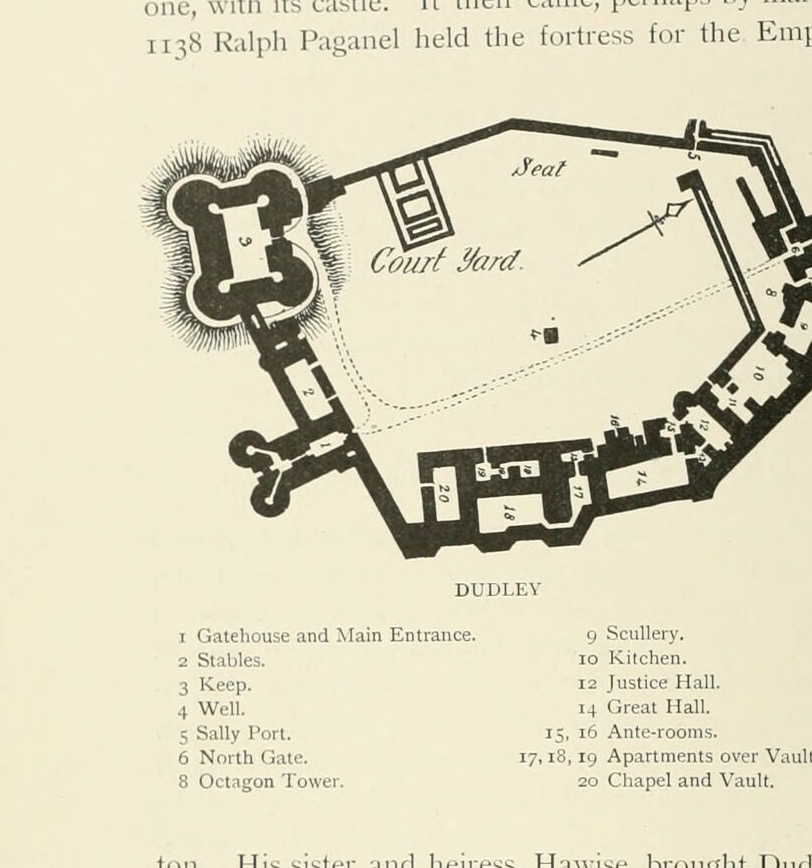
DUDLEY
1897 · J. D. Mackenzie, The Castles of England, vol. 1 (1897)
Public domain
Nearby