England · Restored
Dunster Castle
Dunster Castle sits atop the Tor overlooking the village of Dunster in Somerset. The site developed from an early motte-and-bailey into a medieval castle with a later Jacobean mansion in the Lower Ward and substantial Victorian Gothic remodelling in the 19th century. It is now a National Trust property and a Grade I listed building.
Its prime
1870
Today
Restored
As it stood in 1870
What Dunster Castle looked like in its prime.
Perched on a steep wooded hill (the Tor), the composition shows a dominant upper ward keep and a lower-ward Jacobean manor with square corner towers and a symmetrical stone front. A separate multi-storey gatehouse built of Bristol red sandstone stands at right-angles to the approach. Stone is pale ash to warm sandstone with areas of red sandstone dressings; roofs are stone-tiled with multiple gables and crenellated parapets. At prime the roofs, mullioned windows and battlements are complete and intact.
Its story
The story of Dunster Castle.
William de Mohun's Landing and the Anarchy Siege, 1066–1138
The summit of the Tor carried an Anglo-Saxon burh, held by the mid-11th century by a nobleman called Aelfric. After Hastings the conquest of the south-west fell to Robert of Mortain; while he marched into Somerset, a force under William de Mohun landed by sea on the coast. Granted 68 manors in the region, de Mohun had established a motte-and-bailey castle at Dunster by 1086, the caput of his new lands, guarding against fresh sea-borne attack and controlling the coastal road from Somerset to Gloucestershire. Stone fortifications, probably a shell keep on the motte, followed in the early 12th century.
When England descended into the Anarchy, de Mohun's son William was a noted supporter of the Empress Matilda, and Dunster was considered one of her faction's strongest castles in the south-west. Forces loyal to King Stephen besieged it in 1138, but William held out and was made Earl of Somerset by the grateful Empress; chroniclers complained that he then raided and controlled the region by force.
From Mohun to Luttrell for 5,000 Marks
In the 13th century Reynold Mohun rebuilt the Lower Ward in stone, paying for it partly by commuting his tenants' feudal duty of wall-repair into a one-off payment, and partly through marriage to a rich local heiress. By 1266 the Upper Ward held halls, a kitchen, a bakehouse and the chapel of Saint Stephen, guarded by three towers; the Fleming Tower below served as a prison.
When Sir John de Mohun, childless and in debt, died in 1376, his widow Joan agreed to sell the castle to Lady Elizabeth Luttrell for 5,000 marks, to transfer on Joan's death. Joan outlived Elizabeth, and Sir Hugh Luttrell (Henry V's seneschal in Normandy) took possession in 1404. He spent £252 on the neglected castle, building the three-storey Great Gatehouse of Bristol red sandstone between 1419 and 1424: a grand, if ill-defended, ceremonial entrance.
Lancastrian Loyalty and Arnold's Jacobean Mansion
The Luttrells backed the House of Lancaster in the Wars of the Roses. Sir James Luttrell died following the Lancastrian defeat at the Second Battle of St Albans in 1461, and Edward IV stripped the family of their estates, giving Dunster to the Herberts; the Luttrells regained it when Henry VII took the throne in 1485. By 1542 John Leland found the keep and buildings in considerable disrepair, and by 1571 the castle was dilapidated.
In 1617 George Luttrell employed William Arnold (builder of Montacute and Wadham College, Oxford) to raise a Jacobean mansion within the old castle walls in the Lower Ward, with a symmetrical front and square towers. The project ran almost three times over budget, costing more than £1,200.
Blake's Siege and the Slighting, 1642–1650
In the Civil War Thomas Luttrell held Dunster for Parliament, and when the Royalist William Seymour attacked in 1642 the garrison, led by Thomas's wife Jane, repulsed him. The war in the south-west then turned for the King, and after a second Royalist assault on 7 June 1643 Luttrell switched sides. Colonel Francis Wyndham became Royalist governor, and the future Charles II stayed at the castle in May 1645.
That October Colonel Robert Blake led a Parliamentarian force against Dunster; in November he set artillery in the village and mined beneath the walls. The castle was briefly relieved in February 1646, but the siege resumed, and in April Wyndham negotiated an honourable surrender. When Parliament ordered castles in Royalist areas slighted, George Luttrell persuaded the authorities to destroy only the medieval walls: 300 workmen demolished them over 12 days in August 1650, sparing the Great Gatehouse, the bases of two towers, and the mansion, damaged but still habitable.
Salvin's Victorian Remodelling and the Last Luttrells
Francis Luttrell modernised the castle in the 1680s, and in November 1688 mustered infantry companies at Dunster in support of William of Orange, the basis of the later Green Howards regiment. George Luttrell, inheriting in 1867, employed Anthony Salvin to remodel the castle between 1868 and 1872 at a cost of £25,350, adding asymmetrical towers, gas lighting, central heating and a 40,000-gallon underground reservoir, a castle meant to seem to have grown up organically over time.
The castle served as a convalescent home for injured naval and American officers in 1943–44. When Alexander Luttrell died in 1944 the death duties proved crippling: his son Geoffrey sold the castle and 8,600 acres to the Ashdale Property Company in 1949, staying on as tenant, and bought the castle back in 1954. In 1976 Colonel Sir Walter Luttrell gave Dunster and most of its contents to the National Trust, ending the Luttrell occupation begun in 1404.
Step inside
9 places to explore in 1870.
The record describes 9 distinct spots at Dunster Castle, including 3 interiors: great gatehouse apartments, chapel of saint stephen, kitchen and bakehouse area. Create your own photoreal reconstruction and explore every one, more scenes means more rooms, more angles, and more of the place to stand in.
Build Your Own Castle
Recreate Dunster Castle with AI to explore it.
The artist rebuilds it as it stood in 1870, a photoreal reconstruction that belongs to you alone. Pay with coins, no subscription needed.
Recreate this castle →Defend this castle →Whose castle
Clans who held Dunster Castle.
The families that held Dunster Castle for a decade or more across its history, follow a name to its clan.
Mohun
Held by the de Mohuns from the Norman Conquest, one William de Mohun was made Earl of Somerset, until the sale agreed in 1376.
Luttrell
Sold to Lady Elizabeth Luttrell in 1376; the family occupied Dunster until giving it to the National Trust in 1976.
From the archive
Dunster Castle on paper: the measured plan and period views.
The survey plan and photographs below are the ground truth this page's reconstructions are checked against, drawn and photographed while the castle was still a working garrison. Every image is public-domain or openly licensed, with its source named.
Dunster Castle
1897 · J. D. Mackenzie, The Castles of England, vol. 2 (1897)
Public domain
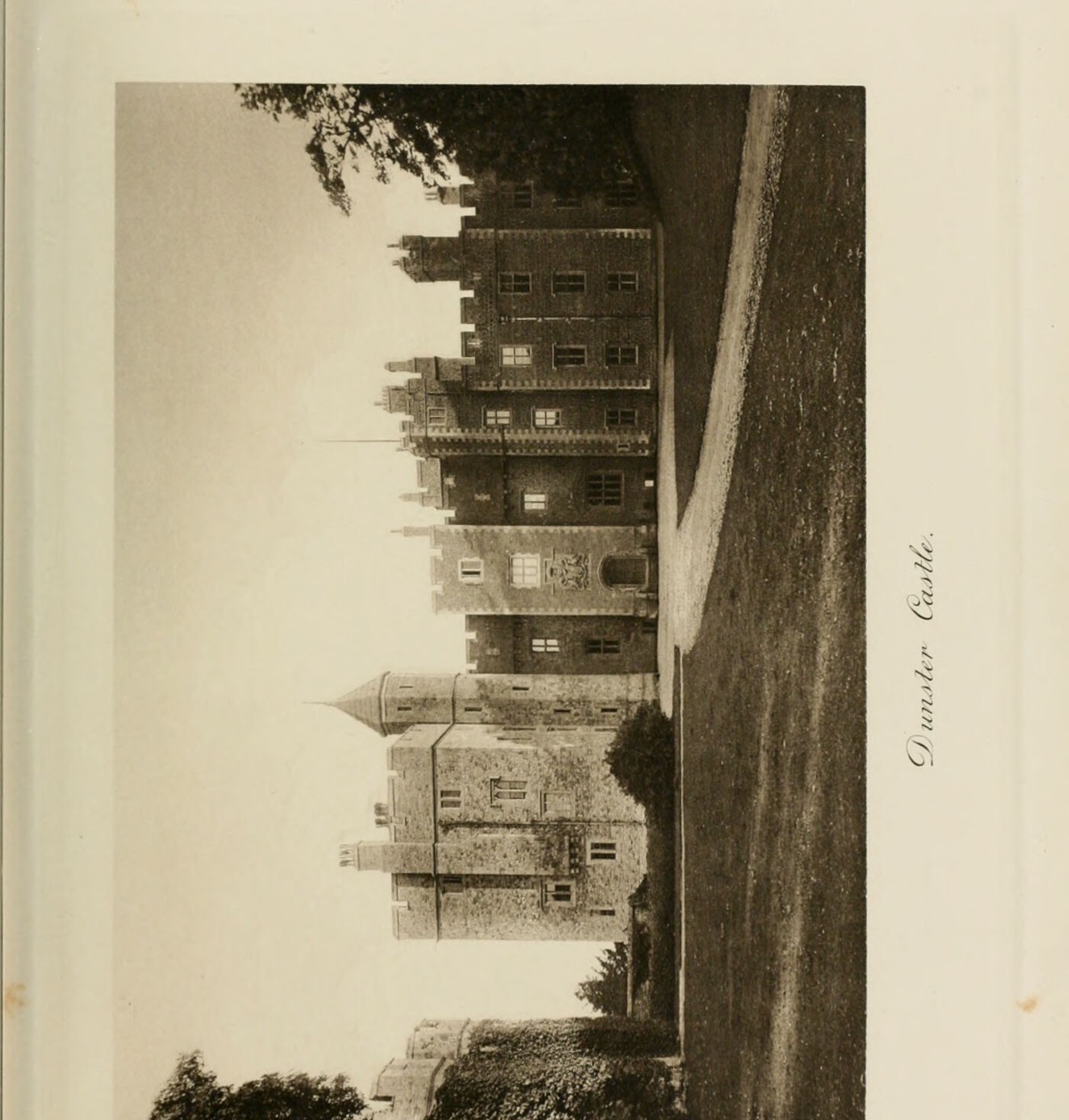
Dunster Castle.
1897 · J. D. Mackenzie, The Castles of England, vol. 2 (1897)
Public domain
Nearby