England · Partial ruin
Leicester Castle
Leicester Castle is a medieval castle complex in the city of Leicester, Leicestershire. Substantial surviving elements are the motte, the medieval Great Hall, the Church of St Mary de Castro, and the partly-ruined Turret Gateway; the site later served administrative and judicial functions and is a scheduled monument.
First raised
1060
Its prime
1300
Today
Partial ruin
As it stood in 1300
What Leicester Castle looked like in its prime.
A thick stone curtain wall pierced by a large pointed arched gateway formed of two concentric arches dominates the scene; the masonry is a patchwork of pale grey-buff and red-tinged sandstone blocks. Projecting turret bases and irregular window and doorway voids sit above the arch, and the gateway forms a passage through the town wall onto a cobbled street. At its prime the gateway and adjoining curtain walls rose to full upper storeys and a continuous roofline enclosing the bailey.
Its story
The story of Leicester Castle.
A Norman Motte on the Bank of the Soar
Leicester Castle was built into the south-western corner of the town, over the Roman walls on the eastern bank of the River Soar, and formed part of the medieval town defences. It was probably raised around 1070, soon after the Norman Conquest, under the governorship of Hugh de Grandmesnil. The mound thrown up in that first wave of work originally stood 40 feet high.
The Beaumont Earls and the Slighting of 1173
In 1107 Henry I made Robert de Beaumont, Count of Meulan, the first Earl of Leicester and granted him the castle and the old Roman town. Beaumont built substantially in the bailey and founded a college of priests to serve a chantry in the castle chapel and the pastoral needs of his household.
In 1173 the three eldest sons of Henry II led a rebellion against their father with the backing of several magnates, Robert de Beaumont, 3rd Earl of Leicester, among them. Henry's forces laid siege to Leicester and burnt most of the town. The castle was then slighted, partially demolished, with parts of its ditches filled in. By Sidney Painter's count it was one of at least twenty-one castles pulled down on Henry II's instructions.
Montfort, Lancaster and the Parliament of Bats
The earldom passed to the House of Montfort from 1239 to 1265, and after 1267 to the House of Lancaster, when the earldoms of Leicester and Lancaster were combined. Kings stayed here from time to time, Edward I in 1300, Edward II in 1310 and again in 1311. Henry of Grosmont, 1st Duke of Lancaster and one of the leading captains of the early Hundred Years' War, died at the castle on 23 March 1361. Constance of Castile died here in 1394 and her husband John of Gaunt in 1399.
Under Henry IV, Henry V, Henry VI and Edward IV the castle was an official royal residence, but by the middle of the 15th century it was no longer thought suitable for one and served mainly as a courthouse, with sessions held in the Great Hall. The hall also housed sittings of the Parliament of England, most notably the Parliament of Bats in 1426, convened here when conditions in London were unsuitable.
Gun Loops for the Siege of 1645
When the main royalist field army under Charles I and Prince Rupert besieged, took and ransacked parliamentarian Leicester on 31 May 1645, the garrison punched firing ports through the medieval castle wall beside the Turret Gateway; those gun loops are still there in the masonry. The gateway itself lost its third storey much later, wrecked in an election riot in 1832.
The Assize Court in the Great Hall, to 1981
For centuries the Great Hall was the home of the Leicester County Assizes. In the 1880s J. M. Barrie attended the assize courts regularly, spending many hours inside as a reporter for the Nottingham Journal. Assizes and quarter sessions continued to sit here, and after 1972 the hall took hearings of Leicester Crown Court, until the new Leicester Law Courts in Wellington Street were completed in 1981.
Step inside
9 places to explore in 1300.
The record describes 9 distinct spots at Leicester Castle, including 3 interiors: turret gateway passage, turret gateway upper chambers, great hall (interior/main chamber). Create your own photoreal reconstruction and explore every one, more scenes means more rooms, more angles, and more of the place to stand in.
Build Your Own Castle
Recreate Leicester Castle with AI to explore it.
The artist rebuilds it as it stood in 1300, a photoreal reconstruction that belongs to you alone. Pay with coins, no subscription needed.
Recreate this castle →Defend this castle →Whose castle
Clans who held Leicester Castle.
The families that held Leicester Castle for a decade or more across its history, follow a name to its clan.
Beaumont
Seat of the Beaumont Earls of Leicester from 1107, when Robert de Beaumont was granted the castle by Henry I, until 1175.
Montfort
Held by the House of Montfort as Earls of Leicester, 1239–1265.
Lancaster
With the House of Lancaster from 1267, when the earldoms of Leicester and Lancaster were combined.
From the archive
Leicester Castle on paper: the measured plan and period views.
The survey plan and photographs below are the ground truth this page's reconstructions are checked against, drawn and photographed while the castle was still a working garrison. Every image is public-domain or openly licensed, with its source named.
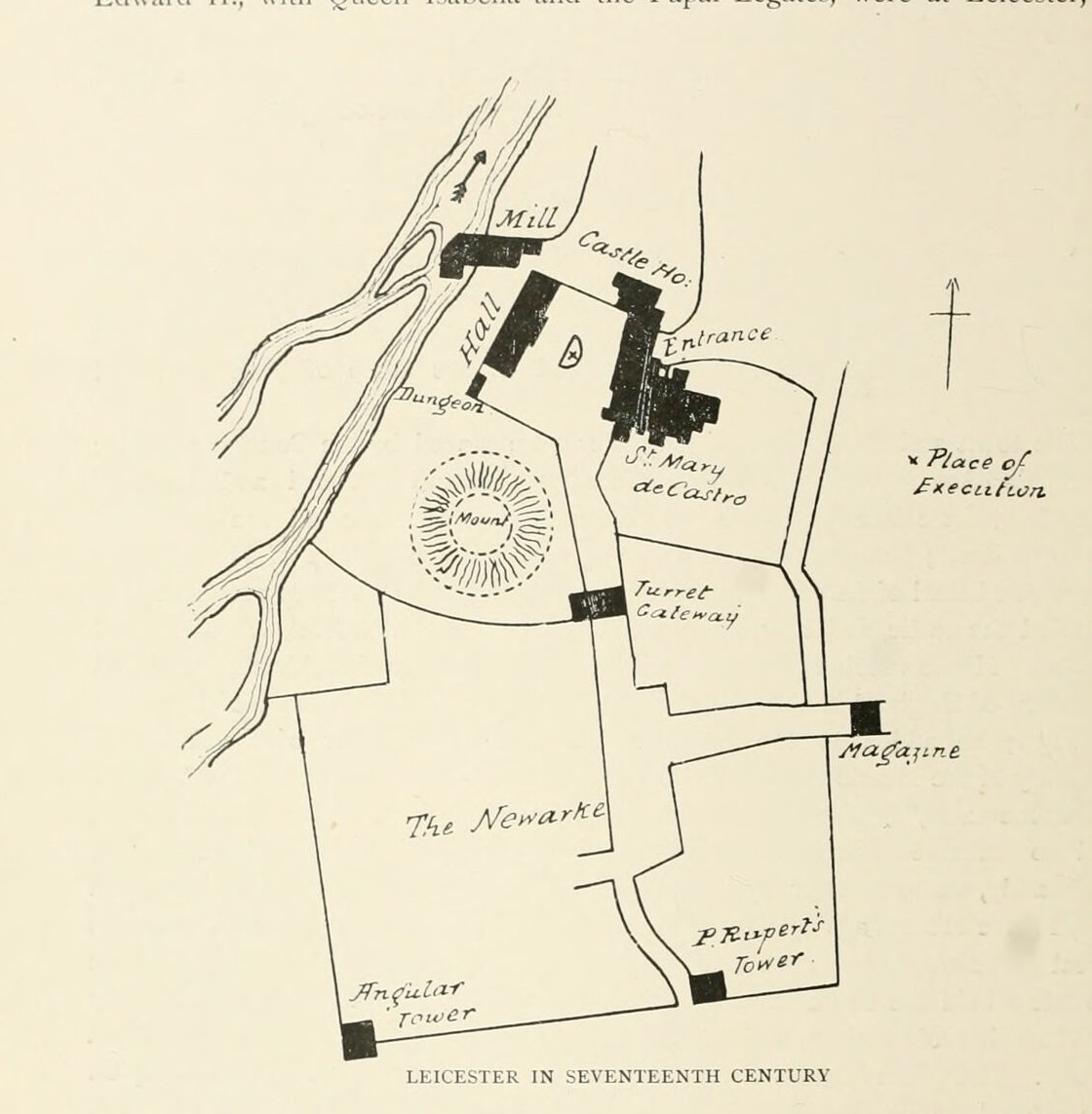
LEICESTER IN SEVENTEENTH CENTURY
1897 · J. D. Mackenzie, The Castles of England, vol. 1 (1897)
Public domain
Nearby