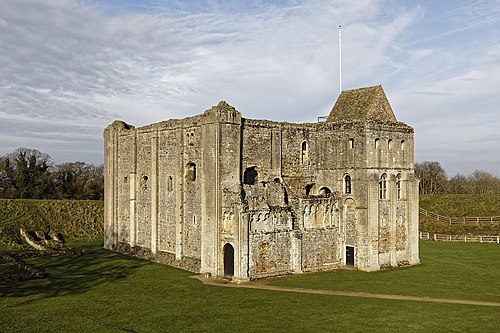
England · Partial ruin
Wingfield Castle
Wingfield Castle is a 14th-century fortified manor house in Wingfield, Suffolk, England, long associated with the Wingfield and de la Pole families and now a privately owned Grade I listed building. The site is a roughly square, moated enclosure whose surviving fabric includes a high south curtain wall, a prominent gatehouse with portcullis groove, several tall towers and an internal ward.
First raised
1384
Its prime
1430
Today
Partial ruin
As it stood in 1430
What Wingfield Castle looked like in its prime.
A roughly square moated enclosure of about 1.5 acres with flint-cobble curtain walls and stone quoins; two main cylindrical towers rising to about 60 ft and octagonal corner towers to about 50 ft punctuate the corners. The south curtain wall stands approximately 42 ft above the moat and is pierced by a noble gatehouse approached by a timber bridge; the gate passage has a deeply recessed depressed pointed arch, portcullis grooves and heavy oak gates. Rooflines are those of a fortified manor rather than a single keep.
Its story
The story of Wingfield Castle.
Sir John de Wingfield's Heiress, 1361–1385
Sir John de Wingfield, who died in about 1361, was chief administrator to Edward the Black Prince and the last male of his line. His daughter and heiress Catherine married Michael de la Pole, who was seated at Wingfield; the records show him applying for a royal licence to crenellate his manor house there in 1384, and in 1385 he was created Earl of Suffolk.
The need for the old sort of castle had already passed by then, and kings were not pleased to see such strongholds built, so what went up at Wingfield was a cross between a fortress and a standard moated manor house, an almost square enclosure of roughly an acre and a half.
Alice Chaucer and the Prisoner of Agincourt
Catherine's grandson William de la Pole, 1st Duke of Suffolk, married Alice Chaucer, granddaughter of Geoffrey Chaucer, in 1430 and lived at Wingfield; after William's death Alice moved to another of his properties, Wallingford Castle.
The castle served several times as a prison for Charles, Duke of Orléans, father of the future Louis XII, taken by the English at Agincourt in 1415. His family offered money for his release and were refused: Henry V forbade it, because Charles stood in the line of succession to the French throne and was judged too important to be given his liberty. He was not freed until 1440.
The Dukedom Surrendered and Restored, 1493–1533
Michael de la Pole's descendant Edmund de la Pole, 3rd Duke of Suffolk, was forced to surrender his dukedom in 1493. Henry VIII resurrected it in 1514 for his favourite Charles Brandon, himself of the Wingfield line as great-grandson of Sir Robert Wingfield of Letheringham, who died in 1454. Brandon used the castle on his tours around the county and lived there with his third wife, Mary Tudor, when they were not at their main residence of Westhorpe Hall.
Wingfield passed out of the family's hands in 1533, after Mary's death. Brandon then married Katherine Willoughby, and Henry VIII, who wanted his Duke of Suffolk based outside East Anglia because of the tension with his near neighbour the Duke of Norfolk, suggested he settle in Lincolnshire where the new duchess held property. Brandon went, giving up several Suffolk properties including the old family residence.
Jerningham Pulls Down the Western Part, 1544
The castle passed to Sir Henry Jerningham in 1544. He demolished its western part and built a newer manor house at right angles to the main south wall (the one piece of the original castle still standing), and the Tudor brick merlons along the top of that wall were added at the same time.
Jerningham later ran into financial difficulty, and the castle fell into disrepair with much of its fabric appropriated; even the deer were poached from its park. The Catelyn family of Norwich bought the ruins in 1624 and held them through the Civil War. Sir Nevill Catlin died at Wingfield in 1702, and his widow Mary carried the manor to her second husband, Sir Charles Turner of Warham, who died in 1738. A Lord Berners sold the castle to the Adair family in 1886. The whole wall was apparently intact at the beginning of the 20th century, but the north and east walls had been demolished by 1945.
The 1980s Sales and Godsend Castle
Lady Darrell, a descendant of Lord Berners, sold Wingfield in 1981, and it changed hands three times more before the decade was out: to Gerald Fairhurst two years later, who refurbished it before selling to a London businessman in 1987, and in 1989 to the barrister Michael Lyndon-Stanford. Elton John and Johnny Rotten of the Sex Pistols were among the musicians who came to view it during those sales. Dodie Smith had already borrowed the place in another form; Wingfield was the inspiration for Godsend Castle, home of the Mortmain family, in her 1949 novel I Capture the Castle.
Step inside
8 places to explore in 1430.
The record describes 8 distinct spots at Wingfield Castle, including 2 interiors: gatehouse passage and archway, interior chamber of a main cylindrical tower. Create your own photoreal reconstruction and explore every one, more scenes means more rooms, more angles, and more of the place to stand in.
Build Your Own Castle
Recreate Wingfield Castle with AI to explore it.
The artist rebuilds it as it stood in 1430, a photoreal reconstruction that belongs to you alone. Pay with coins, no subscription needed.
Recreate this castle →Defend this castle →Whose castle
Clans who held Wingfield Castle.
The families that held Wingfield Castle for a decade or more across its history, follow a name to its clan.
Wingfield
Ancestral home of the Wingfield family until the death of Sir John de Wingfield, c. 1361.
de la Pole
Seat of the de la Pole Earls and Dukes of Suffolk from 1385.
Brandon
Home of Charles Brandon, 1st Duke of Suffolk, from 1514 until 1533.
Nearby