
England · Partial ruin
Farleigh Hungerford Castle
Farleigh Hungerford Castle is a medieval quadrangular castle in Somerset, England, built around an inner court in the late 14th century and expanded with an outer court in the 15th century. The site includes a gatehouse, corner towers, curtain walls and a chapel with medieval murals; it passed through the Hungerford family for centuries and is now managed by English Heritage as a historic monument.
First raised
1383
Its prime
1449
Today
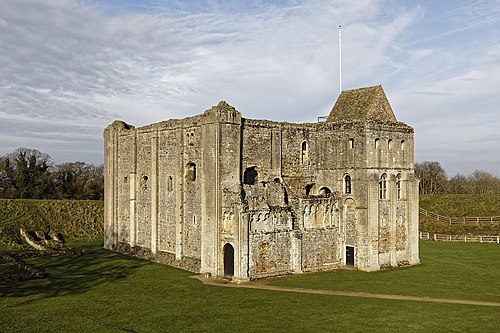
Partial ruin
As it stood in 1449
What Farleigh Hungerford Castle looked like in its prime.
A stone quadrangular castle with a tall, rectangular twin-towered gatehouse and a large arched entrance at its centre, linked to crenellated curtain walls that stretch to either side. The masonry is warm, weathered limestone; several round corner towers project from the inner court. To the right a range of stone buildings with pitched roofs and chimneys abuts the curtain. A paved approach and grassy forecourt lead to the arch, and a flagpole rises above the gatehouse.
Its story
The story of Farleigh Hungerford Castle.
Thomas Hungerford's Unlicensed Castle, 1369-1397
Sir Thomas Hungerford, Chief Steward to John of Gaunt and the first recorded Speaker of the House of Commons, bought the manor from the Bunghersh family in 1369 for £733 and between 1377 and 1383 raised a castle on the existing manor site above the River Frome. He had begun without a licence to crenellate and had to obtain a royal pardon in 1383.
The plan was quadrangular, a French form of the early 13th century already slightly old-fashioned: a curtain wall with a round tower at each corner, a twin-towered gatehouse and a wet moat on two sides. The low spur was overlooked from higher ground and not ideally placed for defence. A deer park was attached, for which most of the village of Wittenham was destroyed. Thomas died in 1397.
Walter Hungerford's Outer Court, 1412-1445
Sir Walter Hungerford inherited on his mother Joan's death in 1412. Speaker of the Commons in 1414, he fought at Agincourt in 1415 and later served as Treasurer of England and a guardian of the young Henry VI. Wool taxes from Wells and ransoms taken from French prisoners bought him some 110 new manors and estates, even after he paid £3,000 in 1429 to ransom his captured son.
Between 1430 and 1445 he added an outer court on the south side, more weakly defended than his father's work. It enclosed the parish church, which became the castle chapel; Walter built the village a replacement and had the chapel painted with Saint George and the Dragon, a saint favoured by Henry V.
Attainder, Bosworth and the Castle Oven, 1453-1554
Walter's grandson, the later Lord Moleyns, was taken by the French at Castillon in 1453; the ransom of over £10,000 crippled the family and he did not reach England again until 1459. A Lancastrian, he fought the Yorkists in 1460 and 1461, was exiled and then attainted, and the Crown seized Farleigh Hungerford. He was executed in 1464 and his eldest son Thomas in 1469. Moleyns's younger brother Sir Walter joined the failed revolt against Richard III in 1483, escaped custody in 1485, fought beside Henry Tudor at Bosworth, and had Farleigh back in 1486.
Sir Edward Hungerford died in 1522, leaving the castle to his second wife Agnes. It emerged that two of her servants had strangled her first husband, John Cotell, at Farleigh and burnt his body in the castle oven; Agnes and both servants were hanged in London in 1523. The castle passed instead to Edward's son Walter, a client of Thomas Cromwell, who confined his third wife Elizabeth in one of the towers for several years; she complained of being starved and of repeated attempts to poison her. Cromwell fell in 1540 and Walter with him, executed for treason, witchcraft and homosexuality, and the castle reverted to the Crown until his son bought it back in 1554 for £5,000.
Colonel Hungerford's Garrison, 1643-1645
Sir Edward Hungerford, who inherited in 1607, was a reformist Member of Parliament and a Puritan, made Parliament's commander in Wiltshire early in 1643. His record in the field was unexceptional: he abandoned towns to advancing Royalist armies and lost at Roundway Down, though he did take Wardour Castle in 1643. Farleigh Hungerford itself was taken without a fight later that year by Colonel John Hungerford, Edward's half-brother, whose Royalist garrison supported itself by pillaging the countryside; Parliamentary raids through 1644 failed to shift it. On 15 September 1645 Parliamentary forces reached the castle and Colonel Hungerford surrendered at once on good terms, so Farleigh escaped the slighting that destroyed neighbours such as Nunney.
Debt, Salvage and the Lead Coffins, 1648-1915
Edward died in 1648, and his widow Margaret spent £1,100 on an elaborate tomb in the north chapel. Four men, two women and two children were embalmed and laid in the crypt in lead anthropomorphic coffins, an expense reserved for the wealthiest. The last Hungerford owner, another Sir Edward, inherited in 1657, but gambling and extravagance ran up debts of some £40,000; in 1686 he sold Farleigh Hungerford and his remaining south-western lands to Sir Henry Bayntun for £56,000.
The castle passed in 1730 to the Houlton family, who broke up its walls and contents for salvage. It was ruinous by the end of the 1730s; the north-west and north-east towers had collapsed by 1797, and the ivy-clad south-west tower fell in 1842 after local children accidentally set the vegetation alight. The chapel, repaired in 1779, became a museum of curiosities, and its 15th-century wall paintings were rediscovered in 1844. Lord Cairns passed the castle to the Office of Works in 1915, whose ivy-stripping repairs H. Avray Tipping condemned for "giving the whole castle the effect of a new concrete building".
Step inside
11 places to explore in 1449.
The record describes 11 distinct spots at Farleigh Hungerford Castle, including 3 interiors: great hall and grand porch, st leonard's chapel (castle chapel), kitchen, bakery and service range (west side). Create your own photoreal reconstruction and explore every one, more scenes means more rooms, more angles, and more of the place to stand in.
Build Your Own Castle
Recreate Farleigh Hungerford Castle with AI to explore it.
The artist rebuilds it as it stood in 1449, a photoreal reconstruction that belongs to you alone. Pay with coins, no subscription needed.
Recreate this castle →Defend this castle →Whose castle
Clans who held Farleigh Hungerford Castle.
The families that held Farleigh Hungerford Castle for a decade or more across its history, follow a name to its clan.
Hungerford
Held by the Hungerford family from 1369 until sold in 1686.
Houlton
Bought by the Houlton family, Trowbridge clothiers, in 1730.
Nearby
Landmarks within reach of Farleigh Hungerford Castle.


Questions about Farleigh Hungerford Castle
What is the history of Farleigh Hungerford Castle?
What is inside Farleigh Hungerford Castle?
Who owns Farleigh Hungerford Castle now?
Why was Farleigh Hungerford Castle built, and what was it used for?
Does anyone live at Farleigh Hungerford Castle now?
Where is Farleigh Hungerford Castle?
When was Farleigh Hungerford Castle built?
Was Farleigh Hungerford Castle ever attacked or besieged?
Which family or clan held Farleigh Hungerford Castle?
What did Farleigh Hungerford Castle look like in its prime?
Is Farleigh Hungerford Castle still standing, or is it a ruin?
Who built Farleigh Hungerford Castle?
Can you visit Farleigh Hungerford Castle?
More castles of England


Explore the city


