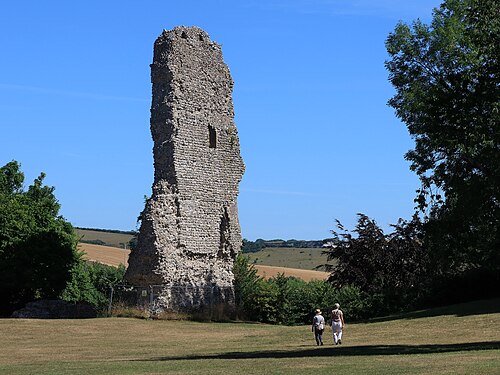
England · Restored
Stansted Mountfitchet Castle
Stansted Mountfitchet Castle is a reconstructed Norman ringwork and bailey on high ground in Stansted Mountfitchet, Essex, now operated as a living-history museum. The site preserves the earthwork ringwork with a small inner keep enclosure and a lower bailey area historically used for livestock and service buildings.
Its prime
1100
Today
Restored
As it stood in 1100
What Stansted Mountfitchet Castle looked like in its prime.
A small-scale Norman ringwork: a low, rounded earthen motte and bank topped by a dense palisade of upright timber stakes, with a simple timber gateway set into the palisade facing down the grassy slope. A distinct lower bailey lies on gentler ground with wooden fencing and animal pens; the inner circuit contains a small, round enclosure that held the timber keep. Overall setting: open Essex fields and short grass slopes around the earthworks.
Its story
The story of Stansted Mountfitchet Castle.
Robert Gernon's Ringwork After the Conquest, From 1066
The site had already drawn earlier occupation (artefacts recovered here support the belief that it had been an early Iron Age fort and, later, a Roman, Saxon and Viking settlement), before the Normans attacked in 1066 and Robert Gernon built his castle on the high ground, making it his chief seat and the head of his barony. Gernon had crossed from France with William the Conqueror and was rewarded with this lordship and several others in the county; he appears in the Domesday Book of 1086 as Robert Greno. His male line continued for only five generations.
A Living-History Museum Since 1985
The earthworks survive as a scheduled monument and a Grade II listed building, designated as such in 1976: a ringwork of about half an acre enclosing a small round keep enclosure, with a bailey of about an acre on lower ground once used for livestock and service buildings. After years of negotiation with planners, reconstruction in timber on the original earthworks began in 1980 and was complete by 1985, when the castle reopened to the public as, in its own billing, "the only wooden motte and bailey reconstruction on its original site anywhere in the world"; the earthwork itself is classed as a ringwork rather than a motte.
It now operates as a living-history museum keeping livestock of the kinds that would have been kept when the castle was in use. In 2013 one of its cockerels, a Light Brahma named Little John, was nominated for the world record for tallest chicken, standing 26 inches tall.
Step inside
6 places to explore in 1100.
The record describes 6 distinct spots at Stansted Mountfitchet Castle, including 1 interior: small round inner enclosure for the keep. Create your own photoreal reconstruction and explore every one, more scenes means more rooms, more angles, and more of the place to stand in.
Build Your Own Castle
Recreate Stansted Mountfitchet Castle with AI to explore it.
The artist rebuilds it as it stood in 1100, a photoreal reconstruction that belongs to you alone. Pay with coins, no subscription needed.
Recreate this castle →Defend this castle →Whose castle
Clans who held Stansted Mountfitchet Castle.
The families that held Stansted Mountfitchet Castle for a decade or more across its history, follow a name to its clan.
Montfitchet
Built by the Montfitchets after the Conquest, Robert Gernon's chief seat; the male line lasted five generations.
Nearby