England · Still standing
Wray Castle
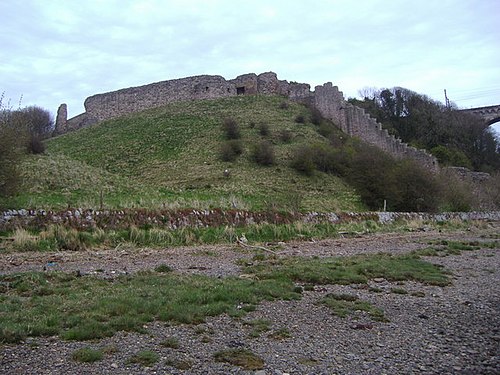
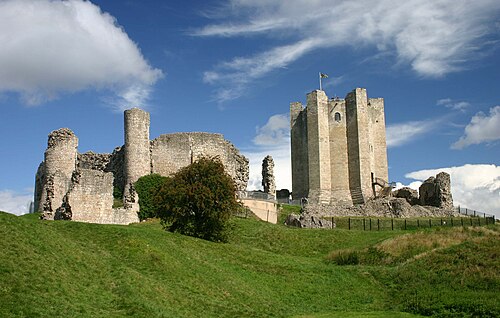
Wray Castle is a Victorian neo‑Gothic castellated country house on the Claife estate beside Windermere in the Lake District. Built as a romantic, castle‑like residence in 1840, it has long lawns, specimen trees and a castellated gatehouse with a central tower, and its grounds include part of the lake shore. The property has been in National Trust care since 1929.
Its prime
1840
Today
Still standing
As it stood in 1840
What Wray Castle looked like in its prime.
A mid‑19th century neo‑Gothic castellated house in grey ashlar stone, dominated by a central, keep‑like tower and a lower crenellated gatehouse with an arched carriageway. Flanking round and square turrets rise from curtain‑like facades punctured by tall vertical windows and narrow slit openings. The roofline is defined by stepped parapets and corbelled battlements. The building sits on lawns edged with specimen trees and rhododendrons, with the fells and Windermere visible beyond.
Its story
The story of Wray Castle.
James Dawson's Castle on Windermere, 1840
Wray Castle is a castle in silhouette only: a Victorian neo-Gothic house at Claife on Windermere, in Cumbria within the historic county of Lancashire, built in 1840 for James Dawson, a retired Liverpool surgeon, with his wife's fortune. About a decade later the Dawsons added the church of Saint Margaret nearby to serve the spiritual needs of the family and its employees; the church shares the castle's Gothic Revival manner, its tower echoing the house itself.
The grounds were planted in the spirit of the "Picturesque" movement, with conifers including Wellingtonia alongside ginkgo, weeping lime and varieties of beech, and remain renowned for their specimen trees. In 2026 a sapling grown from the felled Sycamore Gap tree was stolen from the grounds.
The Rawnsleys, Ruskin and the Idea of the National Trust
When Dawson died in 1875 the estate passed to his fifteen-year-old nephew, Edward Preston Rawnsley. Two years later Edward's cousin Hardwicke Rawnsley took up the post of vicar of Wray Church, and it was Hardwicke who (building on an idea propounded by John Ruskin, and alarmed at damaging development in the countryside) conceived of a National Trust that could buy and preserve places of natural beauty and historic interest for the nation.
The house touches another key player in that movement. Beatrix Potter spent a summer holiday at Wray in 1882, aged sixteen. In 1905 she bought Hill Top, a small farm in the Claife area, with royalties from The Tale of Peter Rabbit, and went on to acquire considerable tracts of land nearby, though never the castle itself. At her death in 1943 she left 4,000 acres and fourteen farms to the care of the National Trust.
Biologists and Radio Officers, 1929–2004
In 1929 Sir Noton and Lady Barclay, then the owners, gave Wray Castle and 64 acres to the National Trust. The house was briefly a youth hostel that same year, and from 1931 spent twenty years as the offices of the Freshwater Biological Association.
From 1958 to 1998 it served as a training college for Merchant Navy radio officers (RMS Wray Castle) with up to 150 cadets living in the house while learning the radio procedures that governed the Safety of Life at Sea. The Global Maritime Distress and Safety System, introduced in 1988 and required aboard all ships by 1999, ended the radio officer's profession; the last left in 1995, and the college diversified into ROV and general telecoms training as Wray Castle Limited, finally moving out of the castle in 2004.
Two Ships Named Wray Castle
The house lent its name to two ships of the Lancashire Shipping Company, the Castle Line, of James Chalmers & Co. The first, a steel ocean-going three-masted sailing ship of 1,937 gross registered tons, was launched in March 1889 at the Williamson shipyard at Workington, one of five castle-named sailing vessels built there alongside Greystoke Castle, Lancaster Castle, Lowther Castle and Pendragon Castle. She survived a serious fire in her hold in 1906 and was wrecked on the islands off Coronel, Chile, in 1924. The second, a steamship of 4,253 tons built by William Hamilton of Glasgow in 1938, was torpedoed and sunk off Freetown, West Africa, on 3 May 1941.
From Empty House to Visitor Attraction
By 2011 the house had been stripped of its furnishings and the National Trust proposed leasing it as a hotel, but opened it to visitors that season instead; the empty rooms proved unexpectedly child-friendly, and high visitor numbers persuaded the Trust to seek planning permission in 2014 to run the listed building (Grade II* since 1970) as a visitor attraction. It stayed open for a dozen years before closing in 2024 for refurbishment, due to run until 2027. The grounds, including part of the Windermere shoreline, remain open all year, within the Lake District National Park, itself a UNESCO World Heritage Site.
Step inside
6 places to explore in 1840.
The record describes 6 distinct spots at Wray Castle, including 1 interior: gatehouse arched carriageway. Create your own photoreal reconstruction and explore every one, more scenes means more rooms, more angles, and more of the place to stand in.
Build Your Own Castle
Recreate Wray Castle with AI to explore it.
The artist rebuilds it as it stood in 1840, a photoreal reconstruction that belongs to you alone. Pay with coins, no subscription needed.
Recreate this castle →Defend this castle →