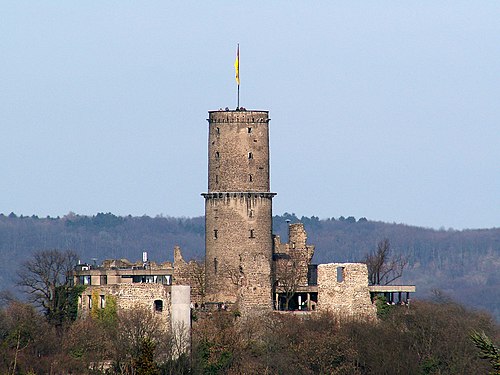
Germany · Restored
Blankenburg Castle
Schloss Blankenburg
Great Blankenburg Castle (Schloss Blankenburg) is a hilltop castle and later Baroque residence above the town of Blankenburg in Saxony-Anhalt, Germany. Originating c.1123, it was reshaped into a princely Baroque complex in the early 18th century with a multi-storey octagonal royal church and a suite of formal reception rooms. After periods of decline in the 20th century, key representative rooms have been restored and are open for guided tours and events.
First raised
1123
Its prime
1718
Today
Restored
As it stood in 1718
What Blankenburg Castle looked like in its prime.
Perched on the limestone summit of the Blankenstein, the complex reads as a multi-wing Baroque residence rising above the town with a clear, regular outer silhouette. The conversion added a multi-storey octagonal royal church volume breaking the roofline; the palace presents long, tiled roofs, regular rows of windows and a compact courtyard plan set above the town wall, with views down to a nearby castle park and pond.
Its story
The story of Blankenburg Castle.
Poppo's Fief and the Siege of 1181
The castle on the limestone hill of Blankenstein first appears in the record at the turn of 1122/23, when the Annalista Saxo has Duke Lothar of Süpplingenburg attacking the neighbouring Heimburg from it. In 1128 Poppo, of the Frankish house of the Reginbodonen, took the county as a fief and his name from it; the overlordship passed through Lothar's son-in-law Henry the Proud to the Welfs.
In 1181 imperial armies laid siege to castle and town under the direction of Bishop Dietrich of Halberstadt. Blankenburg was captured the next year and given over to plunder, and the brothers Henry and Siegfried II went into captivity, recovering the county once peace was restored and rebuilding the castle on a larger scale. Siegfried II kept Blankenburg from 1190 and his descendants held it until 1343, when it passed to the younger Heimburg branch of the Regenstein counts. A carved head in the castle wall recalls a raid of 1386, when Dietrich of Wernigerode is said to have looted the place in Count Busso's absence.
The Fire of 19 November 1546
Count Ulrich V broke with the Roman Catholic Church in 1539, and a new Renaissance east wing followed, begun in 1540 and finished in 1545 by the reckoning of the Topographia Germaniae; a stone carrying the comital arms and the date 1471 survives in its masonry from an earlier building.
Fire broke out on the night of 19 November 1546, before the new wing had been occupied, destroying much of the old castle; it was blamed afterwards on the castle's stoker, paid in gold to set dry kindling under the stairs. The household woke too late; the servants escaped over the roofs, but the pregnant Countess Magdalena of Regenstein was cut off by the flames and told her husband to save himself. Count Ulrich escaped through the privy window and hung from it until he was pulled clear, badly burnt; the plaque he had cut in Latin and German in memory of the dead shows him, the countess and their six sons and four daughters. The comital line died out in 1599 and the castle fell back as a lapsed fief to the Welf dukes of Brunswick-Wolfenbüttel.
Hermann Korb's Baroque Residence, from 1705
The dukes used Blankenburg only occasionally for hunting through the 17th century. Louis Rudolf of Brunswick-Wolfenbüttel took castle and county as an apanage in 1690, and in 1707, around his daughter Elisabeth Christine's marriage to the future Emperor Charles VI, Emperor Joseph I raised Blankenburg to a principality.
In 1705 the state architect Hermann Korb began recasting the castle as a Baroque residence; the east wing was finished in 1711. Korb gave the house the Grey Hall, the Redoute Hall and the Imperial Hall, along with a court church built as a multi-storey octagon. Seven canvases by Johann Conrad Eichler hung in the Imperial Hall, setting Louis Rudolf and his wife Christine Luise among their kin: Charles VI and Elisabeth Christine with their small daughter, the future Maria Theresa, and the duke's second daughter Charlotte Christine between her husband Alexei of Russia and his father, Tsar Peter the Great. Louis Rudolf became reigning duke in 1731 and moved to Wolfenbüttel.
Imperial Hunts and the Flight of 1945
Duke Wilhelm repaired the neglected buildings in the mid-19th century, and the summer residence became known for the imperial hunts that Wilhelm I and Wilhelm II attended. Duke Ernst August and Duchess Viktoria Luise lost their Brunswick property in the November Revolution, but the princely compensation settlement of 1924 gave them the castle outright and they lived there from 1930; their daughter Frederica, later Queen of the Hellenes, had been born at Blankenburg in 1917.
In the last weeks of the war the Brunswick state conservator Kurt Seeleke had some hundred crates of paintings, among them Cranach, Rembrandt, Rubens and Vermeer, trucked fifty kilometres to the castle vaults. The family fled in 1945 as the town fell into the Soviet zone, taking almost the whole historic inventory to Schloss Marienburg.
Dry Rot, Forced Auction and the Rescue Association
The expropriated castle housed a convalescent home from 1947 to 1957 and, from 1959, the Technical College for Domestic Trade. The college lasted until 1991, and a Munich businessman who bought the building from the Treuhand in 1996 for a tourism scheme called Planet Harz broke ground in 1997 but never secured his financing.
The empty building took heavy weather damage: leaking roofs, permanent damp, dry rot and a danger of collapse. An association formed in 2004 to save the castle began securing works, bought it through its own company at a forced auction in 2008 and finished the roofs over the four main wings in 2018.
Step inside
10 places to explore in 1718.
The record describes 10 distinct spots at Blankenburg Castle, including 7 interiors: grey hall (grauer saal), redouten hall (redouten saal), imperial hall and more. Create your own photoreal reconstruction and explore every one, more scenes means more rooms, more angles, and more of the place to stand in.
Build Your Own Castle
Recreate Blankenburg Castle with AI to explore it.
The artist rebuilds it as it stood in 1718, a photoreal reconstruction that belongs to you alone. Pay with coins, no subscription needed.
Recreate this castle →Defend this castle →Whose castle
Clans who held Blankenburg Castle.
The families that held Blankenburg Castle for a decade or more across its history, follow a name to its clan.
Regenstein
Held from 1190 by Siegfried II and his descendants until 1343, then by the younger Heimburg line of the House of Regenstein.
From the archive
Blankenburg Castle on paper: the measured plan and period views.
The survey plan and photographs below are the ground truth this page's reconstructions are checked against, drawn and photographed while the castle was still a working garrison. Every image is public-domain or openly licensed, with its source named.
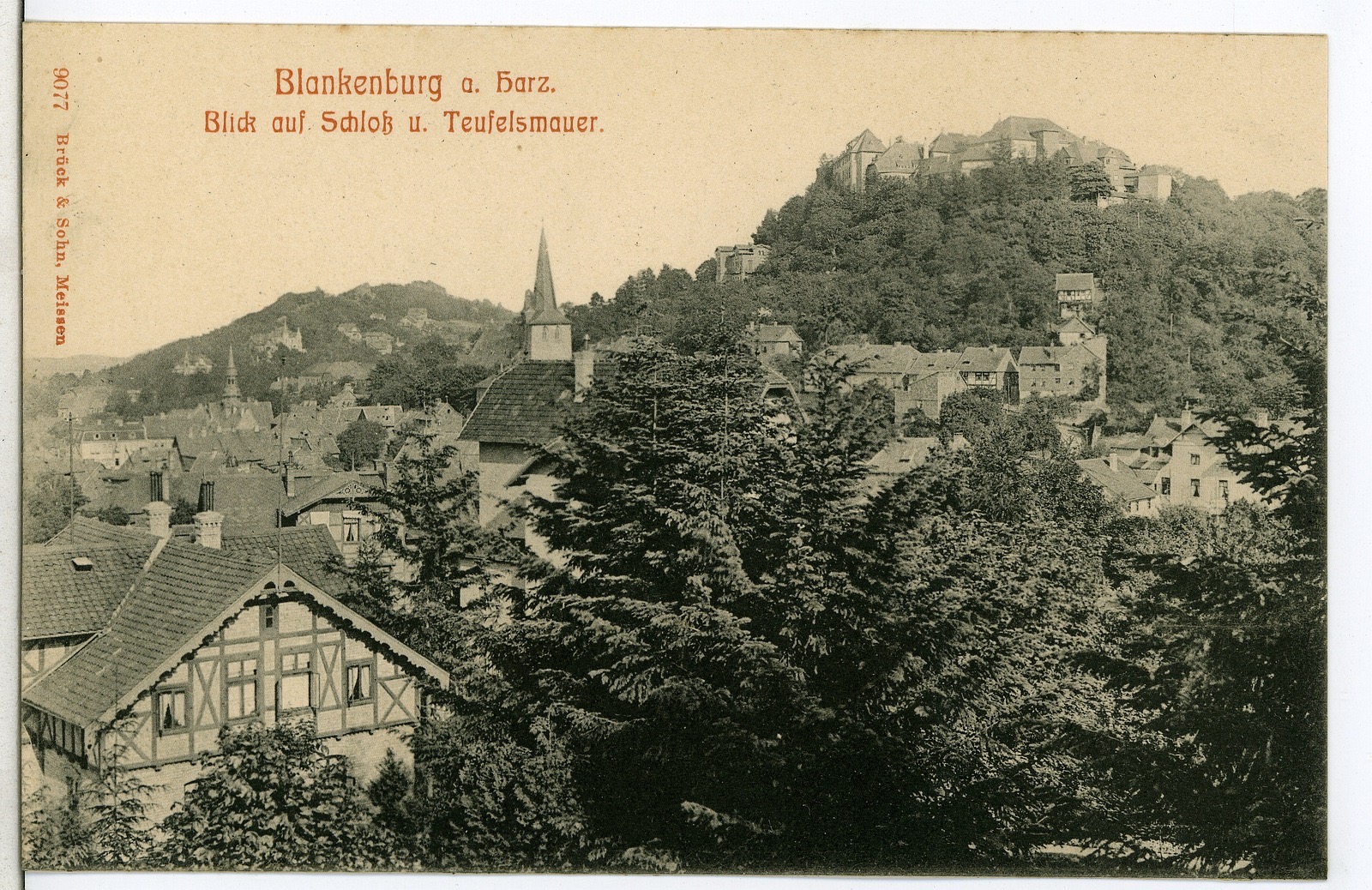
Blankenburg. Castle & Devil’s Wall
· Deutsche Fotothek (via Europeana)
Public domain
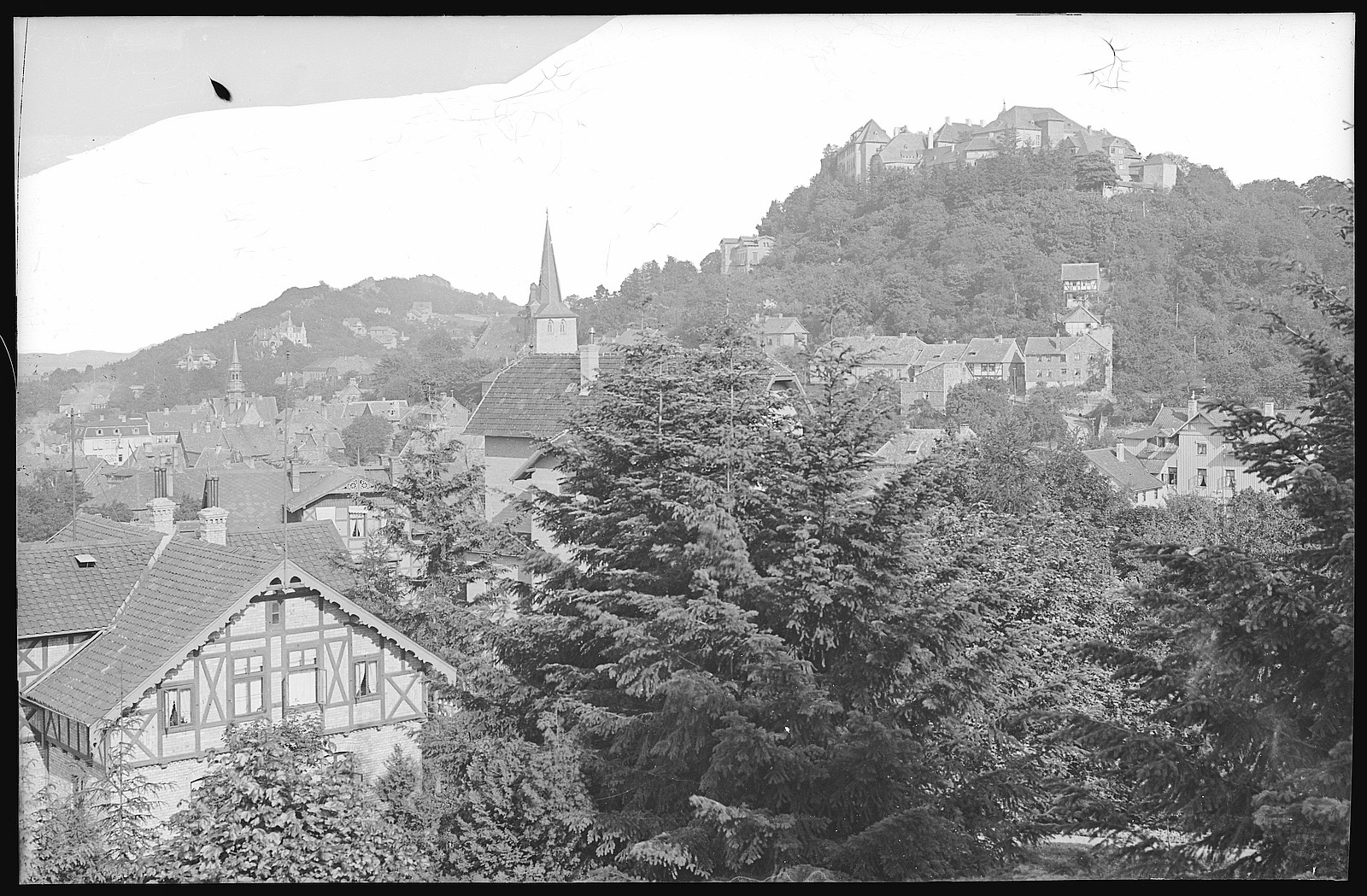
Blankenburg. Schloss & Teufelsmauer
· Deutsche Fotothek (via Europeana)
Public domain
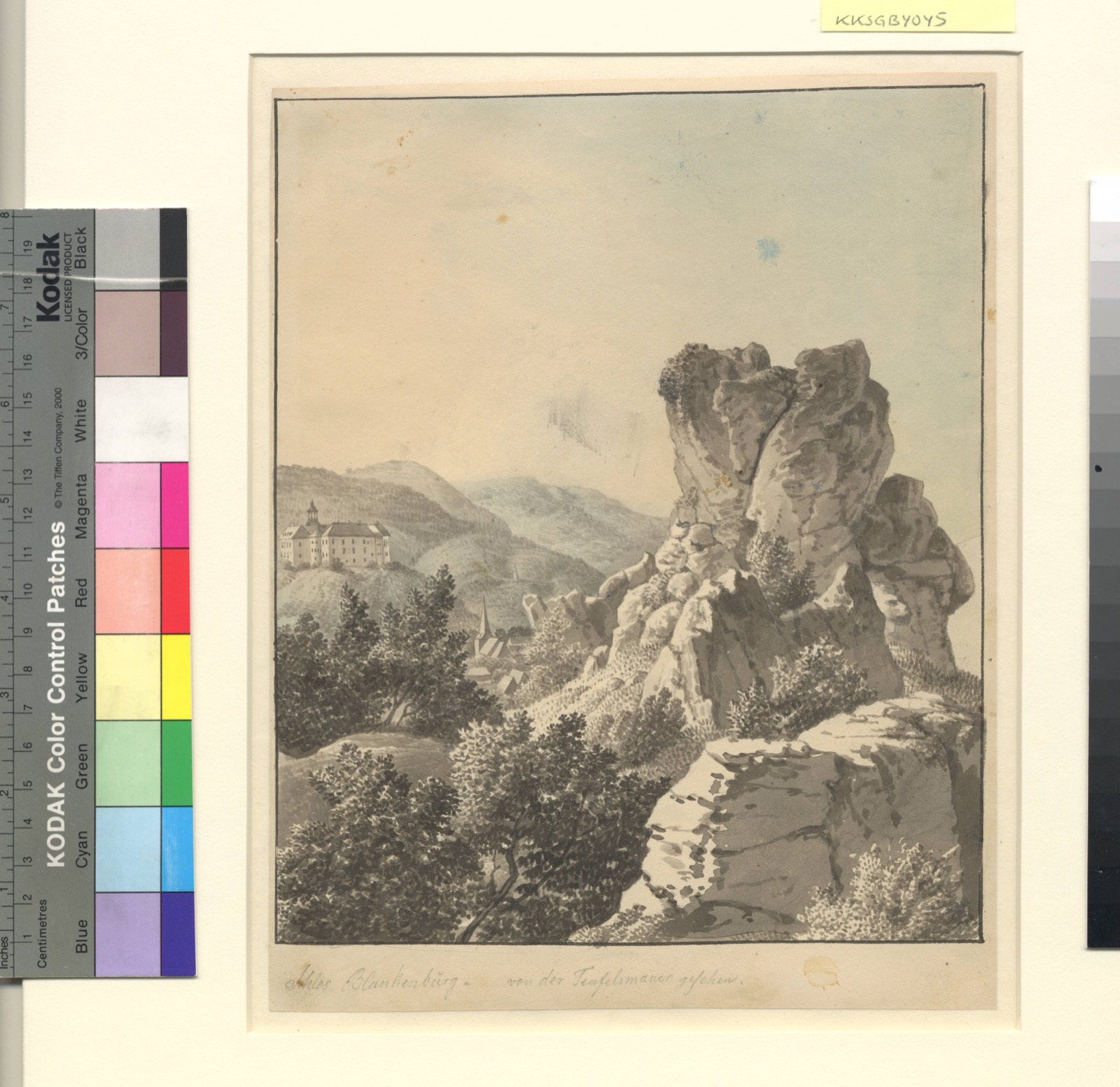
View from Harzen, from Teufelsmauer, the Blankenburg Castle in the Background
· National Gallery of Denmark (via Europeana)
Public domain