
Germany · Partial ruin
Neurathen Castle
Felsenburg Neurathen
Neurathen Castle (Felsenburg Neurathen) is a former rock castle in Saxon Switzerland near the Bastei, built into tall sandstone pillars. Today only rock-cut rooms, carved passages, a cistern and the beam sockets of a former wooden superstructure survive; parts have been adapted as an open-air museum. The site was once the largest rock castle in the region and sat across a cluster of vertical sandstone spires above the surrounding forested valley.
First raised
1100
Its prime
1300
Today
Partial ruin
As it stood in 1300
What Neurathen Castle looked like in its prime.
A cluster of tall, vertical grey-beige sandstone pillars and spires rising from a wooded valley, joined at their summits by timber galleries and short linking bridges set on visible beam sockets; the rock faces show layered striations and weathering, narrow carved stair slots and entrances cut into the stone, flat summit plateaux with tree cover, and small openings and chambers hewn directly into the sandstone beneath timber rooflines.
Its story
The story of Neurathen Castle.
A Bohemian Border Castle Above the Elbe, to 1289
The beginnings of the largest medieval rock castle in Saxon Switzerland are obscure. Historians suppose it went up around 1245, when Henry the Illustrious was granted Burg Wehlen a few kilometres downstream and was securing the Meissen frontier against Bohemia. An eleventh-century origin, sometimes claimed, has no written or archaeological evidence.
The first written trace is indirect: a papal instruction of 29 November 1261 to settle a quarrel between the Bishop of Meissen and Bohemian vassals, among them Teodoricus de Raten. An exchange agreement of 1289 between King Wenceslas II of Bohemia and Friedrich Clem, lord of Dresden, states that a castrum stood at Rathen. With the lower castle of Altrathen it formed a double castle; both names are modern, and Neurathen is reckoned the older of the two.
The Michelsbergs and the Berken von der Duba, 1361-1419
A charter of Emperor Charles IV in 1361 names ambo castra Ratny, the two castles of Rathen, for the first time. Neurathen was then a free lordship of the lords of Michelsberg, and Peter von Michelsberg submitted symbolically to the emperor by opening the gates of both castles to him. In 1406 Rathen passed by purchase to the Berken von der Duba, and when Hinko Berka von der Duba the Elder divided his holdings among his five sons in 1410 it fell to Benesch Berka, who took possession only on his father's death in 1419.
Friedrich von Oelsnitz Against the Berken, 1426-1450
The Berken von der Duba, who had pressed on the building of rock castles across what is now Saxon Switzerland, stood in constant feud with the Wettin margraves of Meissen. Königstein fell to Meissen in 1408, and in 1426 its Vogt, Friedrich von Oelsnitz, took Rathen for his lord Frederick I of Saxony. He is named lord of the castle in 1428, the year the Berken were forced to swear hereditary homage to the elector.
The settlement did not hold. Albrecht Berka von der Duba retook Rathen in 1438, and Oelsnitz won it back the next year, probably with the support of Elector Frederick II. In the fighting that followed Benesch Berka was killed, while Albrecht Berka and his ally Jan von Wartenberg were shut in the dungeon at Rathen. An atonement treaty of 10 March 1441 closed the quarrel: Rathen stayed with Oelsnitz and the Berken gave up their claim. From 1450 at the latest the castle took toll from Elbe shipping, and in that year Dresden sent a messenger to win toll-free passage for a load of stone.
Robber Knights and the Burning of Both Castles, 1466-1593
Under Friedrich's son Hans von Oelsnitz, owner by 1466, Rathen became a robber-knights' hold, as Johannes Lindner's chronicle records. Elector Ernst of Saxony and his brother Duke Albrecht moved against him from 1467, besieging both castles. It took more than a year: only in May 1469 could the margravial troops set them alight and take them. Hans von Oelsnitz escaped. Rathen was drawn in as a forfeited fief and attached to the Amt Pirna.
The main approach had been a timber bridge from the Bastei across the Mardertelle ravine, which could be destroyed under the feet of attackers. The castle went to Duke Albrecht of Saxony in the Leipzig division of 1485, and within sixty years of the storming both had decayed. Neurathen is said to have been a ruin by 1530, yet Matthias Oeder's first map of Saxony still marked a Schloss Der neue Raden, the earliest record of the present name, in 1593.
Refuge, Excavation and the Open-Air Museum, 1639-2025
In 1639 many citizens of Pirna are said to have hidden in the castle rocks for fear of the Swedes, and an inscription cut into the rock during the Northern War carries the same fear - CHRISTOPF HASE, 1706 WAR TER SWETE IN LANTE ES KUSTETE VIL GELT. In 1755 the piers of the old bridge over the Mardertelle still stood. The site passed from the hereditary court of Rathen to the kingdom of Saxony in 1826, and the stone Bastei bridge replaced its wooden predecessor in 1851.
Herbert Beschorner made the first archaeological examination in 1906 and uncovered the cistern. Alfred Neugebauer, digging between 1932 and 1934, found the wall-walk buried under centuries of humus, and 120 metres of it were rebuilt for visitors in 1934. Excavations from 1982 to 1984 examined the cistern and water supply, rebuilt the walkway in metal, and laid the site out as an open-air museum. Only rock-cut rooms, passages, the cistern and beam seatings of the vanished timber buildings survive. The rocks have lain in the core zone of the Saxon Switzerland National Park since 1990; the site has been closed since September 2023 because the rock is shifting, and Lohmen, which had leased it from the Free State of Saxony since 1996, gave up the lease in April 2025 with no repair in prospect.
Step inside
6 places to explore in 1300.
The record describes 6 distinct spots at Neurathen Castle, including 3 interiors: rock-hewn rooms and passages, rock-cut cistern, entrance passage and stair carved in the rock. Create your own photoreal reconstruction and explore every one, more scenes means more rooms, more angles, and more of the place to stand in.
Build Your Own Castle
Recreate Neurathen Castle with AI to explore it.
The artist rebuilds it as it stood in 1300, a photoreal reconstruction that belongs to you alone. Pay with coins, no subscription needed.
Recreate this castle →Defend this castle →From the archive
Neurathen Castle on paper: the measured plan and period views.
The survey plan and photographs below are the ground truth this page's reconstructions are checked against, drawn and photographed while the castle was still a working garrison. Every image is public-domain or openly licensed, with its source named.
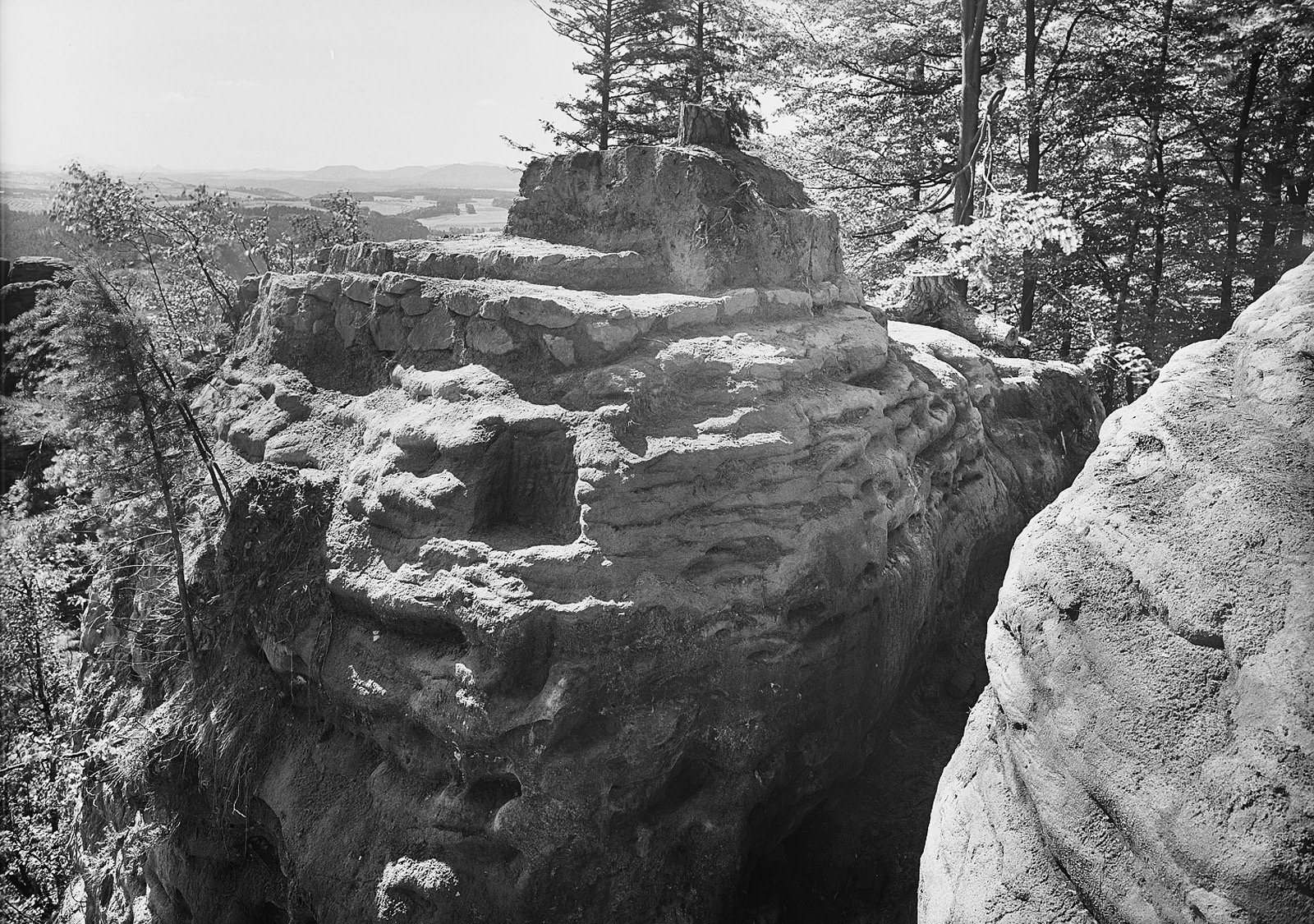
Neuraths Castle
· Deutsche Fotothek (via Europeana)
CC BY-SA
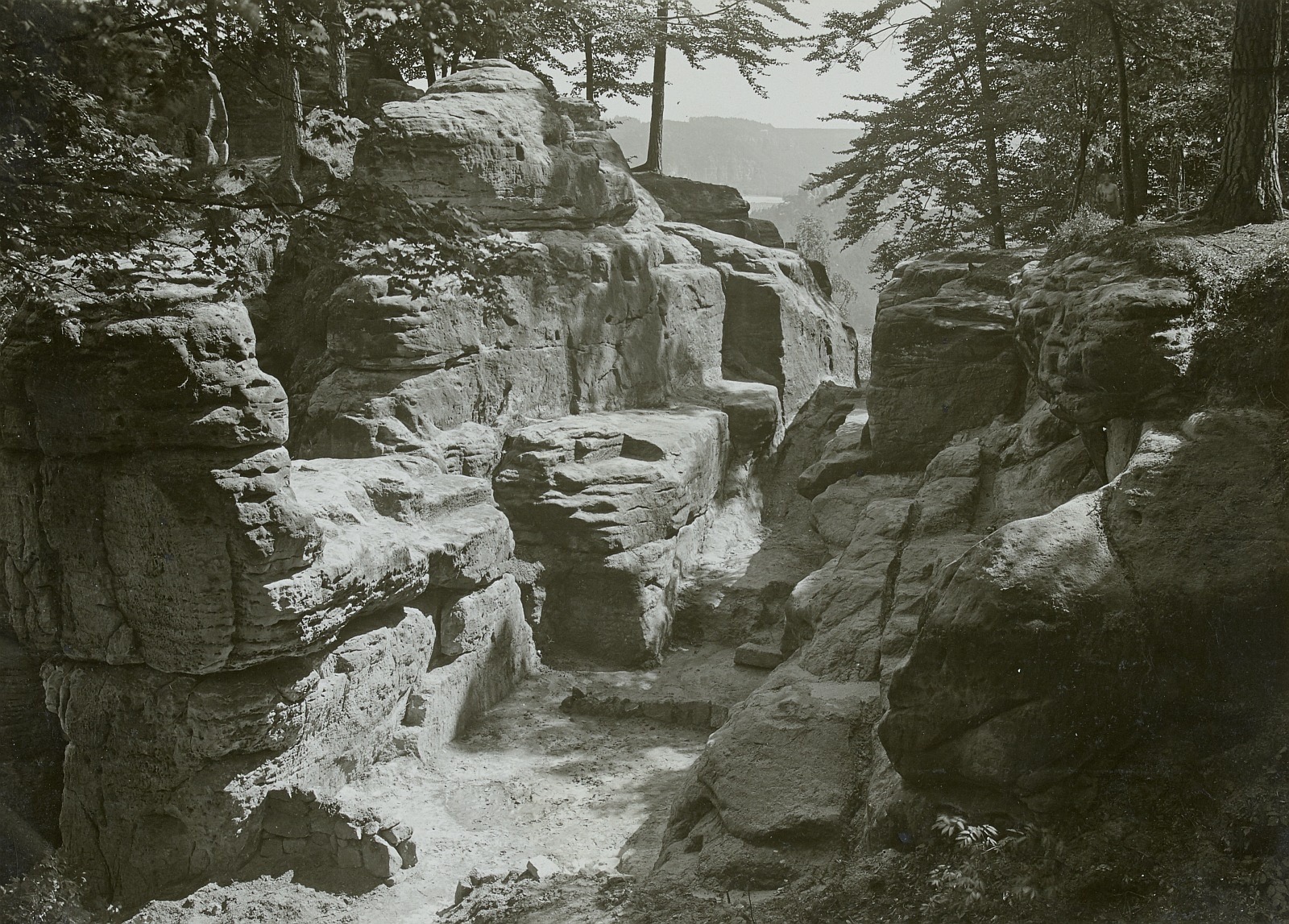
Neuraths Castle
· Deutsche Fotothek (via Europeana)
CC BY-SA
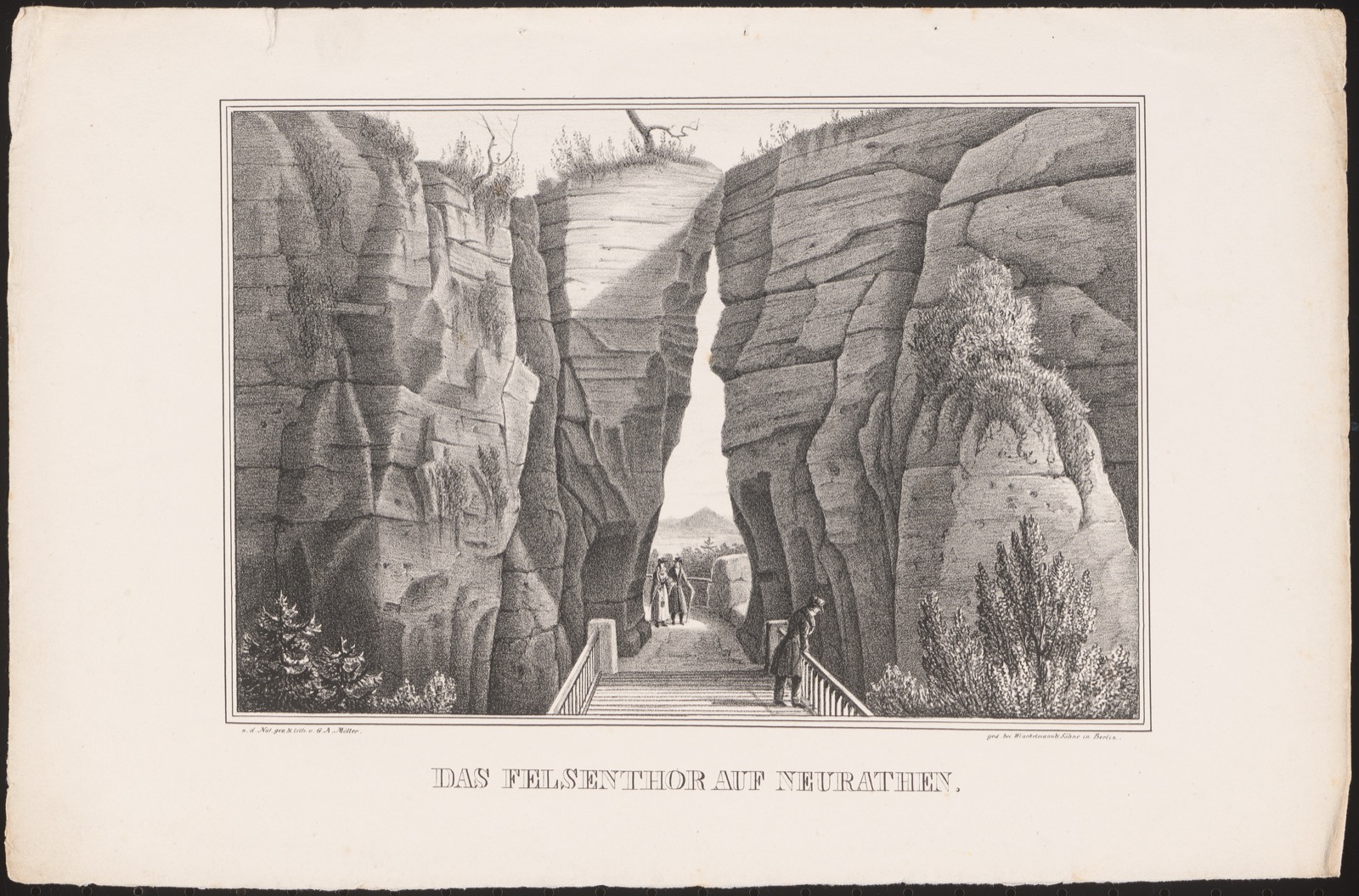
Felsentor auf Neurathen: Ansicht
· Museum of Architecture at Berlin Institute of Technology (via Europeana)
CC0 (no rights reserved)


