
Germany · Partial ruin
Rheinfels Castle
Burg Rheinfels
Rheinfels Castle is a large medieval castle complex on a steep wooded slope above the left bank of the Rhine at Sankt Goar, Germany. Begun in the 13th century and much enlarged, it consists of multiple concentric curtain walls, terraces, towers and service ranges; parts of the outer buildings survive in good condition and some inner ranges now house a hotel and museum.
First raised
1245
Its prime
1589
Today
Partial ruin
Ranked among Europe’s castles
As it stood in 1589
What Rheinfels Castle looked like in its prime.
Perched on a steep wooded Rhine slope, the complex is a sprawling, terraced cluster of grey-brown stone curtain walls, rectangular residential ranges and several prominent towers. A tall square gate/clock tower marks the lower entrance; behind it rise massive vaulted ranges and a round drum tower capped by a narrower upper tower. Stone walls step down the hillside in terraces and form multiple courtyards; some outer buildings retain intact rooflines while much of the core is ruined but standing.
Its story
The story of Rheinfels Castle.
Count Diether's Toll Castle and the Siege of 1256
Count Diether V of Katzenelnbogen began Rheinfels in 1245 as a toll castle, built above St Goar to take duties from ships working up the Rhine. The annals of Worms record under 1256 that Diether had broken the public peace against the citizens of Mainz, most likely over the tolls, and an army of the Rhenish League of Towns besieged the new castle. The siege failed, and Rheinfels gained the reputation of being impregnable.
Around 1360–1370 Count Wilhelm II enlarged the core castle; further works gave it the great shield wall flanked by two towers, the clock tower and the gunmaster's tower. Between 1360 and 1371 he also raised Burg Katz on the opposite bank, so tolls could be taken from downriver ships too, the St Goar double toll. Court life peaked in the fifteenth century under Counts Johann IV and Philipp, and under Philipp the round keep was heightened with a slender butter-churn turret to 54 metres, the tallest keep known of any German castle. In 1479 county and castle passed by marriage to Landgrave Heinrich III of Hesse-Marburg.
Hesse Against Hesse, 1626–1648
Landgrave Philip the Magnanimous remade the castle as a Renaissance palace, and after his death it became the seat of the short-lived landgraviate of Hesse-Rheinfels. Its great cellar (24 metres long, roughly 16 wide and high, with walls up to four metres thick and room for 400 people) was vaulted over in 1587–89 and is the largest self-supporting vaulted cellar in Europe.
In 1623 the imperial court awarded the lower county, Rheinfels included, to Hesse-Darmstadt; Landgrave Moritz of Hesse-Kassel refused the verdict, and Ferdinand of Bavaria, Elector-Archbishop of Cologne, was sent to enforce it. He besieged the castle in 1626, and after hard fighting Rheinfels was handed to Hesse-Darmstadt on 2 September. Kassel took it back by force in 1647, and on 14 April 1648 the two Hessian houses agreed to divide castle and town between them. From 1649 Landgrave Ernst of Hesse-Rheinfels-Rotenburg made Rheinfels his residence, and from 1657 to 1674 rebuilt it as a sprawling fortress aimed at France.
Three Thousand Against Twenty-Eight Thousand, 1692–93
Ernst, short of money, secretly promised the castle to Louis XIV in return for a pension. Landgrave Karl of Hesse-Kassel learned of the deal in time, seized Rheinfels and held it. In December 1692 the Comte de Tallard (who had promised Louis XIV the keys of Rheinfels as a New Year's gift) attacked the fortress; by the end of the siege 28,000 French soldiers stood against a garrison of 3,000.
On a reconnaissance ride Tallard was shot through the chest at 200 metres by Johann Kretsch, a master turner of the St Goar marksmen's company, firing a heavy double-hook gun from the gallery of the collegiate church at the officer with the tallest plume. Tallard gave up his command gravely wounded, the siege faltered, and two assaults were beaten off at a cost of 4,000 French dead and 6,500 wounded against 564 defenders killed. When Karl's relief army approached on 3 January 1693, the French withdrew, and the Peace of Utrecht confirmed Hesse-Kassel in possession of castle and town in 1713.
The Flight of 1794 and the Blasting of the Fortress
On 1 December 1758, in the Seven Years' War, Marshal Soubise's French troops appeared before a castle held only by local militia, and the commandant surrendered without a fight. Worse followed in 1794. General Philipp Valentin von Resius, the 77-year-old commandant, held a well-provisioned fortress with 3,000 men; yet on 1 November, on nothing firmer than a French drummer's message that 30,000 besiegers stood ready to storm, he led the whole garrison in headlong flight across a hastily built bridge to the far bank. The French under General Moreaux marched in next day to find the tables of the garrison's last meal still half laid. Resius was condemned to death, commuted to life imprisonment; he died in captivity in 1798.
The Revolutionary troops then destroyed the fortress, blowing up the outworks in 1796 and the palace and keep in 1797. In 1812 the ruin was sold off as French state property, and much of its stone went to build the fortress of Ehrenbreitstein at Koblenz.
From Quarry to Kaiser, and a Hohenzollern Claim
The ruin passed to Prussia in 1815 and was worked as a quarry until Prince Wilhelm of Prussia, the future Kaiser Wilhelm I, bought it in 1843. The town of St Goar has owned it since 1925, and since 2002 Rheinfels has formed part of the UNESCO World Heritage Upper Middle Rhine Valley. A claim by Georg Friedrich, Prince of Prussia, that the castle be returned to the Hohenzollern family was dismissed by a court in June 2019 and settled out of court in January 2020.
Step inside
9 places to explore in 1589.
The record describes 9 distinct spots at Rheinfels Castle, including 3 interiors: darmstadt living quarters (interior), great vaulted cellar, castle chapel (museum). Create your own photoreal reconstruction and explore every one, more scenes means more rooms, more angles, and more of the place to stand in.
Build Your Own Castle
Recreate Rheinfels Castle with AI to explore it.
The artist rebuilds it as it stood in 1589, a photoreal reconstruction that belongs to you alone. Pay with coins, no subscription needed.
Recreate this castle →Defend this castle →Whose castle
Clans who held Rheinfels Castle.
The families that held Rheinfels Castle for a decade or more across its history, follow a name to its clan.
Katzenelnbogen
Started by Count Diether V of Katzenelnbogen in 1245 and expanded into the largest fortress in the Middle Rhine Valley.
Hesse-Darmstadt
Held by the landgraves of Hesse-Darmstadt, whose living quarters, the Darmstadt Building, stand within the castle.
From the archive
Rheinfels Castle on paper: the measured plan and period views.
The survey plan and photographs below are the ground truth this page's reconstructions are checked against, drawn and photographed while the castle was still a working garrison. Every image is public-domain or openly licensed, with its source named.
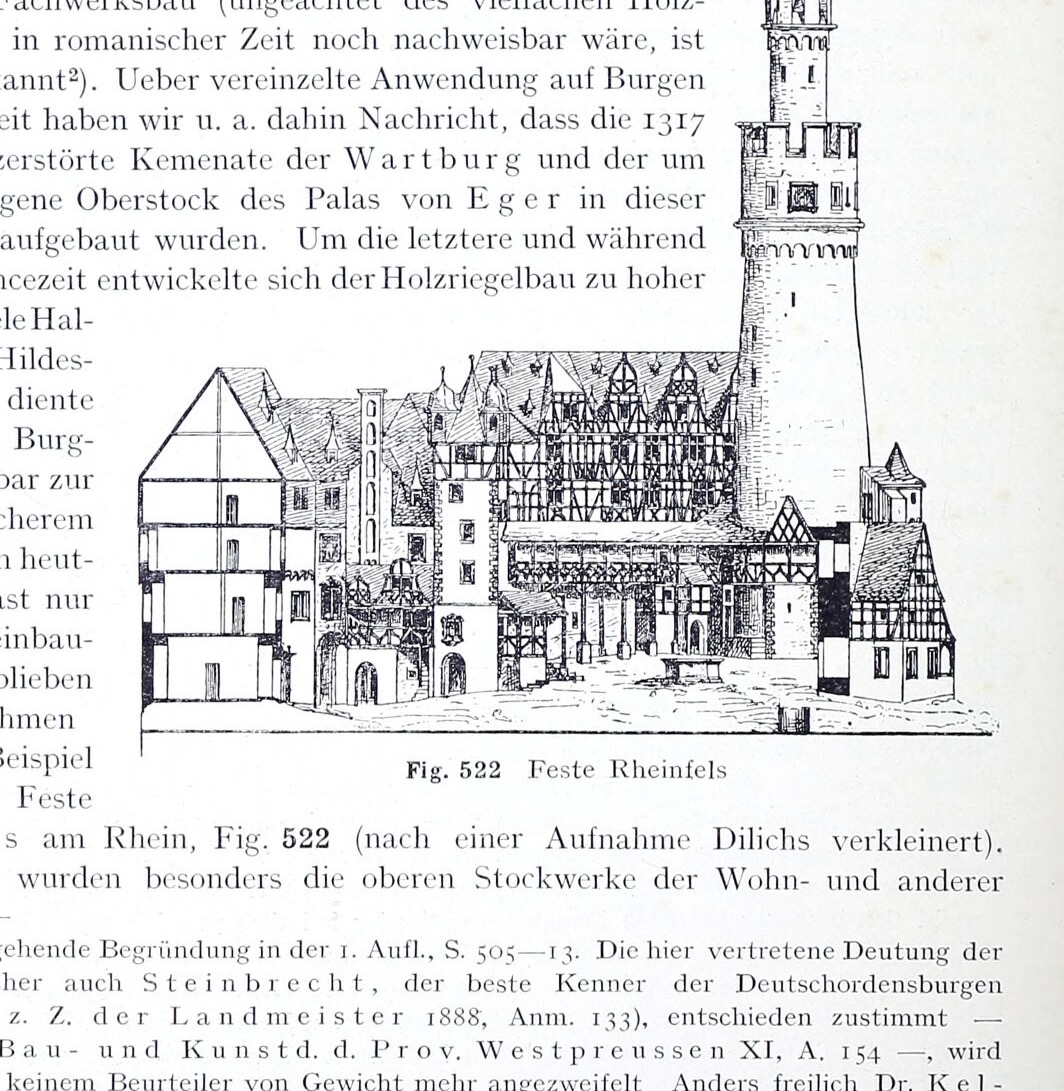
Fig. 522 Feste Rheinfels
1912 · Otto Piper, Burgenkunde (1912)
Public domain


