
Germany · Still standing
Vischering Castle
Burg Vischering
Vischering Castle is a moated medieval castle in Lüdinghausen, North Rhine-Westphalia, Germany, centred on a horseshoe-shaped main building, outer defensive courtyard, drawbridge and chapel. The site now houses the Münsterlandmuseum and a cafe and remains a well-preserved example of a feudal-age moated castle.
First raised
1271
Its prime
1525
Today
Still standing
As it stood in 1525
What Vischering Castle looked like in its prime.
A horseshoe-shaped three-storey sandstone main building with heavy outer walls and regularly spaced windows faces a broad moat; red clay-tile roofs cap steep gables and a long timber-framed service building runs along the water's edge. A cylindrical brick stair-tower with decorative banding rises above the roofline. The inner courtyard is closed off by a chapel and a lower defensive wall; an outer defensive courtyard and gateways sit between the main block and the surrounding woods.
Its story
The story of Vischering Castle.
A Bishop's Counter-Castle, 1271
The lords of Lüdinghausen, the knights Hermann I and his brother Bernhard, had raised a castle called Wolfsberg south of Burg Lüdinghausen, apparently without their bishop's consent. Gerhard von der Mark, Bishop of Münster, answered shortly before 1271 by building Vischering as a Zwingburg on a sand island some 80 metres long in an arm of the River Stever, to secure the diocese's rights against the two rebellious brothers. A charter of 25 July 1271 granted the castle in hereditary fief to the ministerial Albert III von Wulfheim, whose family had served the bishops as Drosten for about a hundred years. Gerhard reserved a right of entry and planned Vischering as an episcopal Landesburg, though that expansion never took place. Albert held it with three Burgmannen, a chaplain, a gatekeeper and a watchman.
Partition and the Münster Diocesan Feud, 1309-1473
By 1309 the local title Droste had wholly displaced Truchsess as the family's name, though the castle was not commonly called Vischering until the second half of the 14th century. In 1455 the brothers Heinrich and Johann divided the family property into two lines, and by then the branch resident here was styling itself Droste zu Vischering. Their partition deed names an "olde steynhus to Vischerinck" and a "nye steynhus mit dem berchvrede", a keep of which nothing survives above ground. Repeated pledges and sales followed, above all during the Münster Diocesan Feud of 1450 to 1457, so that Gerhard II von Morrien of Nordkirchen, hereditary marshal of the prince-bishopric, gathered nearly every right in Vischering into his own hands during the 15th century. His daughter Richmond married Heidenreich Droste von Vischering in 1473, and the castle returned to Droste hands.
Fire and Renaissance Rebuilding, 1519-1580
An inscription and the arms of Johann Droste zu Vischering and his wife Elisabeth von Münster date the gatehouse to 1519. It was the only part to come through the fire of 1521, which largely destroyed the core castle and took the whole family archive with it, and it is the oldest standing building on the site. Johann began the present west wing in Renaissance forms, a storey higher than its predecessor; the work outlasted him, and he died about 1540. His son Heidenreich finished the shell in 1552 with the new south wing. Windows broken through the formerly closed ring wall lessened the defensive character of the main castle somewhat. A chimneypiece dated 1570 shows the interior still being fitted out that year, and the stair tower was complete by 1580.
Hessian Soldiers and the Move to Darfeld, 1633-1826
Hessian soldiers occupied Vischering in the Thirty Years' War, probably shortly before 3/4 February 1633; whether any fighting attended it is not known. The castle was still in Hessian hands at least as late as October 1634. Christoph Heidenreich Droste zu Vischering inherited Schloss Darfeld on his uncle Goswin's death in 1690 and moved his household there altogether; a Rentmeister ran Vischering afterwards. No major building work followed until 1720, when Christoph Heidenreich had the outer bailey remodelled. The family was made Freiherren on 21 January 1670, and in 1826 Friedrich Wilhelm III of Prussia made Adolf Heidenreich Droste zu Vischering a count.
Rotting Piles, an Aerial Mine and the Museum, 1911-2018
The dry summers of 1911 and 1912 dropped the moat pond so far that the oak pile-grid foundation lay partly exposed and began to rot; as the piles lost their bearing capacity the complex threatened to burst apart, and cracks up to 15 cm wide opened in the façades. Between 1927 and 1929 the owners had the wall-ring stiffened with reinforced concrete and radial anchors. In November 1944 an aerial mine detonated at the Wallkopf, destroying the granary and the corn mill outright, damaging the bridge to the outer bailey and the drawbridge gate, and bringing down the oriel of the gatehouse. The damage was largely made good between 1948 and 1952.
The district of Lüdinghausen leased the castle from the early 1970s as a cultural centre. Repairs to 1972 laid bare the foundations of the presumed keep 1.45 metres below the courtyard, and timbers of the pile grid were dated by dendrochronology to about 1270, very probably belonging to Gerhard von der Mark's castle. The Münsterlandmuseum opened in 1972 and passed to Kreis Coesfeld in the district reform of 1975. The whole site has been a protected monument since 8 October 1986 and remains the property of the Droste zu Vischering family; after eighteen months of work costing some 9.6 million euros the redesigned permanent exhibition reopened on 4 February 2018, and the exterior can be viewed free of charge at any time.
Step inside
8 places to explore in 1525.
The record describes 8 distinct spots at Vischering Castle, including 1 interior: castle chapel (interior). Create your own photoreal reconstruction and explore every one, more scenes means more rooms, more angles, and more of the place to stand in.
Build Your Own Castle
Recreate Vischering Castle with AI to explore it.
The artist rebuilds it as it stood in 1525, a photoreal reconstruction that belongs to you alone. Pay with coins, no subscription needed.
Recreate this castle →Defend this castle →Whose castle
Clans who held Vischering Castle.
The families that held Vischering Castle for a decade or more across its history, follow a name to its clan.
Droste zu Vischering
Seat of the Droste zu Vischering family, hereditary noble administrators (Droste) serving the Bishops of Münster.
From the archive
Vischering Castle on paper: the measured plan and period views.
The survey plan and photographs below are the ground truth this page's reconstructions are checked against, drawn and photographed while the castle was still a working garrison. Every image is public-domain or openly licensed, with its source named.
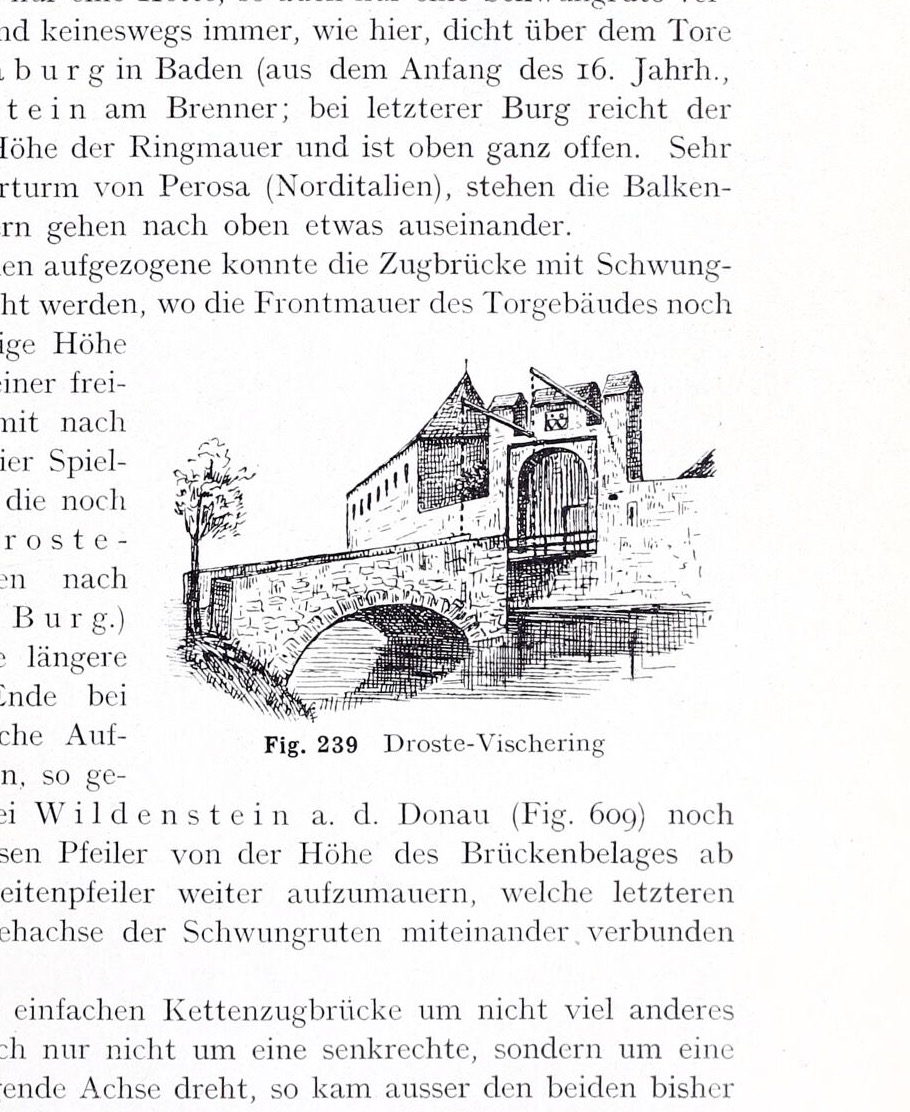
Fig. 239 Droste-Vischering
1912 · Otto Piper, Burgenkunde (1912)
Public domain


