
Germany · Restored
Ronneburg Castle
Burg Ronneburg
Ronneburg Castle is a hilltop medieval and Renaissance castle near Ronneburg in Hesse, Germany, sited on a prominent basalt cone overlooking the Fallbach Valley. Founded in the 13th century and remodelled in the 16th century as the Ysenburg residence, its well-preserved core includes a cylindrical keep with a domed helmet, a hall building with chapel bay, the Zinzendorf Building, and a sizable outer bailey. It is a protected historic monument and a popular regional excursion site.
First raised
1200
Its prime
1576
Today
Restored
As it stood in 1576
What Ronneburg Castle looked like in its prime.
Perched atop a steep basalt cone, the castle forms a rectangular core with a tall round keep rising from the eastern side topped by a distinctive domed helmet; clustered around it are multi-storey stone buildings with red tiled roofs (hall building, Zinzendorf Building, New Bower). A continuous quarry-stone curtain wall encircles the summit with a visible upper gate and outer bailey to the south and east; masonry is pale to mid-grey, roofs are steep red clay tiles, and trees sit against the walls.
Its story
The story of Ronneburg Castle.
A Mainz Castle above the Hohe Strasse, 1231-1424
The first record is a charter of either 1231 or 1258 in which a Burgmann of the von Rüdigheim family names himself "de Roneburg", and the work is very probably older than that. It may have been raised by the lords of Büdingen - Gerlach I or Gerlach II - to secure the surrounding court districts, the Büdingen forest and the trade roads below. It probably began as a territorial castle of the Archbishopric of Mainz, in the Mainz court of Langendiebach, on a basalt cone above the Fallbach valley and the Hohe Strasse. The oldest known fabric of the present core castle belongs only to the second quarter of the 14th century.
After the Büdingen line died out before 1247 the castle went not at first to their chief heirs, the counts of Ysenburg, but was in Hohenlohe hands at its first mention, and Gottfried III of Hohenlohe-Brauneck sold it to the archbishopric in 1313. Mainz pledged it from 1327 to the knights of Rockenberg, who enlarged it, then in 1356 pledged it to Hartmut VI and Frank VIII of Cronberg as security for 18,000 small gold florins; they held it until 1407, and from 1424 it went in pledge to the counts of Hanau.
The Ysenburg-Büdingen-Ronneburg Line, 1476-1601
In 1476, probably as a consequence of the Mainz Diocesan Feud, Archbishop Diether of Ysenburg made the castle over to his brother, Count Ludwig II of Ysenburg-Büdingen. Ludwig's death in 1511 was followed from 1517 by a war of succession among his three sons, and only in 1523 did the castle fall to Philipp von Ysenburg-Büdingen, founder of the Ysenburg-Büdingen-Ronneburg line.
As that line's residence Ronneburg took its lasting Renaissance form: the outer bailey was built between 1538 and 1550, and the domed helmet of the keep raised between 1576 and 1581 to a design by the master builder Joris Robin of Ypres.
Philipp's son Anton had fifteen children, but his sons' marriages stayed childless, and Georg and Heinrich ruled in turn. Heinrich's remodelling gave the castle a last flowering; on his death in 1601 the line was extinct, and Wolfgang Ernst I of Ysenburg-Büdingen in Birstein claimed it as a reverted fief and seized it by force, though Heinrich's widow went on living there.
Fire, Croatian Horsemen and the End of the Noble Seat, 1621-1698
In 1621 a fire caused by the carelessness of the burgrave destroyed large parts of the castle, among them the New Bower and the Upper Gate Building, and ended its use as a dowager's seat. Thirteen years later the damaged and empty castle was plundered by Croatian cavalry in the Thirty Years' War. Repairs waited until the war was over, and the New Bower was not rebuilt to its full height. The castle also lost its standing as seat of the Ysenburg office of Ronneburg, whose administrative seat passed to Langenselbold in 1698.
Refuge for the Persecuted, 1700-1885
From 1700 the Calvinist Ysenburg-Büdingen allowed Protestant exiles to settle in the castle, which became a long-standing refuge for the religiously persecuted: the Swiss mystic Ursula Meyer held 156 disputations there between 1715 and 1719. It also housed people with no home of their own, among them Jews and Roma, who worked at crafts in its rooms. In 1736 Count von Zinzendorf moved in with his Herrnhut Brethren and made the castle a much-visited place of pilgrimage; two years later, finding it too small, they founded Herrnhaag on a nearby hill, and from 1750 many of those settlers emigrated to America and elsewhere.
So many people lived at the Ronneburg that an administrative reform made it a municipality of its own in 1821, a status reversed in 1829. In 1838 the outer castle buildings were pulled down, evidently with the encouragement of the administration on account of the unwelcome inhabitants; further demolition sales followed in 1870, and the last resident left only in 1885.
Monument Protection, Museum and Sale, 1890-2004
Heinrich Wagner's 1890 volume on the art monuments of the Büdingen district brought the site to the notice of monument care in Hesse, and it was first placed under protection in 1905. The Büdingen architect Peter Nieß laid out a thorough building history in 1936, backed by the Ysenburg princely house.
The castle museum opened in 1952 and a restaurant in the Marstall in 1967, and a 1988 agreement gave the Förderkreis Freunde der Ronneburg charge of its structural and museum care. In June 2004 Wolfgang Ernst zu Ysenburg und Büdingen sold the Ronneburg to Forfin GmbH, whose sole shareholder, Joachim Benedikt Freiherr von Herman auf Wain, is a cousin of his wife. The castle is a cultural heritage monument in Hesse; the outer castle and its restaurant are open by day, the core castle holds the museum, and visitors may climb the 32-metre keep.
Step inside
10 places to explore in 1576.
The record describes 10 distinct spots at Ronneburg Castle, including 1 interior: hall building interior and chapel bay. Create your own photoreal reconstruction and explore every one, more scenes means more rooms, more angles, and more of the place to stand in.
Build Your Own Castle
Recreate Ronneburg Castle with AI to explore it.
The artist rebuilds it as it stood in 1576, a photoreal reconstruction that belongs to you alone. Pay with coins, no subscription needed.
Recreate this castle →Defend this castle →Whose castle
Clans who held Ronneburg Castle.
The families that held Ronneburg Castle for a decade or more across its history, follow a name to its clan.
Büdingen
Believed built by the lords of Büdingen, who held the castle until their line's extinction (before 1247).
Hohenlohe
Held by the von Hohenlohe family after the Büdingen extinction until Gottfried III of Hohenlohe-Brauneck sold it to Mainz in 1313.
Cronberg
Held Ronneburg in pledge from Mainz from 1356 (Hartmut VI and Frank VIII of Cronberg).
Hanau
Counts of Hanau held the castle in pledge from 1424.
Ysenburg
Held by the Ysenburgs from 1476; 16th-century residence of the Ysenburg-Büdingen-Ronneburg collateral line.
From the archive
Ronneburg Castle on paper: the measured plan and period views.
The survey plan and photographs below are the ground truth this page's reconstructions are checked against, drawn and photographed while the castle was still a working garrison. Every image is public-domain or openly licensed, with its source named.
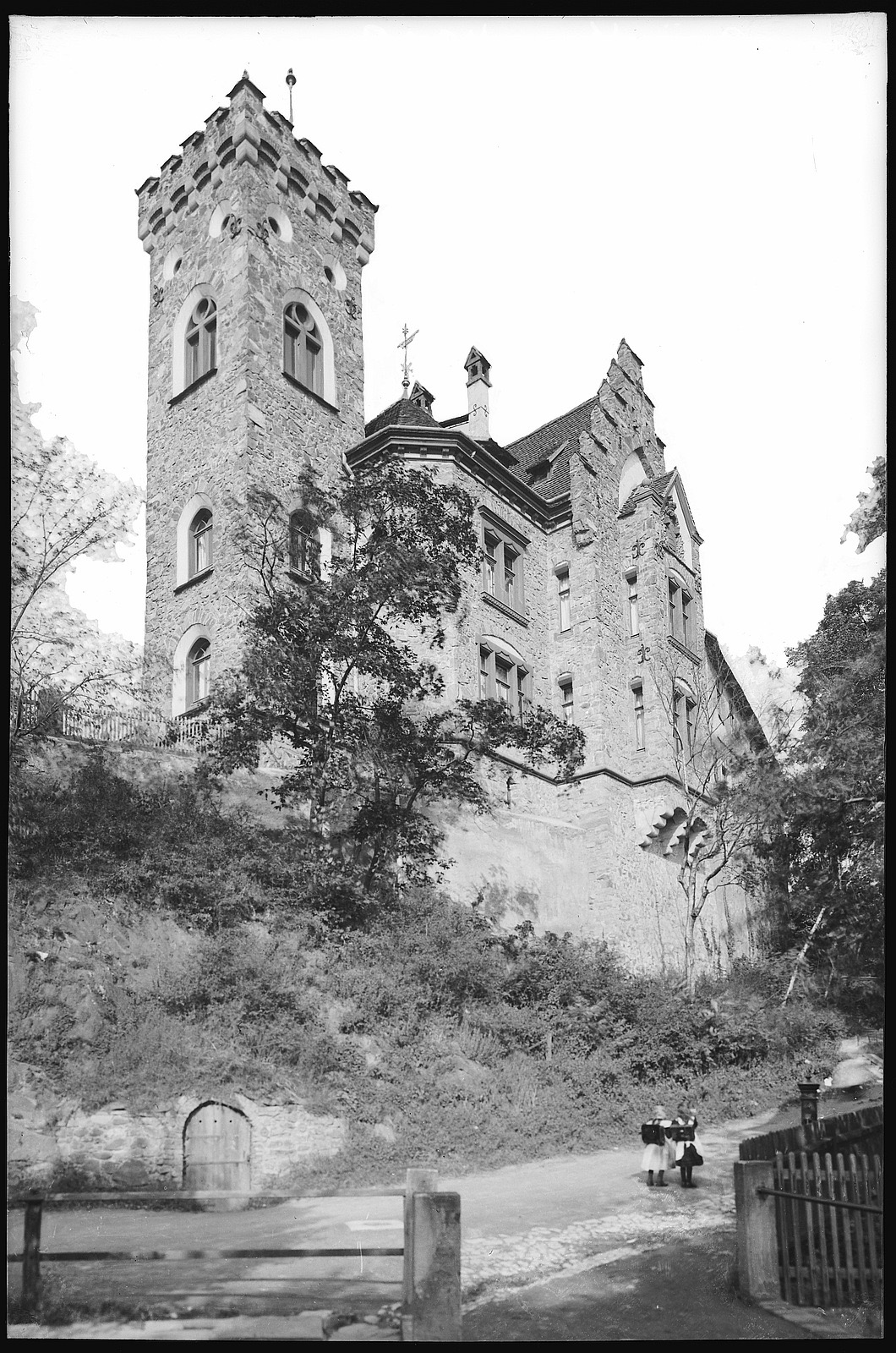
Ronneburg. Schloss
· Deutsche Fotothek (via Europeana)
Public domain
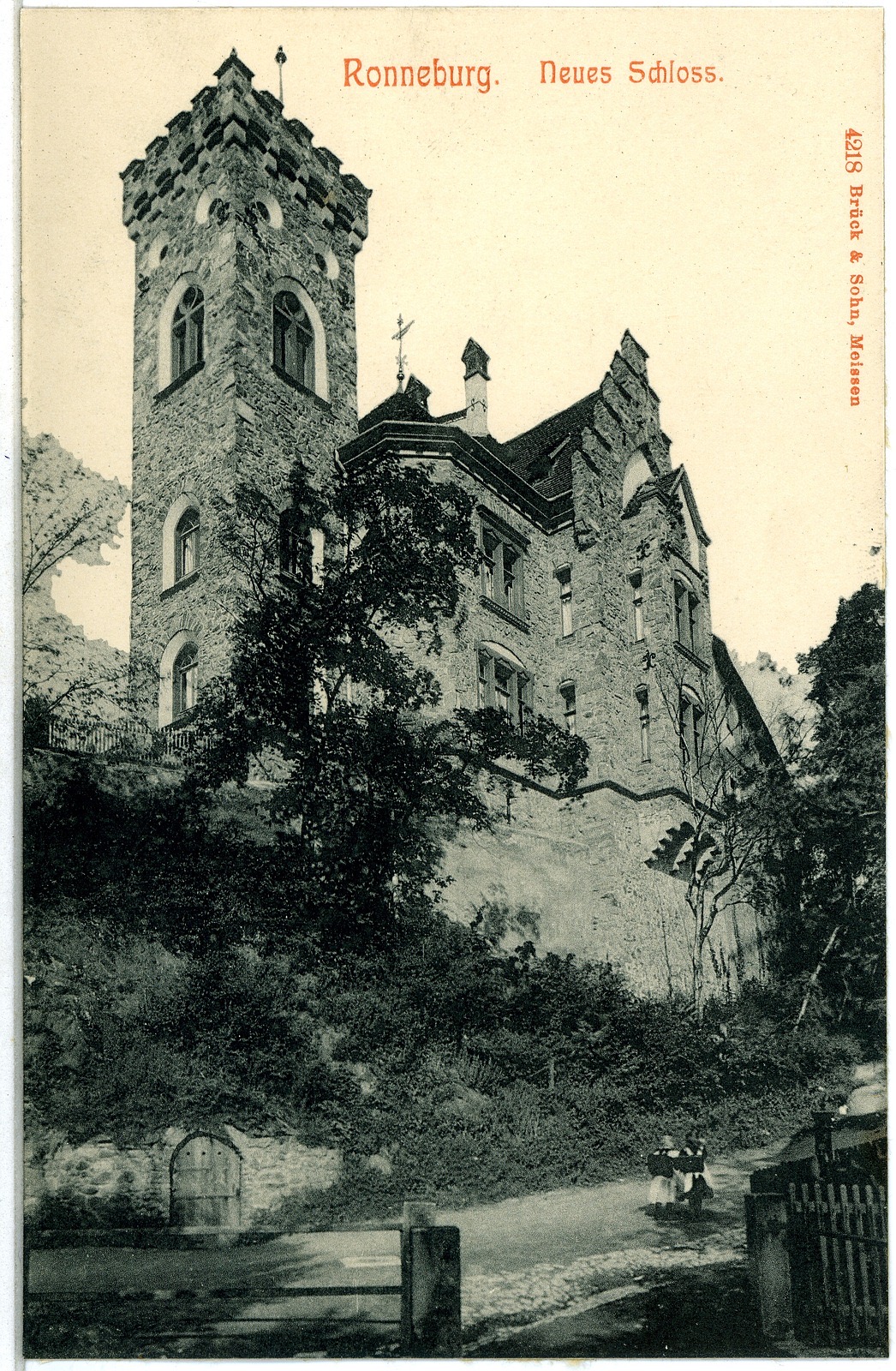
Ronneburg. Castle
· Deutsche Fotothek (via Europeana)
Public domain
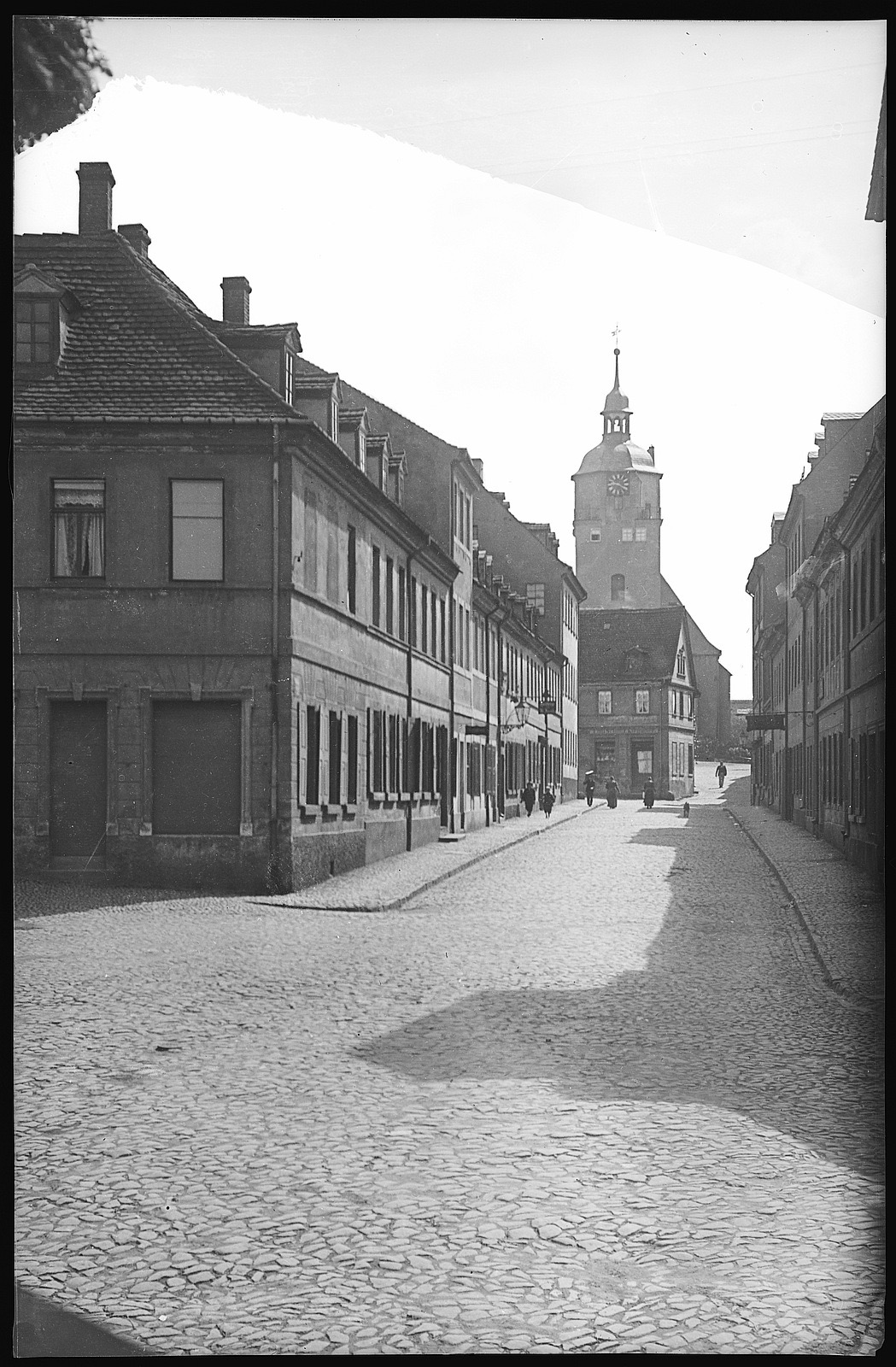
Ronneburg. Schlossstraße
· Deutsche Fotothek (via Europeana)
Public domain
Nearby


