
Italy · Restored
Buonconsiglio Castle
Castello del Buonconsiglio
Buonconsiglio Castle is a large multi-period castle complex on a slight rise above the city of Trento that served as the residence of the prince-bishops of Trento. The ensemble combines an older fortified Castelvecchio, a sixteenth-century Renaissance Magno Palazzo and several towers, and houses notable fresco cycles including the 15th-century 'Cycle of the Months' in the Torre Aquila.
Its prime
1530
Today
Restored
As it stood in 1530
What Buonconsiglio Castle looked like in its prime.
A long, slightly elevated stone enceinte fronts the city, punctuated by a tall cylindrical keep/tower with battlements at the northwest corner and several round bastions; a crenellated curtain wall runs along the slope. Behind the wall are contiguous buildings of differing heights: the older Castelvecchio block with crowned crenellations and a Gothic double-loggia entrance, and the lower, elongated pale-stone Palazzo Magno with rows of rectangular windows and an open Renaissance loggia opening onto an inner court. Mountains form the distant backdrop.
Its story
The story of Buonconsiglio Castle.
From Malconsey to Buonconsiglio
The castle was raised for defence on a rocky rise above Trento, beside the city walls, on ground that had earlier held a Roman castrum. The knoll was called Malconsey, a name Bishop Alberto di Ortenburg was still using in 1381; from the 14th century the name was set aside for a more favourable one, and Malconsey became Buonconsiglio.
The oldest part is the Romanesque core of the Castelvecchio, begun in the 13th century and rebuilt in 1440, dominated by the broad round keep known as the Torre d'Augusto. From the 13th century the Castelvecchio was the seat of the bishops of Trent, and the complex that grew around it is one of the largest fortified works in the Alps.
George of Liechtenstein's Eagle Tower and Hinderbach's Loggia
Bishop George of Liechtenstein was the first to enlarge the castle, in the late 14th century, turning it into a well-styled residence and joining the Torre Aquila to the Castelvecchio. Around 1400 he commissioned the Cycle of the Months inside that tower from a foreign painter, probably Bohemian, identified by some as Master Wenceslas, whose presence in Trento is documented in 1397. Eleven panels survive, March having been lost in a fire. They set courtly noble life against the farming and herding year, and are prized for their exact record of the landscape, work, habits and dress of medieval Trentino; the cycle counts among the most noteworthy examples of International Gothic painting.
Johannes Hinderbach further modified the Castelvecchio, raising the great line of battlements and the Gothic-Venetian double loggia of the entrance gate.
Bernardo Clesio's Magno Palazzo, 1514-1686
Bernardo Clesio (1485-1539) became bishop of Trent in 1514. A diplomat in the service of the House of Habsburg and one of the chief organisers of the Council of Trent, he set about remaking the city and had a new Renaissance residence, the Magno Palazzo, put up to the south of the complex beside the old castle. In 1531 he called in the Ferrarese brothers Dosso and Battista Dossi, Marcello Fogolino and the Brescian Girolamo Romanino to paint it.
The Dossi frescoed the Sala Grande, the Camera del Camin Nero, the refectory known as the Stua della Famea and the library. Romanino took the loggia of the Lions' Court, mixing mythological and Roman episodes with biblical ones and scenes of daily life. In the Audience Hall he painted Clesio at work with his secretary, and ranged the Habsburg sovereigns along the walls facing the Roman emperors opposite. The hunting scenes on the walls of the Torre del Falco, of the late 16th century, are a rare example of German landscape painting in northern Italy. The last great addition was the Giunta Albertiana, named for Bishop Francesco Alberti Poja (1686), which linked the medieval castle to the Magno Palazzo.
The Last Prince-Bishop and the Trial of 1916
Napoleonic troops entered Trento in 1796 and the last prince-bishop, Pietro Vigilio Thun, left the castle for his family's fortress in the Val di Non; the seat of the prince-bishops is reckoned to have lasted until 1803. With the secularisation of the principality and its annexation to the County of Tyrol, the Buonconsiglio fell from a residence of state to an Austrian barracks, later a jail, and decayed. Before the First World War it was taken into the Fortress of Trento, the Festung Trient.
In 1916 the Stua della Famea, the 16th-century refectory the Austrians had converted into a courtroom, was the seat of the trial of the irredentists Cesare Battisti, Fabio Filzi and Damiano Chiesa. All three were sentenced to death for high treason and taken to cells made in the loggia. The sentences were carried out in the meadow between the castle and the walls to the east, since called the Fossa dei Martiri: Damiano Chiesa, a sub-lieutenant from Rovereto serving as a volunteer in the Italian army, was shot on 19 May 1916; Lieutenant Battisti and Sub-Lieutenant Filzi were hanged there on 12 July.
State Ownership and the Provincial Collections, 1918-1992
The Italian state took ownership of the castle in 1918. In the 1920s, with Trento returned to Italy, it was restored and made the seat of a national museum, and in 1974 it passed to the Autonomous Province of Trento. The complex covers some 6,100 square metres and is protected as Italian national heritage. Since 1992 it has been known officially as the Castello del Buonconsiglio, Monumenti e collezioni provinciali, and houses the provincial art collections across archaeology and ancient, medieval, modern and contemporary art, forming a network of displays with the castles of Stenico, Beseno and Thun.
Step inside
12 places to explore in 1530.
The record describes 12 distinct spots at Buonconsiglio Castle, including 9 interiors: torre aquila interior, cycle of the months, palazzo magno loggia (cortile dei leoni), sala grande and more. Create your own photoreal reconstruction and explore every one, more scenes means more rooms, more angles, and more of the place to stand in.
Build Your Own Castle
Recreate Buonconsiglio Castle with AI to explore it.
The artist rebuilds it as it stood in 1530, a photoreal reconstruction that belongs to you alone. Pay with coins, no subscription needed.
Recreate this castle →Defend this castle →From the archive
Buonconsiglio Castle on paper: the measured plan and period views.
The survey plan and photographs below are the ground truth this page's reconstructions are checked against, drawn and photographed while the castle was still a working garrison. Every image is public-domain or openly licensed, with its source named.
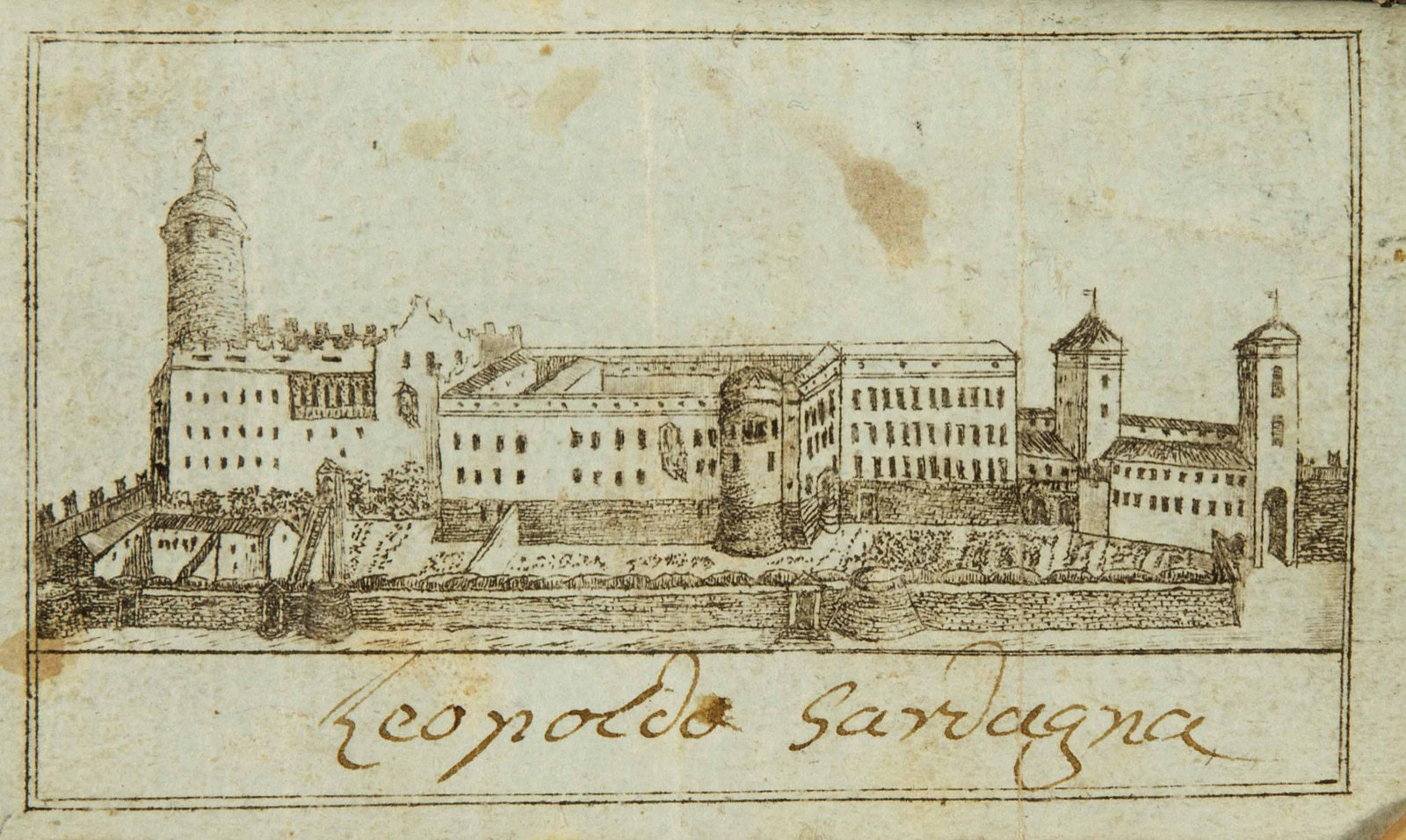
Thirty Castle of the Good Council
· Digital Library Trentino (via Europeana)
Public domain
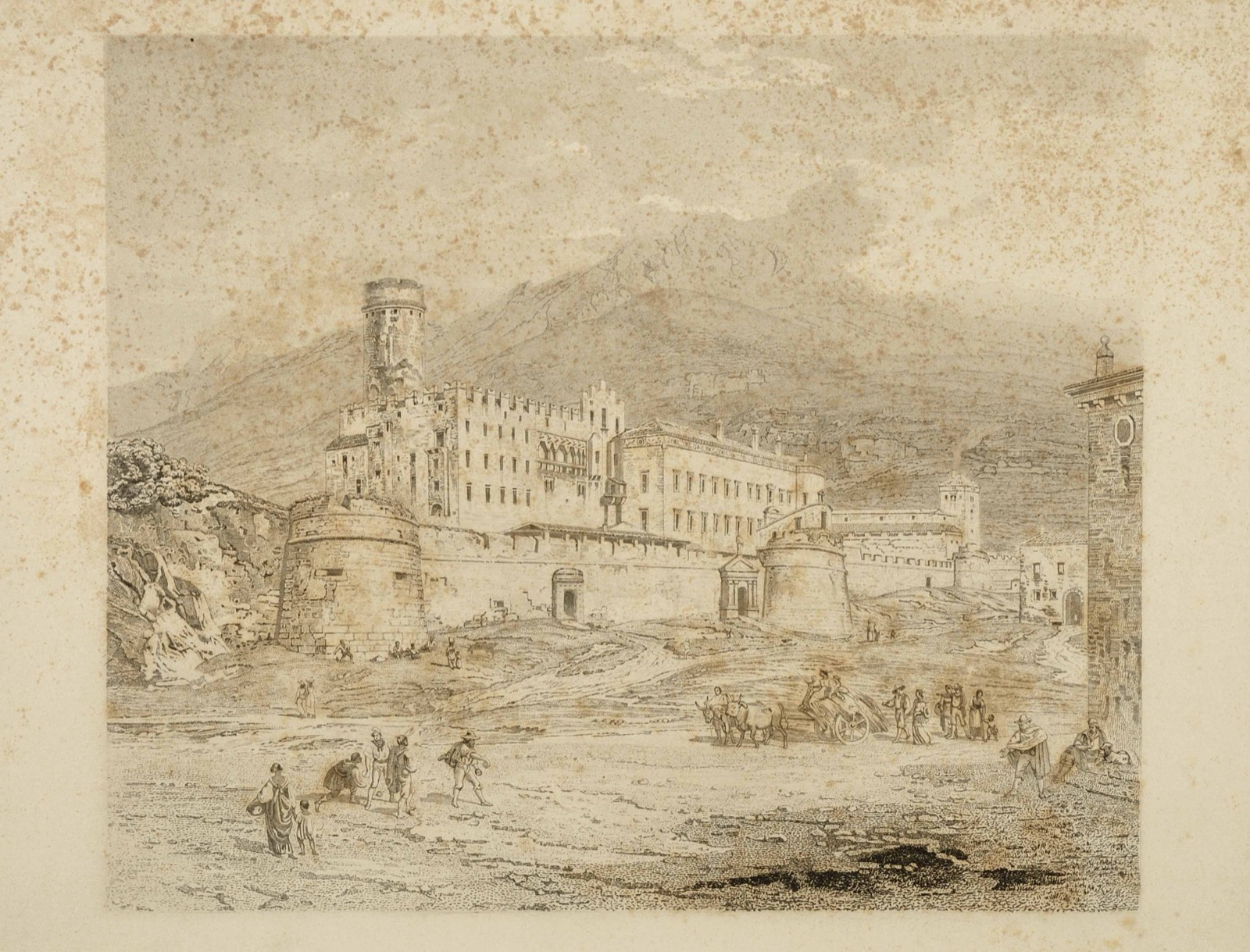
Thirty Castle of the Good Council
· Digital Library Trentino (via Europeana)
Public domain


