
Italy · Still standing
Poppi Castle
Castello dei Conti Guidi
Poppi Castle (Castello di Poppi) is a medieval stone fortress in Poppi, Tuscany, historically associated with the Guidi family. The building presents a tall square tower beside a large rectangular keep with crenellated parapets and an inner courtyard containing a prominent stone staircase and a small chapel with fresco decoration.
First raised
1169
Its prime
1470
Today
Still standing
As it stood in 1470
What Poppi Castle looked like in its prime.
A large rectangular stone keep with a continuous crenellated parapet dominates the silhouette; the masonry is warm ochre-brown local stone with regular courses. A tall, square tower rises immediately to one side, capped in the castle's prime by a machicolated parapet and an open arched belfry near the top. Rows of arched and mullioned windows puncture the façade. Low curtain walls and a smaller secondary tower sit around a wooded hillsite; an inner courtyard and a broad stone staircase link living quarters.
Its story
The story of Poppi Castle.
From the Abbey of San Fidele to the Counts Guidi
A castle at Poppi first appears in writing in the later twelfth century, dated 1169 by some accounts and 1191 by others, and in the earliest of those notices it belonged to the abbey of San Fidele de Strumi. Documentation from the 1190s shows it by then in the hands of the Counts Guidi, whose name it still carries as the Castello dei Conti Guidi. For the next 350 years the Guidi held largely unchallenged control of the Casentino, governing from other castles on its hills as well, among them Romena and Porciano. The construction of the foundations suggests a fortification had stood on the site earlier than the documents reach.
The parts of the castle seen today were begun in the second half of the thirteenth century, with the tower and the keep to its left. The tower was originally taller and carried machicolations, projecting parapets pierced for dropping missiles on anyone beneath.
Simone Guidi's Rebuilding and the Gaddi Frescoes
From 1274 the building was reworked at the direction of Count Simone Guidi and his son Guido. In later years a second keep went up to the right of the tower and was absorbed into the residence, with a jail below it, and at the end of the thirteenth century Simone had the mullioned windows enlarged to give the facade a more elegant line. Authorship is not settled: the oldest part has been attributed, though not with one voice, to Lapo di Cambio, and the later work of the late thirteenth century to Arnolfo di Cambio, who is said to have used Poppi as a prototype for the Palazzo Vecchio he also designed.
The vault of the chapel leading off the courtyard carries one of the most important fresco cycles in the province of Arezzo, and its walls are almost wholly painted as well, three cycles among them running on the stories of St John the Baptist, St John the Evangelist and the life of Mary. The work is given to Taddeo Gaddi, a pupil of Giotto; the Evangelists enthroned in the four corners of the vault are placed in his youthful phase during the 1320s, an attribution confirmed after restorations carried out between 1988 and 1990.
Campaldino, 11 June 1289
Poppi was drawn into two battles that carried important implications for the political direction of the whole Casentino, and the first was fought on its doorstep. On 11 June 1289 the Aretine and Florentine armies met at Campaldino, in front of the castle. Count Guido Novello was a Ghibelline and aligned with Arezzo rather than with the Guelphs of Florence, and Poppi took the Aretine side. The Ghibelline forces were quashed and Poppi had to defer to the rule of Florence. Dante, then a young man of 24 in the Florentine Guelph party, was said to have been present, though historians disagree over whether he actually took part. Defeat did not dislodge the Guidi, who went on ruling the Casentino for another 150 years.
Anghiari, Exile and Florentine Rule from 1440
In 1440, at the Battle of Anghiari, the Guidi again took the field against Florence. The Milanese were defeated by the Florentine army and Count Francesco dei Guidi was forced to surrender. He was lucky to be spared his life; he and his family were exiled, the Guidi dynasty in the Casentino came to an end, and Poppi was ruled by Florence up to the Unification in 1860.
Additions made across the century and a half following the Guidi rebuilding opened up the inner courtyard, and in the 1470s a stone staircase was raised from it to the first floor, attributed to Jacopo di Baldassarre Turriani and perhaps worked from a design by Brunelleschi. At its head stands a pietra serena statue of a knight, usually identified as Guido di Simone da Battifolle. The walls beside the staircase were covered over the years with the arms of the Florentine families who governed Poppi through the fifteenth and sixteenth centuries. Lightning struck the tower during the nineteenth century, and it was remodelled afterwards into its present form.
The Rilliana Library and the Campaldino Museum
Count Fabrizio Rilli Orsini left his library to the community of Poppi on his death in 1828. First kept in a palace in the town, it was moved in 1911 into a wing of the castle, five large rooms and a small parlour. Around 9,000 volumes formed the original nucleus; to these were added private bequests, among them the Soldani legacy, and the book collections of monastic houses suppressed at the Unification of Italy, including the hermitage of Camaldoli, the convent of the Capuchin Friars Minor and the Vallombrosan monastery of San Fedele at Poppi. The Rilliana now holds some 25,000 early books, among them 868 manuscripts, 150 of them medieval, and 930 incunabula of the fifteenth century.
The castle housed the communal administration of the town for years. It now holds a museum devoted to the battle of Campaldino, the Rilliana library and the Giovanni Gualberto Miniati documentation centre, and it is designated Italian national heritage.
Step inside
9 places to explore in 1470.
The record describes 9 distinct spots at Poppi Castle, including 4 interiors: inner courtyard, grand stone staircase and coats of arms, guidi chapel with frescoed walls and more. Create your own photoreal reconstruction and explore every one, more scenes means more rooms, more angles, and more of the place to stand in.
Build Your Own Castle
Recreate Poppi Castle with AI to explore it.
The artist rebuilds it as it stood in 1470, a photoreal reconstruction that belongs to you alone. Pay with coins, no subscription needed.
Recreate this castle →Defend this castle →Whose castle
Clans who held Poppi Castle.
The families that held Poppi Castle for a decade or more across its history, follow a name to its clan.
Guidi
Held by the Counts Guidi from the 1190s, controlling the Casentino for some 350 years until Count Francesco was forced to surrender to Florence and the family was exiled.
From the archive
Poppi Castle on paper: the measured plan and period views.
The survey plan and photographs below are the ground truth this page's reconstructions are checked against, drawn and photographed while the castle was still a working garrison. Every image is public-domain or openly licensed, with its source named.
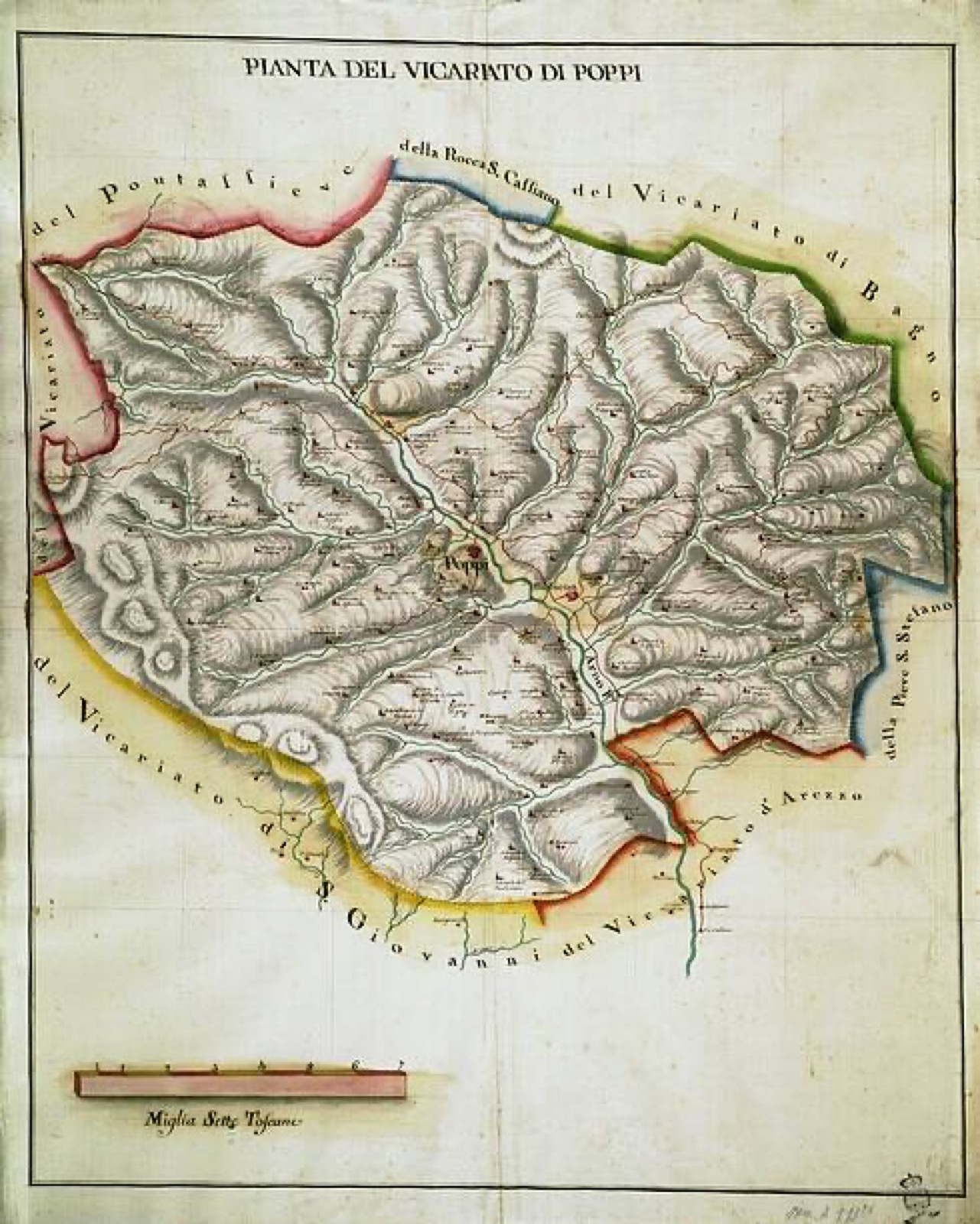
Poppi Vicariate Plan
1780 · The Central National Library of Florence (via Europeana)
Public domain


