
Italy · Restored
Visconti Castle
Castello Visconteo di Pavia
The Visconti Castle of Pavia is a 14th-century brick castle built after 1360 by Galeazzo II Visconti as a sovereign residence and administrative centre. It occupied a square plan with four large corner towers and extensive internal halls; many original frescoed rooms survive only in fragments, and the building today houses the Pavia Civic Museums after 20th-century restorations.
First raised
1360
Its prime
1365
Today
Restored
As it stood in 1365
What Visconti Castle looked like in its prime.
A vast square-plan red-brown brick palace with long, low curtain walls punctuated by regular arched and mullioned windows, and four massive square corner towers capped by steep hipped roofs and open arched top floors. A continuous crenellated cornice runs under the roofline; the structure stands on a raised scarp above a surrounding ditch/moat and is set against an extensive walled park. The internal faces open onto a colonnaded ground-floor portico and a first-floor loggiato with multi-light openings.
Its story
The story of Visconti Castle.
Galeazzo II Visconti Builds a Sovereign Seat, 1360–1402
Galeazzo II Visconti conquered Pavia in 1359 and ruled it as the western portion of Visconti territory. He began the castle in 1360 as a residential palace for the sovereign court rather than a fortress, with military functions concentrated in the surrounding citadel, and the building was finished within about five years. Petrarch, visiting in the autumn of 1365, called it "an enormous palace in the citadel, a truly remarkable and costly structure". The architect is not identified with certainty; the work has been tentatively attributed to Bernardo da Venezia, who was active in Pavia from 1389.
Beside the castle the Visconti laid out a walled hunting park reaching the Certosa di Pavia, the Carthusian monastery Gian Galeazzo founded in 1396. Gian Galeazzo had ousted his uncle Bernabò in 1385 to become sole ruler of Milan, continued to reside at Pavia, and directed military campaigns against neighbouring powers from the castle. Its western tower held the Visconti Library, expanded under Gian Galeazzo; Geoffrey Chaucer is said to have visited it in 1378.
The Sforza Court and a Ducal Wedding, 1402–1499
After Gian Galeazzo's death in 1402 the ducal capital reverted to Milan, but the castle kept being decorated: Filippo Maria Visconti had Pisanello fresco one of its rooms, and Francesco Sforza, Duke of Milan from 1450, arranged to preserve the existing paintings, calling in Bonifacio Bembo to restore the Great Hunting Hall in 1457 and again before Galeazzo Maria Sforza's marriage to Bona of Savoy in 1468. On 17 January 1491 Ludovico il Moro married Beatrice d'Este in the castle's ducal chapel. That year Ludovico also had his nephew Gian Galeazzo Sforza and his wife Isabella of Aragon moved into the castle, where they lived until 1495, the year of Gian Galeazzo Sforza's suspicious death. Louis of Orleans, a Visconti descendant who became King of France as Louis XII, invaded the duchy in 1499 and occupied Pavia; under French rule roughly half the Visconti Library was carried off to Paris.
War Between France and the Empire, 1512–1535
The Duchy of Milan became a battleground of the Italian Wars. The French withdrew from Pavia after the Battle of Ravenna in 1512 and the Sforza returned, only for Francis I to conquer Milan and Pavia again at Marignano in 1515. The Battle of Pavia in 1525, fought in the Visconti park itself, ended with Francis I defeated and taken prisoner, and damaged the park's walls badly enough to start their long decline. After his release the French attacked again in the War of the League of Cognac: Odet de Foix, Viscount of Lautrec, besieged the castle in 1527, and French artillery destroyed its north-eastern side along with two towers, taking the castle's most richly decorated apartments with it. France lost the war again, and Pavia returned to the Holy Roman Empire with the Sforza reinstated as dukes. When Francesco II, the last Sforza duke, died without heirs in 1535, Charles V took direct rule of the city; Spanish builders later raised new city walls along the line of the ruined north-eastern side, cutting the castle off from its own park.
Barracks, Restoration and the Civic Museums, 1796–1940s
Napoleon's forces occupied Pavia in 1796 and turned the castle into a barracks, covering its roof in earth for protection against artillery, which let in damp that damaged the fabric further. Its foundry was reopened and enlarged into the artillery arsenal of the Kingdom of Italy until 1814, and the returning Austrians kept the castle as a barracks after 1815. After Italian unification in 1859–60 it passed to the Italian army, garrisoning 1,200 men and 600 horses; this prolonged military occupation was the primary cause of the deterioration of the frescoes that once decorated its rooms, which now survive only in fragments. Military use ended in 1920, and restorations completed by the 1940s adapted the castle for public use while preserving its existing form. Listed as Italian national heritage, it now houses the Pavia Civic Museums.
Step inside
11 places to explore in 1365.
The record describes 11 distinct spots at Visconti Castle, including 8 interiors: first-floor loggiato (gallery), sala grande delle caze (great hunting hall), camera delli spechi (room of the mirrors) and more. Create your own photoreal reconstruction and explore every one, more scenes means more rooms, more angles, and more of the place to stand in.
Build Your Own Castle
Recreate Visconti Castle with AI to explore it.
The artist rebuilds it as it stood in 1365, a photoreal reconstruction that belongs to you alone. Pay with coins, no subscription needed.
Recreate this castle →Defend this castle →Whose castle
Clans who held Visconti Castle.
The families that held Visconti Castle for a decade or more across its history, follow a name to its clan.
Visconti
Built after 1360 by Galeazzo II Visconti, Lord of Milan; sovereign residence of the Visconti until the Sforza succession.
Sforza
Held by the Sforza Dukes of Milan from 1450 until the death of Francesco II, the last Sforza duke, in 1535.
From the archive
Visconti Castle on paper: the measured plan and period views.
The survey plan and photographs below are the ground truth this page's reconstructions are checked against, drawn and photographed while the castle was still a working garrison. Every image is public-domain or openly licensed, with its source named.
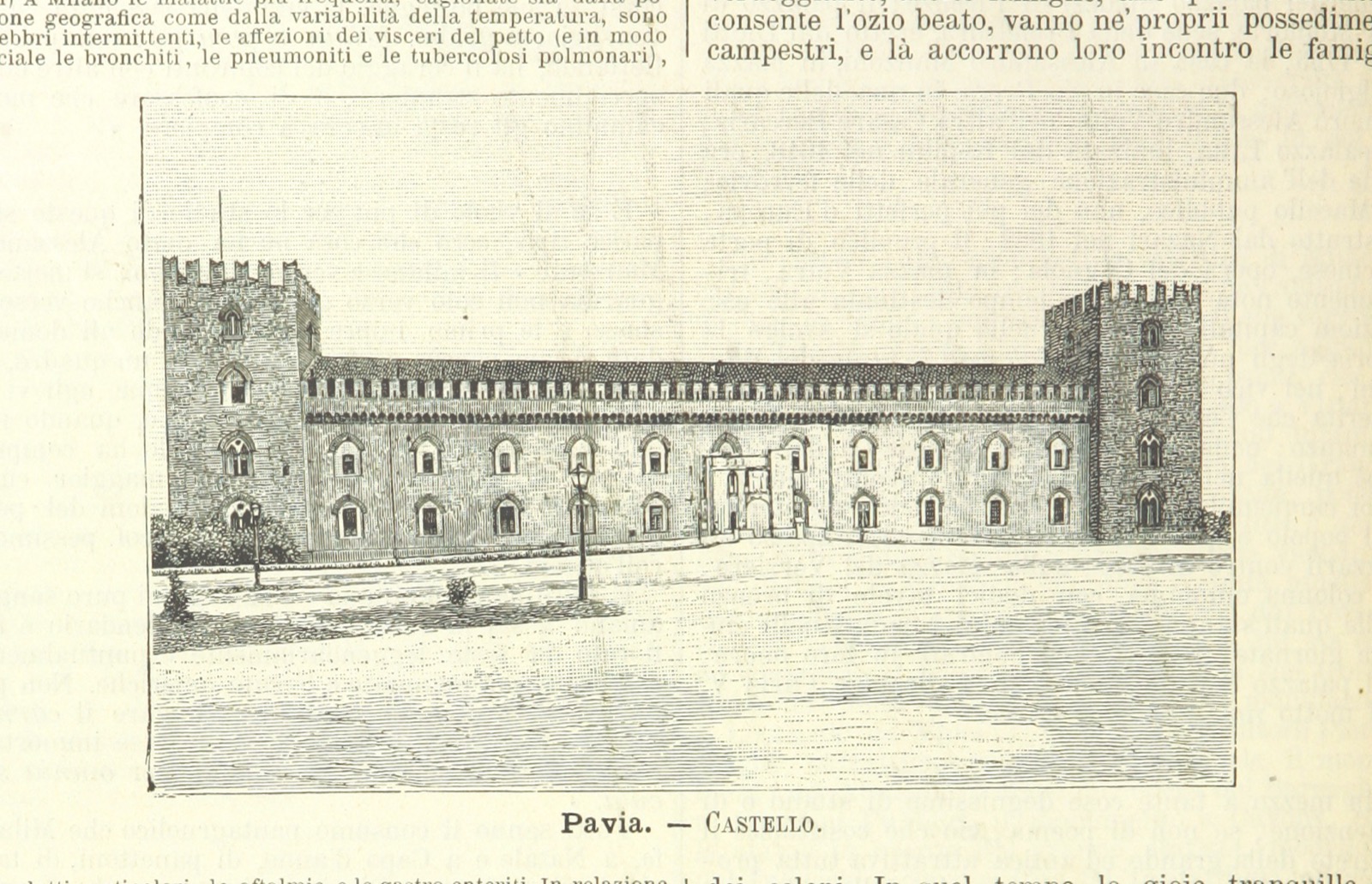
Visconti Castle from "L'Italia geografica illustrata, etc".
1891 · The British Library (via Europeana)
Public domain
Nearby


