Romania · Restored
Bran Castle
Castelul Bran
Bran Castle is a medieval fortress located at Bran, on the Transylvanian side of the historical border with Wallachia in Romania. Built in stone from the late 14th century and substantially refurbished in the early 20th century as a royal residence, it now functions as a museum displaying Queen Marie's art and furniture and is a major national monument and tourist site.
First raised
1289
Its prime
1920
Today
Restored
Ranked among Europe’s castles
As it stood in 1920
What Bran Castle looked like in its prime.
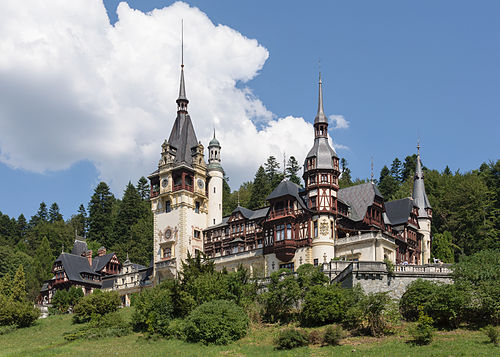
Perched on a wooded rocky hill above a mountain pass, Bran Castle presents a jagged silhouette of cylindrical plastered towers and square stone keeps capped with steep red clay tile roofs. A tall rectangular central keep rises with an open wooden belfry and crenellated parapet; round towers with conical tiles anchor the corners and sections of curtain wall link the volumes. The masonry alternates smooth pale render and exposed stone, with narrow slit windows and visible repair patches; the whole compound sits surrounded by forest.
Its story
The story of Bran Castle.
Dietrich's Stone, 1211–1225
Traders had used the mountain pass at Bran for more than a millennium before anyone fortified it. A claim to an eleventh-century Székely work on the site rests on the Székely Chronicle of Csik, whose veracity is questioned; the documented history begins in 1211, when Andrew II gave the land to the Teutonic Order to protect Hungary from the Cumans.
In 1212 the Order built a wooden castle at the entrance to the pass, in the Burzenland. It was called Dietrichstein (in Latin lapis Theoderici, Dietrich's Stone), after frater Theodericus, the Order's Comthur and regional Preceptor, named in a document of 1212 and the probable builder; a document of 1509 still recorded that Törzburg county had once been his. Royal troops destroyed it around 1225, during the expulsion of the Teutonic Order from the Kingdom of Hungary.
The Saxons' Charter of November 1377
The first documented mention of Bran is an act issued by Louis I of Hungary at Zvolen in November 1377, confirming to the Saxons of the Brașov Seat the right to raise, as they had promised, a new stone castle at their own expense and with their own craftsmen. The wording (novum castrum in lapide Tydrici edificare, a new castle on Dietrich's stone) shows an older work already standing on the rock. In the same act the king promised that if Wallachia came "into our hands" the customs post would move from Rucăr to Bran. Where many castles of the period belonged to the nobility, this one was raised for fortification and for the protection of Transylvania's German colonists; the settlement of Bran grew up nearby.
Sigismund's Base and Moise's Retreat, 1395–1533
In 1395 Sigismund of Luxembourg, king of Hungary, used Bran as the strategic base for an incursion into Wallachia that removed the voivode Vlad the Usurper, rival of his vassal Mircea the Elder. In 1407 Sigismund granted Mircea the castle without its associated domain, and Bran stayed under Wallachian authority until 1419; the customs point on the pass is believed to have been established in Mircea's time. In 1427 it passed to the Hungarian Crown, which financed fortification and extension works, and in 1498 the Crown leased it back to the Brașov Seat. Between 1438 and 1442 it was used in defence against the Ottomans.
In 1530 Moise of Wallachia sent an army to capture the castle; the Székely soldiers under the castle lord Dénes defended it and forced the Wallachian army to retreat. Three years later the city of Brașov regained possession, King Vladislas II having failed to repay his loans. The south tower went up in 1622 to plans by Prince Gabriel Bethlen, and the pass was still garrisoned and its customs post still worked into the middle of the eighteenth century.
Vlad Țepeș and the Gorge Below
Outside Romania the castle is marketed as Dracula's Castle and presented as the home of the title character in Bram Stoker's novel of 1897. Bran is not mentioned in the novel; there is no evidence Stoker knew anything about the castle or ever visited Transylvania, and his description of Dracula's crumbling fictional seat bears no resemblance to this one. The claimed connection is tourism-driven.
The historical thread is thinner still. Vlad Țepeș, voivode of Wallachia in 1448, from 1456 to 1462 and again in 1476, whose byname Drăculea resembles Dracula, passed several times through the Bran Gorge below and does not seem to have had a significant role in the fortress's history. Most historians agree he never lived here, in a place neither friendly for him to visit nor under his rule; it was once believed he was imprisoned at Bran after his capture by the Hungarians in 1462, but historians now conclude that imprisonment was in a fortress in Budapest.
Queen Marie's Gift and the Habsburg Return
With the Treaty of Trianon in 1920 Hungary lost Transylvania, and the Saxons of Kronstadt-Brașov, with no further use for a time-damaged castle and no interest in financing it, gave it up. On 1 December 1920, on the initiative of the mayor Karl Ernst Schnell, the Brașov city council donated Bran to Queen Marie of Romania in recognition of her contribution to the Great Union. It became her favourite home and retreat, and she ordered an extensive renovation from the Czech architect Karel Zdeněk Líman, the heaviest of the work falling between 1920 and 1929.
On Marie's death in 1938 the castle went to her daughter Princess Ileana, who returned to the country during the Second World War, lived at Bran and founded a hospital there for the casualties of the war. In 1948 the communist regime expelled the royal family and nationalised it; it opened to the public in 1956 as a museum of feudal history and art. A 2005 restitution law reopened the question of ownership, and on 18 May 2006 Bran was returned to the children of Princess Ileana, a parliamentary committee called the retrocession illegal in September 2007, but the Constitutional Court rejected parliament's petition in October and a government commission reaffirmed the restitution in December. Administration passed to Archduke Dominic of Austria and his sisters on 18 May 2009; the state's collections had gone to the Vama Medievală, so the family refurnished the rooms from their own and opened the castle that June as the first private museum in the country.
Step inside
7 places to explore in 1920.
The record describes 7 distinct spots at Bran Castle, including 1 interior: museum room with queen marie's furniture. Create your own photoreal reconstruction and explore every one, more scenes means more rooms, more angles, and more of the place to stand in.
Build Your Own Castle
Recreate Bran Castle with AI to explore it.
The artist rebuilds it as it stood in 1920, a photoreal reconstruction that belongs to you alone. Pay with coins, no subscription needed.
Recreate this castle →Defend this castle →From the archive
Bran Castle on paper: the measured plan and period views.
The survey plan and photographs below are the ground truth this page's reconstructions are checked against, drawn and photographed while the castle was still a working garrison. Every image is public-domain or openly licensed, with its source named.
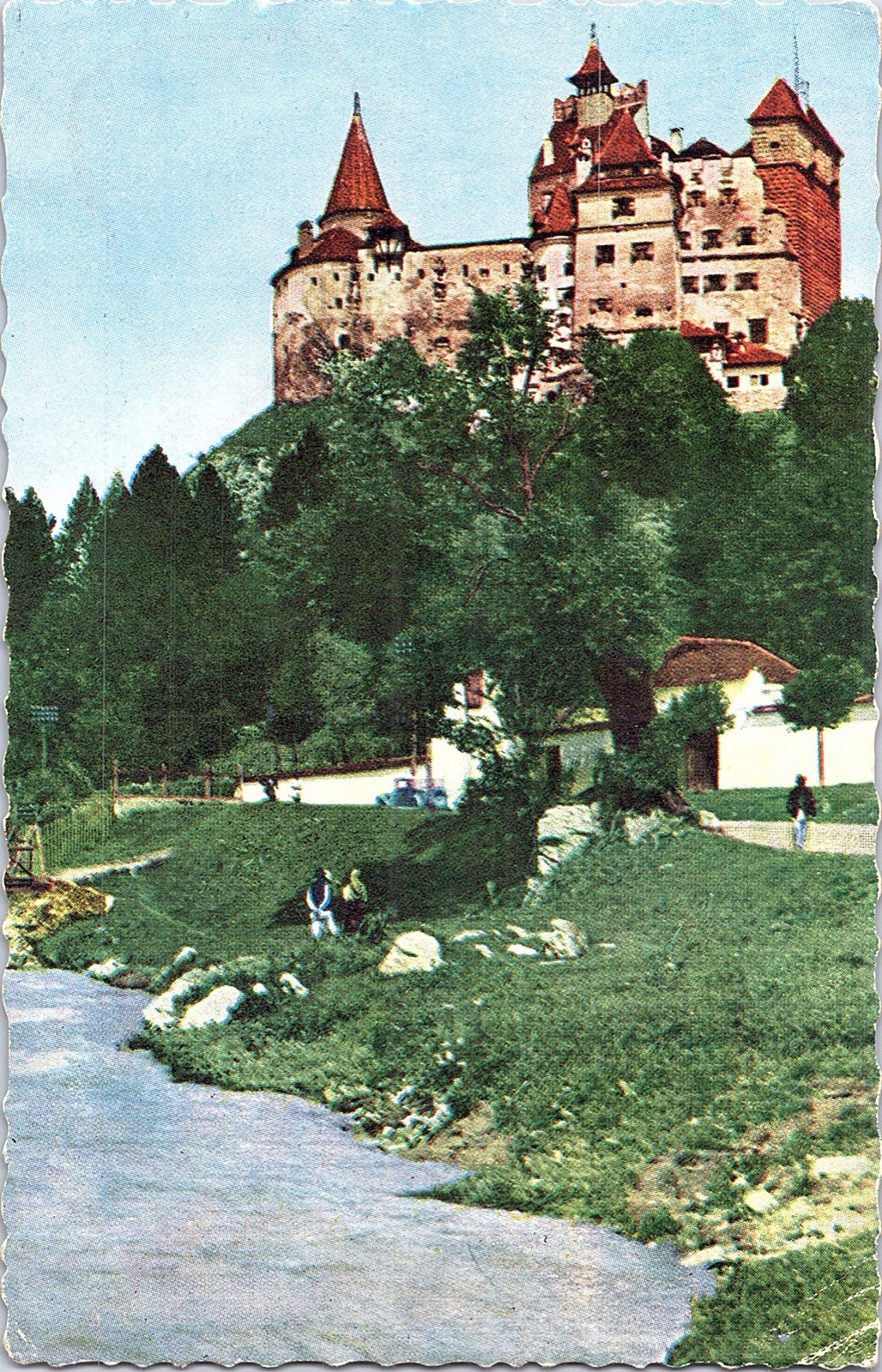
BRAN - Castelul
1383 · National Heritage Institute, Bucharest (via Europeana)
CC BY-SA