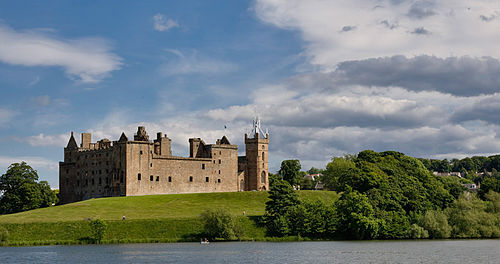
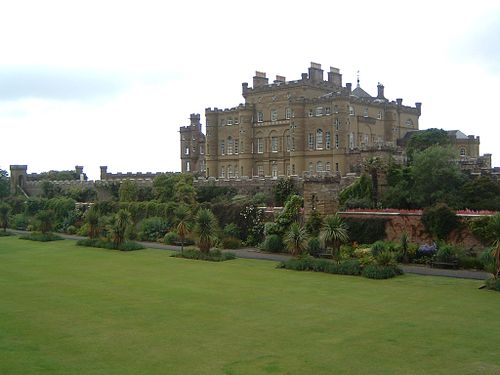
Scotland · Ruin
Castle Tioram
Castle Tioram is a medieval ruined castle standing on the tidal island Eilean Tioram in Loch Moidart, western Scotland. Historically the seat of Clann Raghnaill (Clanranald), it has been unoccupied since the early 18th century and is a scheduled monument. The island is reached at low tide by a causeway but interior access is restricted today because of unstable masonry.
Its prime
1500
Today
Ruin
As it stood in 1500
What Castle Tioram looked like in its prime.
A compact, curtain‑walled stronghold of grey, roughly coursed local stone perched on a low rocky, grassy tidal island. The silhouette is a near‑rectangular block with stout, slightly rounded corner massing, a continuous crenellated parapet broken by several short rectangular tower/stair projections, and narrow vertical slit windows. The castle rises directly from exposed rock and grass, with the loch and heathered hills behind; in its prime the walls and battlements were complete and continuous.
Its story
The story of Castle Tioram.
Clann Ruaidhrí and the Island in the Charter
Castle Tioram (Caisteal Tioram, the dry castle) occupies Eilean Tioram, a tidal island in Loch Moidart north of Acharacle and some 80 km west of Fort William. It is a position that gives nothing away to the open sea while holding the way into Loch Shiel, and locally the place has long been called Dorlin Castle.
Its beginnings are told more than one way. It is counted among Somerled's castles of his own century, the 12th, though other datings put it in the 13th or 14th. The lordship it served is clearer than its birth date: it appears to have been a principal stronghold of Clann Ruaidhrí, and the island first enters the record in a charter of Cairistíona Nic Ruaidhrí, daughter of Ailéan mac Ruaidhrí. Early modern tradition, preserved in the 17th-century Sleat History, credits the building of the castle to Ailéan's granddaughter Áine Nic Ruaidhrí. What is certain is that it served Áine's Clann Raghnaill descendants as their seat for centuries, and it remains the traditional seat of the Clanranald branch of Clan Donald.
Seized for a King in Exile, 1692
Allan Macdonald of Clanranald had sworn allegiance to William III and II and to Mary II, and then went to join the exiled court of James VII and II in France. Government forces took his castle in around 1692 and installed a small garrison on the island, which held it until the next rising.
Allan Macdonald Burns His Own Seat, 1715
The Jacobite rising of 1715 gave Allan his chance to take Eilean Tioram back, and he recaptured the castle and set it alight, purportedly so that Hanoverian forces could never use it against him. It has stood unoccupied ever since, though not entirely unused: some accounts have it partially inhabited afterwards, put to service for the storage of firearms from the De Tuillay during the Jacobite rising of 1745, and appearing in Lady Grange's account of her kidnapping.
The Restoration Refused, 1997–1998
In 1997 the new owners, Anta Estates, announced proposals to bring the ruin back into use, with a clan centre and museum, domestic apartments and some public access. Highland Council granted planning consent, but Historic Scotland refused Scheduled Monument Consent, and that refusal was upheld after a local public inquiry. The following year the Council issued a Dangerous Buildings Order that closed the castle to the public on grounds of its condition. Assessment found the main structure "inherently strong", while concluding "that without major consolidation work the risk of further collapse in five to 10 years was significant".
The warning proved sound. In 2000 several square metres of the outer layer of the north-west curtain wall came away, and the owners made the repair; a condition report in September 2014 found no significant change in the stonework since. A scheduled monument since April 1920, the castle can be walked to across the tidal causeway (Eilean Tioram is one of seventeen tidal islands reachable on foot from the Scottish mainland), but the interior stays shut against falling masonry. The research, drawings and photographs the owners lodged now sit in the archive of the Royal Commission on the Ancient and Historical Monuments of Scotland, since absorbed into Historic Environment Scotland.
Step inside
5 places to explore in 1500.
The record describes 5 distinct spots at Castle Tioram, including 1 interior: interior courtyard. Create your own photoreal reconstruction and explore every one, more scenes means more rooms, more angles, and more of the place to stand in.
Build Your Own Castle
Recreate Castle Tioram with AI to explore it.
The artist rebuilds it as it stood in 1500, a photoreal reconstruction that belongs to you alone. Pay with coins, no subscription needed.
Recreate this castle →Defend this castle →Whose castle
Clans who held Castle Tioram.
The families that held Castle Tioram for a decade or more across its history, follow a name to its clan.
Traditional seat of the Clanranald (Clann Raghnaill) branch of Clan Donald for centuries, until government forces seized it around 1692 when the chief joined the exiled Jacobite court in France.