Scotland · Ruin
Duchal Castle
Duchal Castle is a medieval courtyard-style castle on a peninsula formed by the Blacketty and Green Waters near Kilmacolm in Renfrewshire, Scotland. Its substantial curtain walls and inner/outer baileys occupy a raised promontory with steep gorges on both sides; the site was occupied from the 12th century and fell into ruin after the 17th–18th centuries.
Its prime
1500
Today
Ruin
As it stood in 1500
What Duchal Castle looked like in its prime.
A broad, irregular curtain wall of thick rubble masonry traces the edge of a raised peninsula with near-vertical drops into twin gorges; the level courtyard inside is divided into inner and outer baileys. The main entrance and gatehouse with a defensive ditch and drawbridge occupy the western approach, while a rocky south-eastern outcrop rises about 20 feet above the courtyard and bears the keep's masonry foundations. Stone-lined well/garderobe or slop-shoots pierce the wall toward the gorge; sections of curtain wall show wide gun loops and a probable lean-to with a window at the north-west angle.
Its story
The story of Duchal Castle.
Duchal was held from the 12th century by the Lyle, L'Isle, Lyell or Insula, family, on a peninsula formed by the Blacketty and Green Waters near Kilmacolm, though the thickness of its curtain walls suggests a 13th-century build. In the mid-15th century Lord Lyle was ennobled by James II, and a successor, Sir Robert Lyle, became Lord Chief Justice and a Privy Councillor to James III.
Robert Lyle, 2nd Lord Lyle fought against the king at the Battle of Sauchieburn in 1488 and supported the Lennox rebellion of 1489, whereupon James IV besieged Duchal, local tradition holds that Mons Meg was brought against it, as at Crookston and Dumbarton. The lands were forfeited and the repaired castle held for a time by Robert Cunningham, 2nd Lord Kilmaurs, but Sir Robert returned to the king's favour and was Lord Chief Justice again in 1492.
On the death of John de Lyle, 3rd Lord Lyle in 1544, Duchal passed by purchase to John Porterfield. Jean Knox of Ranfurly retired to the old seat in 1575 on her husband's death, and the family subsequently used it as a dower house; granted by the Crown to Lord Melfort, it was returned to the Porterfields of that Ilk. Two or three 16th-century wide-mouthed gun loops can still be seen in the courtyard wall of the ruin.
Step inside
12 places to explore in 1500.
The record describes 12 distinct spots at Duchal Castle, including 2 interiors: stone-lined well / garderobe chute, upper apartment (great chamber). Create your own photoreal reconstruction and explore every one, more scenes means more rooms, more angles, and more of the place to stand in.
Build Your Own Castle
Recreate Duchal Castle with AI to explore it.
The artist rebuilds it as it stood in 1500, a photoreal reconstruction that belongs to you alone. Pay with coins, no subscription needed.
Recreate this castle →Defend this castle →Whose castle
Clans who held Duchal Castle.
The families that held Duchal Castle for a decade or more across its history, follow a name to its clan.
Lyle
Held by the Lyle family from the 12th century until the death of John de Lyle, 3rd Lord Lyle in 1544.
Porterfield
Purchased by John Porterfield in 1544; returned to the Porterfields of that Ilk after a Crown grant to Lord Melfort.
From the archive
Duchal Castle on paper: the measured plan and period views.
The survey plan and photographs below are the ground truth this page's reconstructions are checked against, drawn and photographed while the castle was still a working garrison. Every image is public-domain or openly licensed, with its source named.
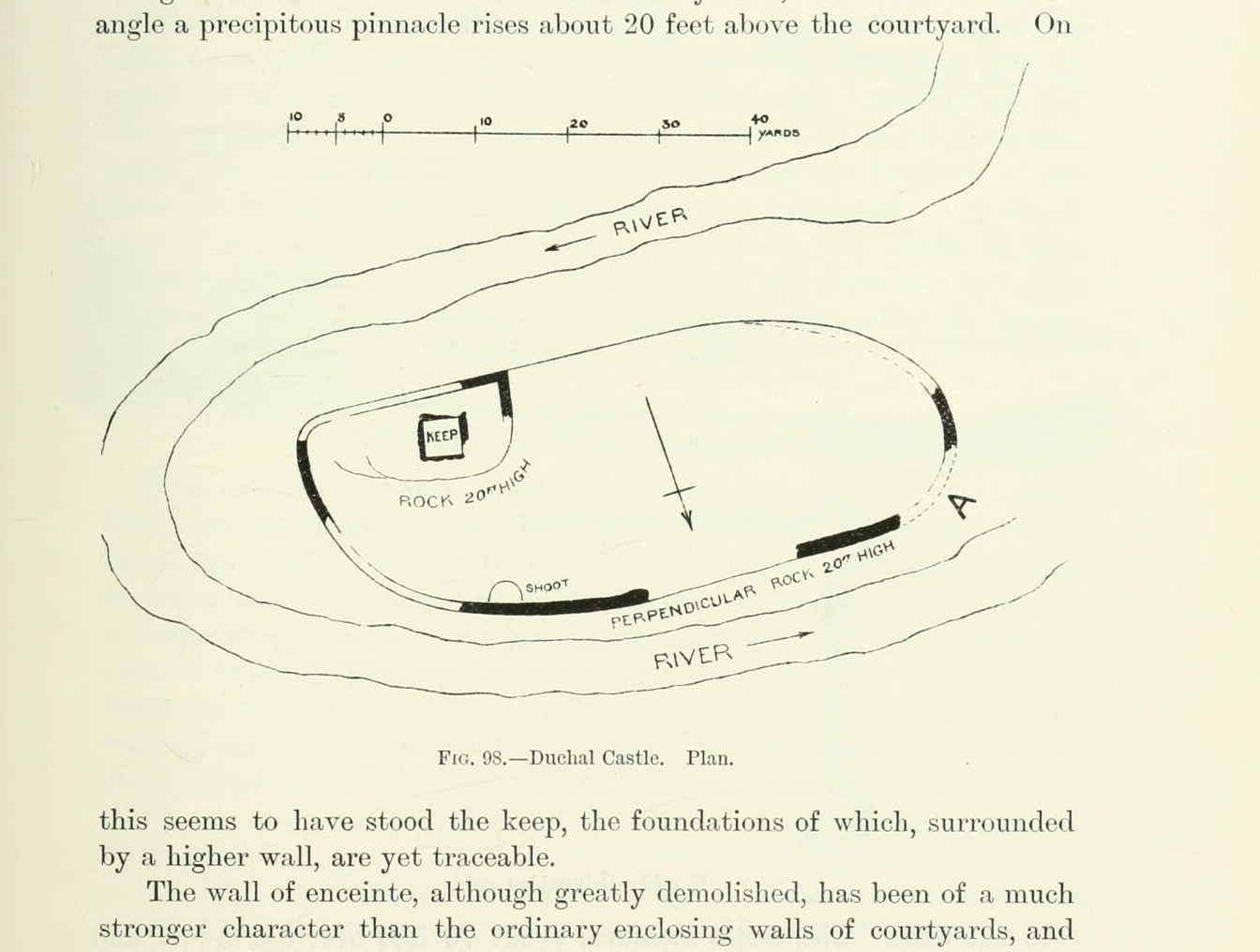
Fig. 98. Duchal Castle. Plan.
1889 · MacGibbon & Ross, vol. 3 (1889)
Public domain
Nearby