Scotland · Ruin
Glengarnock Castle
Glengarnock Castle is a ruined medieval keep with an attached courtyard, sited on a rocky promontory overlooking the River Garnock north of Kilbirnie in North Ayrshire, Scotland. The surviving fabric shows a quadrilateral tower with ranges of lower buildings to the east and a dry moat protecting the only landward approach.
Its prime
1563
Today
Ruin
As it stood in 1563
What Glengarnock Castle looked like in its prime.
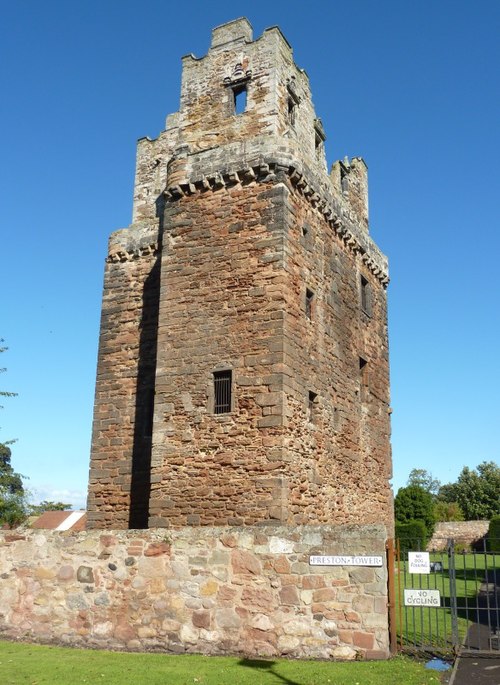
A compact quadrilateral stone tower (rough grey-brown rubble masonry) set on a steep rocky knoll above a deep ravine carrying the River Garnock, with a lower eastward range of courtyard buildings forming a roughly rectangular plan. The tower rises to over 40 feet with small window apertures and a surrounding parapet; the landward approach from the northeast is separated by a dry moat that runs roughly thirty metres, while moss and turf have taken hold on some ruined wall-tops and collapsed sections.
Its story
The story of Glengarnock Castle.
No clear account survives of when Glengarnock's keep was raised, or by whom, it may have been built by the Cunninghams, or by the Riddels who preceded them. In the twelfth and thirteenth centuries the lands were held for the King by the De Morvilles, hereditary Great Constables of Scotland; the Barony of Glengarnock then passed to the Riddels and the Cunninghames. The keep with attached courtyard dates from 1400–1542, set on a remote rocky promontory above the River Garnock north of Kilbirnie, its only landward approach once guarded by a dry moat and drawbridge.
In 1609 Sir James Cunningham assigned the Lands of Glengarnock to his creditors and went to Ireland to manage the 12,000 acres King James VI had granted him. The creditors sold the estate to Cunningham of Robertland, whose son could not retain it; Adam Watt, Clerk to the Signet, obtained the lands before selling them in 1630 to the Honourable Patrick Lindsay, husband of the heiress of Kilbirnie.
A storm in 1839 brought partial collapse, and in 1841 William Cochran Patrick of Ladyland stabilised the ruins: undermined foundations secured, wasted portions of wall taken down and restored, the interior cleared of the rubbish of more than a hundred years of abandonment. The quadrilateral tower and its lower eastern ranges still deteriorate, though without those repairs little would have survived.
Step inside
9 places to explore in 1563.
The record describes 9 distinct spots at Glengarnock Castle, including 2 interiors: upper hall within the tower, narrow circular stair. Create your own photoreal reconstruction and explore every one, more scenes means more rooms, more angles, and more of the place to stand in.
Build Your Own Castle
Recreate Glengarnock Castle with AI to explore it.
The artist rebuilds it as it stood in 1563, a photoreal reconstruction that belongs to you alone. Pay with coins, no subscription needed.
Recreate this castle →Defend this castle →Whose castle
Clans who held Glengarnock Castle.
The families that held Glengarnock Castle for a decade or more across its history, follow a name to its clan.
De Morville
The De Morvilles, hereditary Great Constables of Scotland, held the lands for the King in the 12th and 13th centuries.
Riddel
The Barony of Glengarnock passed to the Riddels, who preceded the Cunninghams.
Held by the Cunninghams until Sir James Cunningham assigned the lands to his creditors in 1609.
Lindsay
Bought in 1630 by the Hon. Patrick Lindsay, husband of the heiress of Kilbirnie.
From the archive
Glengarnock Castle on paper: the measured plan and period views.
The survey plan and photographs below are the ground truth this page's reconstructions are checked against, drawn and photographed while the castle was still a working garrison. Every image is public-domain or openly licensed, with its source named.
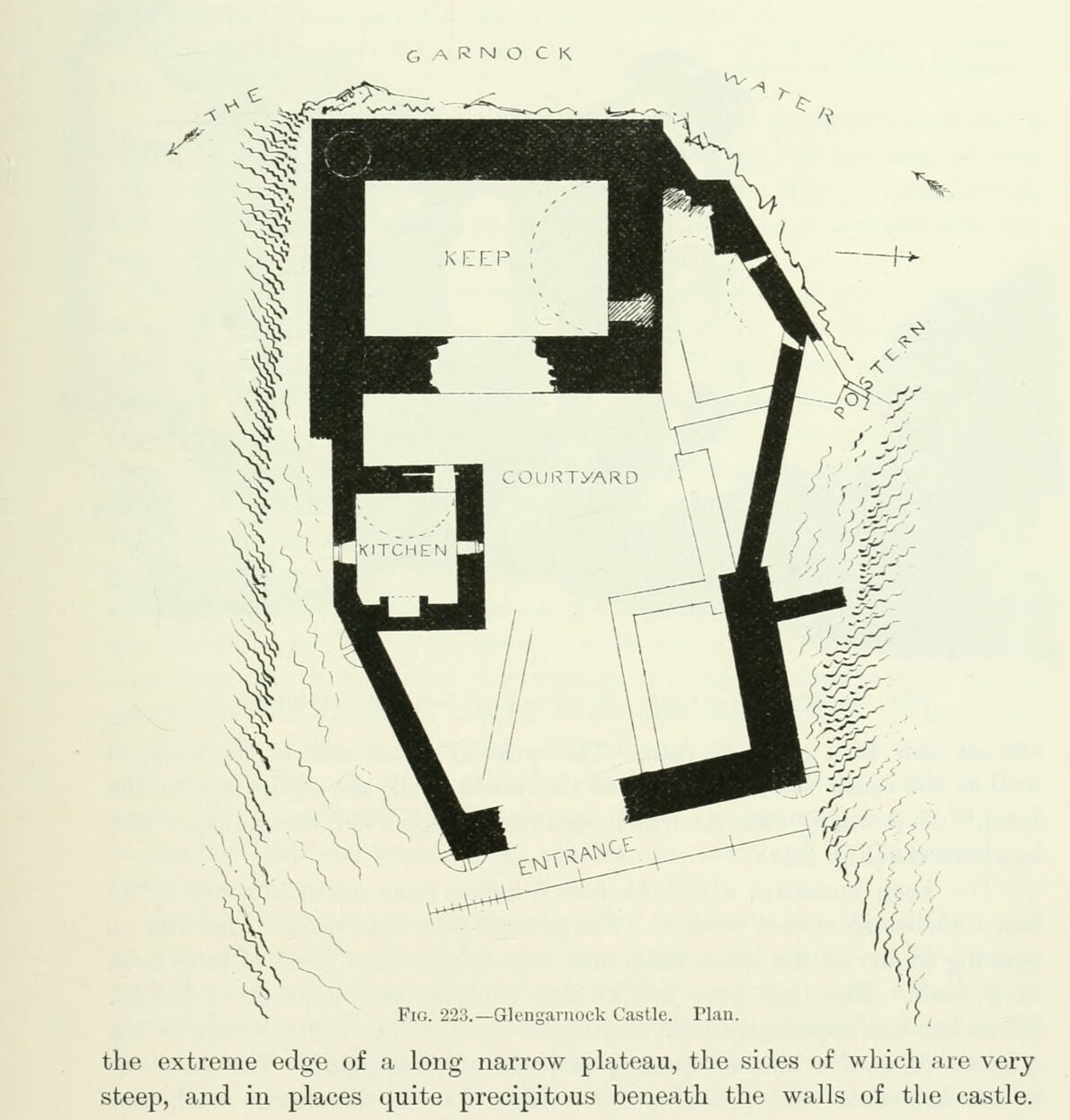
Fig. 223. Glengarnock Castle. Plan.
1889 · MacGibbon & Ross, vol. 3 (1889)
Public domain
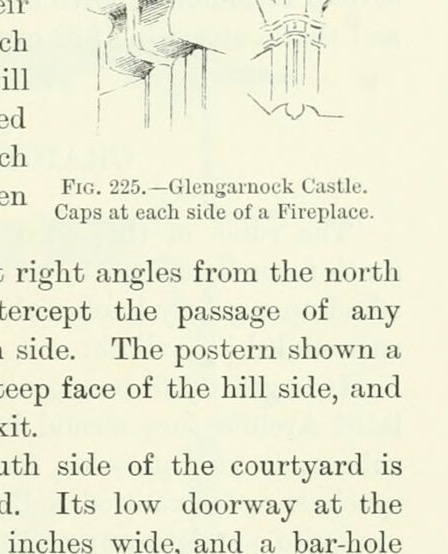
Fig. 225. Glengarnock Castle. Caps at each side of a Fireplace.
1889 · MacGibbon & Ross, vol. 3 (1889)
Public domain
Nearby