
Scotland · Ruin
Knock Castle
Caisteal a' Chnuic
Knock Castle (Caisteal Chamuis) is a small coastal castle on the east side of Knock Bay, Sleat, Isle of Skye, historically held by Clan MacLeod and later by Clan MacDonald. The site today is a ruin with only part of the 15th-century keep and traces of later buildings remaining, and it is a scheduled monument. Local tradition associates the place with a Green Lady ghost and other household spirits.
Its prime
1596
Today
Ruin
As it stood in 1596
What Knock Castle looked like in its prime.
Perched on a low grassy headland projecting into Knock Bay, the castle in its prime consisted of a central rectangular 15th‑century stone keep rising several storeys, surrounded by lower stone ranges added in the 1596 remodelling. The masonry is local grey stone with dressed surrounds to the larger openings; small slit windows punctuate the keep. The complex faces the sea with steep cliffs on three sides, a compact courtyard between the keep and service ranges, and simple pitched roofs over the ancillary buildings.
Its story
The story of Knock Castle.
Caisteal Chamuis on Knock Bay
Knock Castle (Caisteal Chamuis, or Castle Camus) sits on the eastern side of Knock Bay, on the east coast of Sleat on the Isle of Skye, approximately five miles (8 km) north of Armadale and south of Cnoc Uaine. It was built by the Clan MacLeod, and was a stronghold of the MacLeods of Lewis before it passed to the MacDonalds; the keep whose fragments survive is of the fifteenth century. The site is bounded on three sides by a very steep cliff.
Passing Between MacLeod and MacDonald, to the Remodelling of 1596
The MacDonalds captured Knock from the MacLeods in the late fifteenth century, and ownership afterwards passed between the two clans several times. The castle was remodelled in 1596 by the MacDonalds.
Abandonment and the Carrying Off of the Stones
By 1689 the castle stood abandoned and had begun to decay. Most of its stones were taken afterwards for buildings nearby. What is left is part of the old fifteenth-century keep, one window standing to some height, with traces of later buildings about it. The ruins are a scheduled monument, so designated in December 2002; the fabric is not maintained, and the old masonry work can be unstable.
The Green Lady and the Gruagach
Local ghostlore gives the castle a Green Lady, or glaistig, a spirit tied to the fortunes of the family occupying it: she appears happy when good news is coming, and weeps when the news is bad. The castle is also said to have had a gruagach, a spirit with a particular concern for the care of the livestock.
Step inside
7 places to explore in 1596.
The record describes 7 distinct spots at Knock Castle, including 1 interior: keep interior chamber. Create your own photoreal reconstruction and explore every one, more scenes means more rooms, more angles, and more of the place to stand in.
Build Your Own Castle
Recreate Knock Castle with AI to explore it.
The artist rebuilds it as it stood in 1596, a photoreal reconstruction that belongs to you alone. Pay with coins, no subscription needed.
Recreate this castle →Defend this castle →Whose castle
Clans who held Knock Castle.
The families that held Knock Castle for a decade or more across its history, follow a name to its clan.
From the archive
Knock Castle on paper: the measured plan and period views.
The survey plan and photographs below are the ground truth this page's reconstructions are checked against, drawn and photographed while the castle was still a working garrison. Every image is public-domain or openly licensed, with its source named.
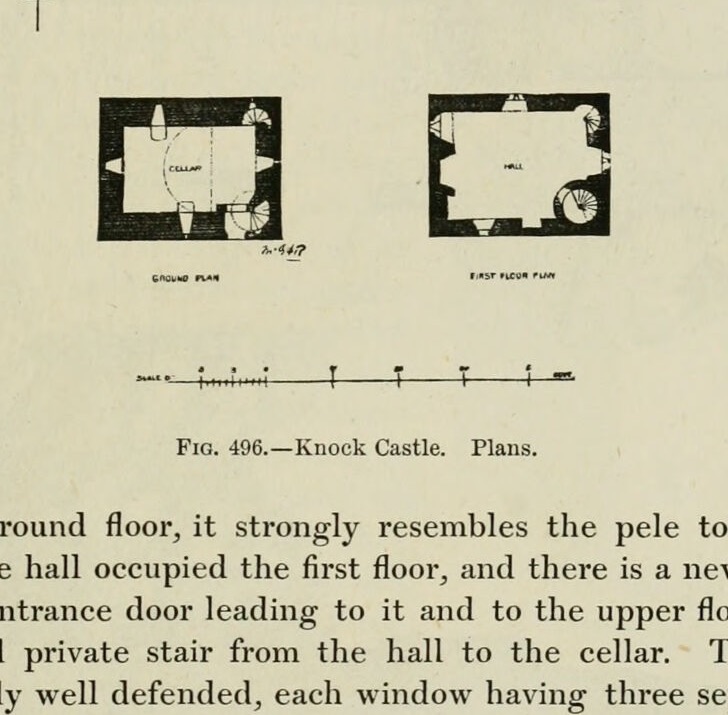
Fig. 496. Knock Castle. Plans.
1887 · MacGibbon & Ross, vol. 2 (1887)
Public domain


