Scotland · Restored
Stanecastle
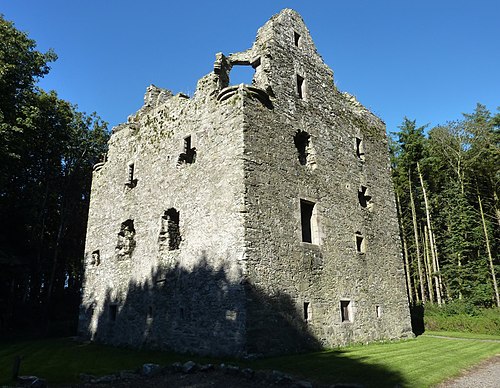
Stanecastle is a medieval barony keep in North Ayrshire, Scotland, built around the early 15th–16th century and later altered as an 18th-century folly. The surviving structure is a single tall rectangular stone keep that has been stabilised and repaired and stands within the former estate grounds near a modern road and gate.
Its prime
1520
Today
Restored
As it stood in 1520
What Stanecastle looked like in its prime.
A compact rectangular stone tower-keep of two-to-three storeys, constructed of irregular coursed rubble with larger ashlar quoins and dressed window surrounds. A projecting corbelled string-course and corbelled parapet run beneath the roofline. In its 1520 form the walls show small narrow defensive slit-windows rather than later decorative arches; an original spiral stair occupies the north-east corner. The keep stands amid trees on the edge of the estate beside a roadside boundary fence, with an armorial/inscribed stone set into one face.
Its story
The story of Stanecastle.
Stanecastle was a medieval barony in North Ayrshire, first mentioned in 1363, when William Fraunces de le Stane held lands that included a chapel dedicated to Saint Bridget. The castle itself was built around 1417 by the Francis family, who also held land at Sprouston near Kelso.
The barony passed by marriage to the Montgomerys of Greenfield, and in the 15th century William Francis of Stane passed his estate to the Earls of Eglinton as their holdings expanded across the district. In 1750 Alexander, 10th Earl of Eglinton, repaired the castle and converted it into a folly, four open and four closed pointed windows built for appearance only, with an armorial panel bearing the Earl's arms set into the west side.
The Montgomery Society of Scotland later attempted to purchase the castle as a clan headquarters and museum, though the plans came to nothing. The single tall rectangular keep has been stabilised and repaired, and stands within the former estate grounds, now part of the Irvine New Town.
Step inside
8 places to explore in 1520.
The record describes 8 distinct spots at Stanecastle, including 2 interiors: keep ground-floor interior, spiral stair in north-east corner. Create your own photoreal reconstruction and explore every one, more scenes means more rooms, more angles, and more of the place to stand in.
Build Your Own Castle
Recreate Stanecastle with AI to explore it.
The artist rebuilds it as it stood in 1520, a photoreal reconstruction that belongs to you alone. Pay with coins, no subscription needed.
Recreate this castle →Defend this castle →Whose castle
Clans who held Stanecastle.
The families that held Stanecastle for a decade or more across its history, follow a name to its clan.
Francis
The Francis family built the castle around 1417 and held the barony of Stane.
Montgomery
Passed by marriage to the Montgomerys of Greenfield and then to the Earls of Eglinton in the 15th century; the 10th Earl converted the keep to a folly in 1750.
Nearby