Clan Rising
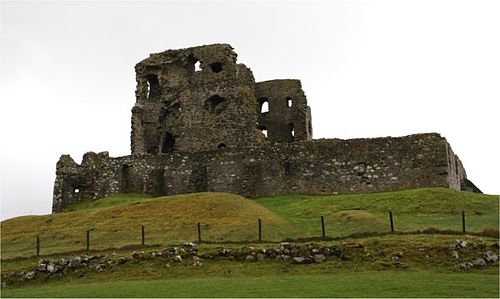
Strome Castle today

Scotland · Ruin

Strome Castle

Strome Castle is a ruined 15th‑century castle on a rocky headland between Loch Carron and Loch Kishorn on Scotland's west coast. Built by the MacDonalds and later contested by other Highland clans, it was besieged and demolished in 1602; today only a courtyard and the remains of a square tower survive as a ruin cared for by the National Trust for Scotland.

Photograph via Wikimedia Commons

Its prime

1600

Today

Ruin

As it stood in 1600

What Strome Castle looked like in its prime.

Perched on a rocky, grassy promontory above the sea, the castle in its prime comprised a central courtyard enclosed by low stone curtain walls and dominated by a substantial square stone tower rising above the headland. The masonry is coarse grey local stone; the tower features a large arched opening on its seaward face and small window apertures. The complex sat directly above a rocky foreshore with a narrow path climbing the grassy slope to the walls.

Its story

The story of Strome Castle.

Built by the Lord of the Isles, 15th Century to 1539

Strome Castle was built on the headland between Loch Carron and Loch Kishorn by Alexander MacDonald, Lord of the Isles and Earl of Ross, in the 15th century. By 1472 it belonged to his eldest son, Celestine of Lochalsh of Clan MacDonald of Lochalsh, with Alan MacDonald Dubh, 12th Chief of Clan Cameron, holding it as constable on the Lochalsh MacDonalds' behalf.

In 1539 James V granted the castle to Clan MacDonell of Glengarry, and Hector Munro, I of Erribol, of Clan Munro became constable for the Glengarry MacDonells.

Siege and Demolition After the Battle of Morar, 1602

In the aftermath of the Battle of Morar in 1602, Kenneth Mackenzie, 1st Lord Mackenzie of Kintail, chief of Clan Mackenzie, besieged Strome with the support of Clan Matheson and Andrew Munro of Novar. The MacDonells surrendered, and the castle was demolished and blown up. The Glengarry MacDonells built a replacement further inland, Invergarry Castle.

National Trust for Scotland Ownership

The ruined castle was presented to the National Trust for Scotland in 1939, which still owns and operates it. It was scheduled as a monument on 24 January 2000. What survives today is a courtyard and the remains of a square tower.

Step inside

7 places to explore in 1600.

The record describes 7 distinct spots at Strome Castle, including 2 interiors: central courtyard, square tower, upper chamber / roofline. Create your own photoreal reconstruction and explore every one, more scenes means more rooms, more angles, and more of the place to stand in.

Approach from shorelineView from Loch Carron (from the water)Central courtyardSquare tower, exteriorSquare tower, upper chamber / rooflineCurtain wall, walkwayRocky foreshore at the cliff base

Build Your Own Castle

Recreate Strome Castle with AI to explore it.

The artist rebuilds it as it stood in 1600, a photoreal reconstruction that belongs to you alone. Pay with coins, no subscription needed.

Recreate this castle →Defend this castle →

Whose castle

Clans who held Strome Castle.

The families that held Strome Castle for a decade or more across its history, follow a name to its clan.
  • MacDonald

    Built in the 15th century by Alexander MacDonald, Lord of the Isles, and held by the MacDonalds of Lochalsh from 1472.

  • MacDonell

    Granted by James V to Clan MacDonell of Glengarry in 1539; held until besieged and demolished after their 1602 surrender.

Questions about Strome Castle

What is the history of Strome Castle?

Strome Castle was built in the 15th century by Alexander MacDonald, Lord of the Isles and Earl of Ross. In 1472 it was owned by his eldest son, Celestine of Lochalsh, and in 1539 James V granted it to Clan MacDonell of Glengarry. After a siege in 1602, the MacDonells surrendered and the castle was demolished and blown up.

What is inside Strome Castle?

Strome Castle contains a central courtyard, the remains of a square tower and an upper chamber or roofline. The surviving spaces are part of a ruin rather than a complete interior. The tower has a large arched opening on its seaward face and small window apertures.

Who owns Strome Castle now?

Strome Castle is owned and operated by the National Trust for Scotland. It has been a scheduled monument since 2000. The ruined castle was presented to the National Trust for Scotland in 1939.

Where is Strome Castle?

Strome Castle is on a headland between Loch Carron and Loch Kishorn, on Scotland’s west coast. It stands on the shore of Loch Carron in Stromemore, 3.5 miles south-west of the village of Lochcarron, within Highland.

When was Strome Castle built?

Strome Castle was built in the 15th century. Its first-raised year is not recorded, but the castle was already owned by Celestine of Lochalsh by 1472. Alexander MacDonald, Lord of the Isles and Earl of Ross, built it on the headland between Loch Carron and Loch Kishorn.

Was Strome Castle ever attacked or besieged?

Strome Castle was besieged in 1602 by Kenneth Mackenzie, 1st Lord Mackenzie of Kintail, assisted by Clan Matheson and Andrew Munro of Novar. After the MacDonells surrendered, the castle was demolished and blown up. The attack followed the Battle of Morar.

Which family or clan held Strome Castle?

Strome Castle was held by the MacDonalds of Lochalsh from 1472. James V granted it to Clan MacDonell of Glengarry in 1539, and the MacDonells held it until their surrender after the 1602 siege and its subsequent demolition.

What did Strome Castle look like in its prime?

In its prime, Strome Castle had a central courtyard enclosed by low stone curtain walls and a substantial square stone tower rising above the headland. It was built from coarse grey local stone, with a large arched opening on the seaward face and small window apertures. The castle stood above a rocky foreshore and grassy slope.

Is Strome Castle still standing or is it a ruin?

Strome Castle is a ruin. Only a courtyard and the remains of a square tower survive after the castle was demolished and blown up in 1602. The surviving ruin stands on the rocky headland above Loch Carron.
All castles of Scotland · Castles of Europe · the best castles in Europe · explore the finished reconstructions.