Scotland · Restored
Towie Barclay Castle
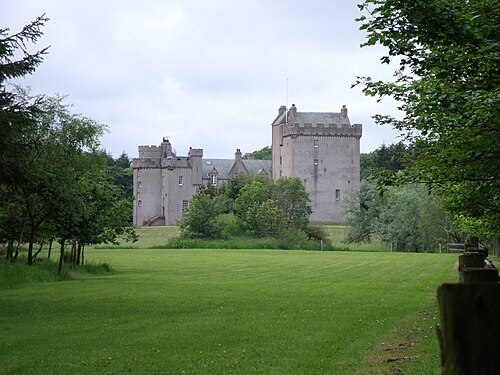
Towie Barclay Castle is a late-16th-century tower house in Aberdeenshire, Scotland, built by Clan Barclay in 1593 and designated a Category A listed building. The present building incorporates sixteenth-century masonry at the lower level with upper floors reconstructed during a 20th-century restoration. It sits within gardened grounds south-south-east of Turriff.
Its prime
1593
Today
Restored
As it stood in 1593
What Towie Barclay Castle looked like in its prime.
A compact quadrangular keep of pink-harled rubble masonry rising two-to-three storeys to a flat crenellated parapet, with small round corner turrets capped by conical slate roofs. Steep slate roof sections with dormer windows and tall chimneys sit behind the parapet; a central flagpole rises from the roofline. The entrance is a small arched doorway at ground level set in a plain stone facade, with a low stone garden wall and trees close around the building.
Its story
The story of Towie Barclay Castle.
The Barclay Grant, the Foundator of 1186 and the Tower of 1593
The site, 4.5 miles south-south-east of Turriff in Aberdeenshire, was given to Clan Barclay in the eleventh century by Malcolm III of Scotland. An early structure appears to have been raised in the twelfth century: an inscription built into the wall reads "Sir Alexander Barclay of Tolly, foundator, deceisit anno domini 1186". From the same century comes the rhyme attributed to Thomas the Rhymer after Clan Barclay pillaged a nunnery: "Towie Barclay of the Glen / Happy to the maids / But never to the men".
The tower that stands today was built by the Barclays in rubble masonry and completed in 1593. Its plan is a slight modification of the traditional quadrangular keep, and the main hall, 30 feet by 20, is vaulted in two compartments.
The Trot of Turriff, 13 May 1639
On 13 May 1639, in the First Bishops' War, the castle was the scene of the first fatality of the Wars of the Three Kingdoms, during the engagement known as the Trot of Turriff.
Findlater, Robert Gordon's Hospital and Two Lost Storeys, 1752–1792
In 1752 Charles Maitland Barclay sold Towie Barclay to James Ogilvy, 5th Earl of Findlater, whose family sold it on to Robert Gordon's Hospital in Aberdeen in 1792. The turrets and embrasures were taken off at that time and the building was cut down by two storeys.
The Ellington Restoration, Late 1960s to 2025
The musician Marc Ellington and his wife Karen bought the castle in the late 1960s. Ellington's music career funded a programme of restoration that Karen Ellington project-managed, extensive work that took many years to finish; the lower storey retains its sixteenth-century masonry while the upper floors are a modern reconstruction. The standard of the work was high enough to win a Saltire Society Award in 1973.
Towie Barclay is a category A listed building. Following Marc Ellington's death in 2021, the castle was bought in 2025 by an American couple, James Burba and Robert Hayes.
Step inside
6 places to explore in 1593.
The record describes 6 distinct spots at Towie Barclay Castle, including 1 interior: vaulted main hall (interior). Create your own photoreal reconstruction and explore every one, more scenes means more rooms, more angles, and more of the place to stand in.
Build Your Own Castle
Recreate Towie Barclay Castle with AI to explore it.
The artist rebuilds it as it stood in 1593, a photoreal reconstruction that belongs to you alone. Pay with coins, no subscription needed.
Recreate this castle →Defend this castle →Whose castle
Clans who held Towie Barclay Castle.
The families that held Towie Barclay Castle for a decade or more across its history, follow a name to its clan.
Barclay
Held by Clan Barclay from the 11th-century grant of Malcolm III until Charles Maitland Barclay sold the castle in 1752.
Ogilvy
Bought by James Ogilvy, 5th Earl of Findlater, in 1752; his family sold it to Robert Gordon's Hospital in 1792.