
Slovenia · Partial ruin
Celje Castle
Celjski grad
Celje Castle is a large medieval castle ruin on a rocky ridge southeast of Celje in Slovenia, formerly the seat of the Counts of Celje. The surviving footprint includes a long curtain wall linking several towers and a multi-storey residential palatium; the site is the largest fortification in present-day Slovenia and is undergoing restoration.
First raised
1322
Its prime
1400
Today
Partial ruin
As it stood in 1400
What Celje Castle looked like in its prime.
Long, continuous pale-grey stone curtain walls run along a ridgeline of three connected hills, linking several tall towers: a dominant square bergfried (Friderikov stolp), a four-storey residential tower, and a distinct five-sided defensive tower on the eastern outcrop. A western multi-storey palatium sits behind the southern entrance; roofs are pitched and tiled, and the walls are topped by parapets with a protected walkway around the inner ward. The whole complex encloses an inner courtyard and an outer bailey.
Its story
The story of Celje Castle.
Origins on the Ridge Above the Savinja, 1125–1322
The first written records of a stronghold on this triple-hilled ridge, where the Savinja bends into the Laško valley, date to between 1125 and 1137, and the site is probably attributable to Count Gunter. The first fortified building actually raised there, a Romanesque palace on the rocky western outcrop, was built in the first half of the 13th century by the Counts of Heunburg from Carinthia: a western wing held a multi-storey residential range, part of whose walls survive, while the eastern side enclosed a courtyard with large water reservoirs behind a wall some three metres thicker than the rest of the circuit, topped with a parapet walkway typical of Ministerialis castles of the period. The castle recorded by the name Celje Castle first appears later still, as "purch Cylie" in 1322.
Fire, the Lords of Sanneck and the Counts of Celje, before 1300–1436
The first castle was probably burned in fighting between the Lords of Sanneck and the Lords of Auffenstein. Freemen loyal to the Sannecks moved the gateway to the north and, before 1300, built a new curtain wall reinforced with a gatehouse tower guarding the inner ward; the entrance was then moved to the south side, where it remains today.
The castle passed to the Lords of Sanneck in 1333, and from 1341 the family bore the title Counts of Celje. They turned the fortress into a comfortable residence and official seat, adding a four-storey tower around 1400 that later took the name Friderikov stolp (Frederick's Tower), a three-storey residential tower on the east side of the courtyard, and a palatium with women's quarters in the west; from 1436 the family bore the higher title of Princes of Celje. An earthquake in 1348 destroyed part of the Romanesque palace and the rock beneath it; the ruined section was rebuilt further into the courtyard. The walls were reckoned impenetrable to direct assault, leaving a would-be attacker no option but to starve the garrison out, though a hidden passage in fact ran from the castle to a nearby granary. In their later years the Counts no longer lived here, stationing a castellan with an armed retinue instead.
Imperial Caretakers and Slow Decline, 1461–1803
After the Counts of Celje died out and the castle's name first appeared as "Obercili", Upper Celje, the Empire administered it through appointed caretakers, beginning with Krištof pl. Ungnad in 1461 and Jurij pl. Apfaltrer two years later. Andrej pl. Hohenwart took charge in 1470, swore to keep the castle in good repair, and held the post until his death in 1503; Jakob pl. Landau, who had lent Emperor Maximilian I 10,000 crowns, succeeded him and was still caretaker in 1514. Bernard Raunacher briefly held the post from 1516 before the emperor transferred it to Gašper Herbst. The castle's military role gave way to an economic one; it was reckoned the most important castle not only in Slovenia but across the entire eastern Alps, covering almost 5,500 square metres at its height.
The castle fell into disrepair once it lost its strategic importance: Georg Matthäus Vischer's depiction of 1681 already shows Friderikov stolp without its roof. The remaining tiled roof over the lower castle was stripped during renovation in 1748, and when Count Gaisruck bought the property in 1755 he removed the roof truss as well, reusing the best-cut stones to build Novo Celje Mansion between Petrovče and Žalec. The castle could no longer be lived in; its last residents left in 1795, and in 1803 the farmer Andrej Gorišek bought the ruin and began quarrying it for stone.
Restoration and Protection, 1846–1986
Styria's governor, Count Wickenburg, bought the ruins in 1846 and donated them to the Styrian estates. Restoration interest grew from 1871, and the Celje museum society began active efforts to restore the castle in 1882. The local municipality took over care of the ruins under the Kingdom of Yugoslavia; the site was abandoned during the Second World War, but reconstruction resumed afterward, with cement blocks replacing missing stones in the corners of Friderikov stolp and archaeological excavations under Tatjana Bregant beginning in 1972. Celje Castle is protected as a monument of local significance, a designation dating to 19 July 1986, and today stands as a ruin under restoration: a long curtain wall linking several towers and a multi-storey residential palatium.
Step inside
10 places to explore in 1400.
The record describes 10 distinct spots at Celje Castle, including 2 interiors: palatium (main residential building) interior, andrew's tower chapel (ground floor). Create your own photoreal reconstruction and explore every one, more scenes means more rooms, more angles, and more of the place to stand in.
Build Your Own Castle
Recreate Celje Castle with AI to explore it.
The artist rebuilds it as it stood in 1400, a photoreal reconstruction that belongs to you alone. Pay with coins, no subscription needed.
Recreate this castle →Defend this castle →Whose castle
Clans who held Celje Castle.
The families that held Celje Castle for a decade or more across its history, follow a name to its clan.
Heunburg
The Counts of Heunburg built the first fortified building on the site in the first half of the 13th century.
Celje
Held by the Lords of Sanneck from 1333, styled Counts of Celje from 1341, until the line died out.
From the archive
Celje Castle on paper: the measured plan and period views.
The survey plan and photographs below are the ground truth this page's reconstructions are checked against, drawn and photographed while the castle was still a working garrison. Every image is public-domain or openly licensed, with its source named.
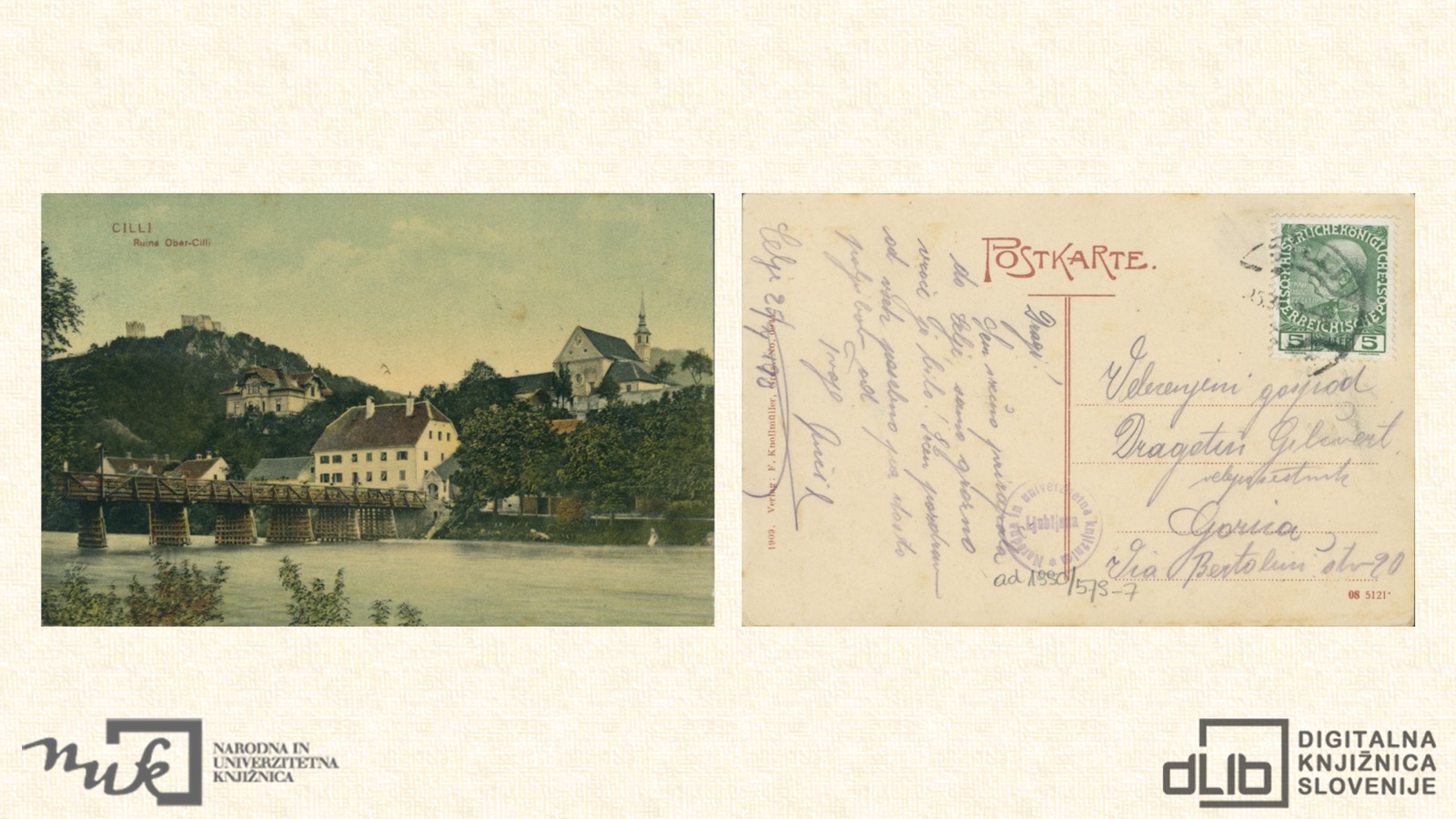
Celjski grad; Celje
· National and University Library of Slovenia (via Europeana)
Public domain


