
Spain · Partial ruin
Sagunto Castle
Castillo de Sagunto
Sagunto Castle is a multi-layered hilltop fortress overlooking the town of Sagunto near Valencia, Spain. The site contains visible remains from Iberian, Roman, Islamic and later Christian and modern periods and is organised into a sequence of plazas and defensive works.
Its prime
1812
Today
Partial ruin
Ranked among Europe’s castles
As it stood in 1812
What Sagunto Castle looked like in its prime.
Sits on a flat-topped hill 172 m above sea level overlooking the Mediterranean, a long serpentine curtain wall descends from the summit to the town below and is punctuated by towers and bastions of varied periods. The summit is divided into seven terraces or plazas laid out around the Plaza de Armas and Roman forum foundations; the plaza area shows the podium and retaining buttresses of a Roman temple, a well-preserved cistern, vaulted refectory arcades and artillery batteries integrated into the curtain wall.
Its story
The story of Sagunto Castle.
Hannibal's Sack of Saguntum and the Second Punic War, 219 BC
The hilltop was apparently first settled by the Iberians in the early Iron Age, inhabited by the Edetani tribe, who formed a defensive alliance with Rome as the Carthaginian empire expanded. In 219 BC the Carthaginian general Hannibal sacked the Iberian settlement, an act that triggered the outbreak of the Second Punic War; Rome retook the city from Carthage in 214 BC.
Between 175 and 100 BC the Romans built a temple, or capitolium, on the hill, with a cistern nearby probably raised when the city was rebuilt after Hannibal's sack. That Republican-era forum was largely demolished in the early Imperial period to make way for a new one, built during the reign of Augustus and paid for by the local aristocrat Gnaeus Baebius Geminus, with the hilltop levelled and reinforced by buttressed retaining walls to carry the new platform. The remains went unexcavated until 1985.
Murbĩtar and the Christian Reconquest, 711–1238
The Roman municipium of Saguntum took the name Sagunto under Wamba, the Visigothic king, a form that lasted until the end of the Visigothic kingdom in 711 AD. Under Muslim rule, Mozarabs called the town Murum Veterum, 'the old wall', a name already current by the 11th century; Christians contracted this into Morvedre while Muslims reshaped it into Murbĩtar. The Albacar and most of the outer wall were built during this period, though its history in these centuries is poorly documented next to that of Valencia; 8th-century Arab records from the reign of Abd al-Rahman I (755–788) place Sagunto under the jurisdiction of Tortosa rather than Valencia.
The Muslim historian Ibn Hayyan recorded that the castle was taken by force in 929–930, and again that it submitted to the sultan Abd-ar-Rahman III in 933, after which the Muslims used it as a fortress to defend the regions of Catalonia and Valencia. El Cid held it between 1098 and 1102, and it was finally taken from Muslim rule in 1238 by James I of Aragon, who folded it into the Kingdom of Valencia; by the mid-13th century the castle itself was garrisoned by Christians even though most of the town's inhabitants remained Muslim.
Peter of Castile's Siege and Antonelli's Modernisation, 1328 to the War of the Spanish Succession
By the early 14th century Morvedre, as the town was then known, had a growing Jewish population, and a Jewish cemetery was established beneath the castle walls in 1328. Peter IV of Aragon reinforced the castle's defences later that century, but in 1363 King Peter of Castile took it after laying siege.
In 1562 Juan Bautista Antonelli was commissioned by Philip II to modernise the castle's defences, and it was then that the precinct was divided into seven fortified plazas, among them the Plaza de Armas, Plaza de Almenara and Plaza de la Ciudadela. During the War of the Spanish Succession in the early 18th century the castle was surrendered to the Archduke of Austria, but soon afterwards it passed under the control of King Philip V.
Blake's Last Repairs and Suchet's Siege, 1810–1811
In 1810, on the recommendation of the British officer Charles William Doyle, Joaquín Blake had the Spanish workers restore the ageing walls, patching gaps with stone quarried from the ancient ruins; the relatively intact Roman theatre was dismantled for building material. The work was still unfinished when General Suchet's French army advanced on the town the following year.
Brigadier Andriani defended the castle when Suchet laid siege on 23 September 1811, holding off several assaults before Suchet ultimately prevailed. Suchet then ordered the defences repaired and strengthened, with the work overseen by Andriani; the castle was declared a National Monument in 1931.
Step inside
10 places to explore in 1812.
The record describes 10 distinct spots at Sagunto Castle, including 2 interiors: roman cistern, link corridor to plaza de san fernando. Create your own photoreal reconstruction and explore every one, more scenes means more rooms, more angles, and more of the place to stand in.
Build Your Own Castle
Recreate Sagunto Castle with AI to explore it.
The artist rebuilds it as it stood in 1812, a photoreal reconstruction that belongs to you alone. Pay with coins, no subscription needed.
Recreate this castle →Defend this castle →From the archive
Sagunto Castle on paper: the measured plan and period views.
The survey plan and photographs below are the ground truth this page's reconstructions are checked against, drawn and photographed while the castle was still a working garrison. Every image is public-domain or openly licensed, with its source named.
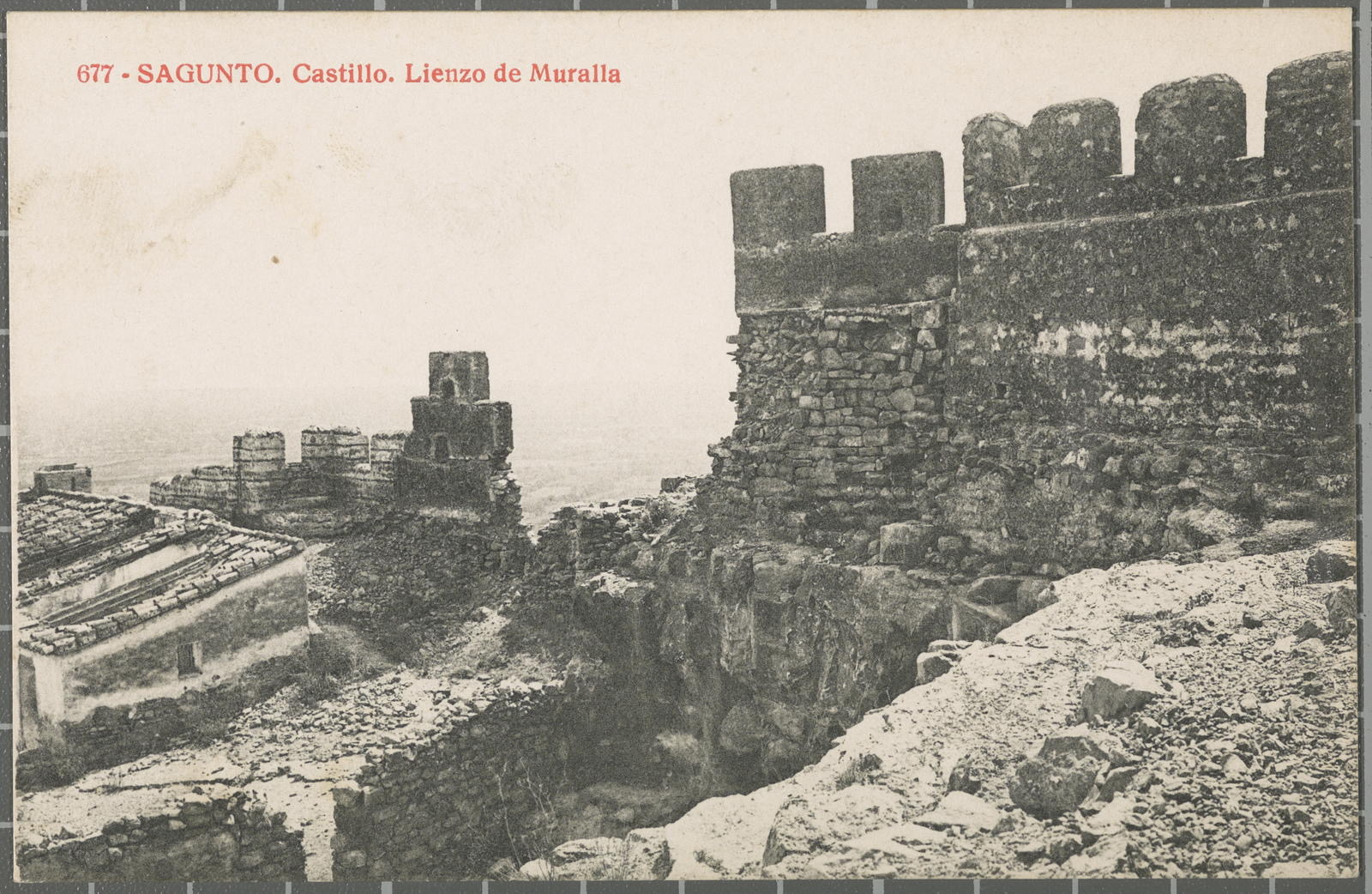
677 - Sagunto. Castle. Wall Lienzo
· Ajuntament de Girona (via Europeana)
Public domain
Nearby


