Historic Cities · Greece
Atlantis through the ages
Atlantis is a fictional island mentioned in Plato's works Timaeus and Critias as part of an allegory on the hubris of nations. By describing Atlantis as a naval empire from the west that had conquered most of Europe and Libya, Plato purposely created a literary contrast with the Achaemenid Empire, the great land-based power that ruled the east.

Atlantis in 9600 BC
The Island of Atlas
This is the island as Plato records it at the height of its power: a central royal islet ringed by concentric moats and land, pierced by a great canal and guarded by walls of red, white and black stone. The walk follows the harbour and bridges into the concentric rings, passes the Temple of Poseidon and the sacred grove, crosses the fertile plain and finishes on the mountains that close the island.
A compact radial city of concentric water and land, the skyline dominated by a low central islet and its silver-clad temple; rings of land and sea step outward like carved terraces. Stone walls quarried from the moats show bands of red, white and black and gleam where faced with brass and orichalcum. Narrow bridges and a broad canal cut through the rings; crowded harbours brim with triremes, wooden masts and the dark planking of merchant ships under a bright Atlantic sky.
The route: 9 streets, squares and views
Outer Ocean View → Canal Entrance → Outer Ring Harbour → Northern Bridge → Royal Islet Causeway → Temple of Poseidon → Grove and Springs → The Great Plain → Mountain Rim View
Step inside, 5 interiors
Canal Exchange Hall · Outer Ring Shipshed · Great Audience Hall · Ivory-Roofed Sanctuary · Hot-and-Cold Spring Baths
Planned from the Wikipedia record: Atlantis.
Its story
The story of Atlantis.
The Only Sources: Plato's Timaeus of 360 BC and the Critias
Every account of Atlantis descends from two dialogues by Plato, the Timaeus, written in 360 BC, and the Critias; there is no other primary source, and all later mentions are built on these. The dialogues claim to be quoting Solon, who visited Egypt between 590 and 580 BC and there translated Egyptian records, the story then passing orally through the family of Dropides until it reached Critias, one of the four speakers. Solon was said to have begun a poem on the subject and never finished it; modern classicists deny the existence of that poem and of any such oral tradition, and take Plato to be the sole inventor of the tale.
In the account Critias gives, an island lay in front of the mouth the Greeks call the Pillars of Heracles, larger than Libya and Asia together, held by a confederation of kings of great power. Poseidon received the island in the gods' division of the earth, fathered five pairs of male twins on Cleito, and made the eldest, Atlas, king of the whole island and of the ocean named after him.
Critias then places, nine thousand years before his own lifetime, a war between those outside the Pillars of Heracles and those within. The Atlanteans, he says, had conquered Libya as far as Egypt and Europe as far as Tyrrhenia and had reduced their peoples to slavery; the Athenians led an alliance against them, and when the alliance broke up prevailed alone and freed the occupied lands. The text continues that afterwards there were violent earthquakes and floods, that in a single day and night the Athenian fighting men sank into the earth and the island disappeared into the sea, and that the sea in those parts was thereafter impassable because of the shoal of mud left by the subsidence.
An Allegory on the Hubris of Nations
The story occupies little space in Plato's work and was written to a purpose. Atlantis is a naval empire from the west that has conquered most of Europe and Libya, set as a literary contrast to the Achaemenid Empire, the great land power that ruled what the Greeks called Asia; the Athens that defeats it is drawn in the image of the ideal state of the Republic, so that the tale testifies to the superiority of Plato's conception of a state. In the account Atlantis loses divine favour after its failed campaign against that fictionalised Athens. One reading of its context is that it served as a warning to Plato's fellow citizens against their striving for naval power.
Present-day philologists and classicists agree the story is fiction. Julia Annas, Regents Professor of Philosophy at the University of Arizona, has written that Plato is using what became a standard device of fiction (stressing the historicity of an event, and the discovery of hitherto unknown authorities, as an indication that what follows is invented), and that readers miss the point when they go off exploring the sea bed instead of examining their ideas of government and power.
Thera, Syracuse and Helike: What Plato May Have Drawn On
What lies behind the invention is still argued. Plato borrowed allegories from older traditions elsewhere, as he did with the story of Gyges, and a number of scholars have suggested he drew on Egyptian records of the Thera eruption, of the Sea Peoples invasion, or of the Trojan War. Others reject that chain of transmission as implausible and hold that he created the account outright, taking loose inspiration from events of his own day: the failed Athenian invasion of Sicily in 415–413 BC, or the destruction of Helike in 373 BC.
An earlier work titled Atlantis, by the logographer Hellanicus of Lesbos, survives only in fragments and appears to have been a genealogy of the daughters of Atlas rather than an account of an island; John V. Luce notes that Plato writes the genealogy of the Atlantean kings in the same style, and Rodney Castleden suggests Plato may have taken his title from him. Castleden has also pointed out parallels between the physical organisation and fortifications of Syracuse and the description of Atlantis, Plato having written of it after returning to Athens from Sicily.
Ancient and Christian Readers, from Crantor to Cosmas
Ancient writers divided over whether the island had existed. Aristotle held that his teacher had invented it to teach philosophy. Crantor, a student of Plato's student Xenocrates, is often cited as a reader who took the story as unadorned history; his commentary on the Timaeus is lost and known only through the fifth-century Neoplatonist Proclus, whose report is ambiguous enough that whether the claim belongs to Crantor or to Plato has been argued at length. Strabo and Posidonius are named among those who believed in the island's existence, while Diodorus Siculus placed the Atlanteans in North Africa and had them go to war with the Amazons.
Jewish and Christian writers took it up in turn. The Hellenistic Jewish philosopher Philo wrote of the destruction in On the Eternity of the World in the early first century, citing Aristotle's successor Theophrastus. Tertullian believed the island had been real, and Arnobius believed it had existed but blamed pagans for its destruction; in the sixth century Cosmas Indicopleustes used it in his Christian Topography as evidence that the world was flat and ringed by water. One misreading has proved durable: the fourth-century historian Ammianus Marcellinus, drawing on a lost work by Timagenes, records the Druids of Gaul saying that part of the population had migrated in from islands, which has been taken as a memory of Atlanteans fleeing west, although his text says the migrants came from islands and lands beyond the Rhine, that is from the north.
The New World, Mayanism and Donnelly's Antediluvian World, 1882
Modern interpretations began in the sixteenth century, when scholars started to identify Atlantis with the New World. Francisco Lopez de Gomara was the first to state that Plato had been referring to America, as did Francis Bacon and Alexander von Humboldt; Athanasius Kircher took the account as literally true, describing a small continent in the Atlantic, and Abraham Ortelius wrote in 1596 that Atlantis had not been sunk so much as torn away from Europe and Africa by earthquakes and flood. The allegory also fed utopian writing: Thomas More coined the word utopia for an imaginary land set in the New World, and Bacon's New Atlantis of about 1623 gives a history close to Plato's and places the island in America.
In the nineteenth century the story was attached to the Maya. Europeans believed the indigenous peoples of Mesoamerica incapable of building the ruins being uncovered, and inferred that another race must have been responsible. Charles Étienne Brasseur de Bourbourg, renowned for his translations of Mayan texts including the Popol Vuh, lost his academic credibility by claiming the Maya had descended from the Toltecs, whom he held to be the surviving population of a racially superior Atlantis. Augustus Le Plongeon, inspired by him, excavated at famous Mayan ruins and invented narratives such as the kingdom of Mu.
Ignatius L. Donnelly's Atlantis: The Antediluvian World, published in 1882, drew on that literature to argue that every known ancient civilisation had descended from a technologically sophisticated Atlantis, that the Garden of Eden had stood there, and that the island was destroyed by the biblical flood. He is credited as the father of the nineteenth-century Atlantis revival and the reason the myth endures.
Theosophy, Ariosophy and Atlantis Under the Nazis
Helena Petrovna Blavatsky, founder of the Theosophists, took up Donnelly's reading in The Secret Doctrine of 1888, which she claimed had originally been dictated in Atlantis. Against Plato, who presents the Atlanteans mainly as a military threat, she made them cultural heroes and the fourth root race in a scheme of racial evolution, succeeded by the fifth, the Aryan race, which she identified with modern humanity. Her Atlanteans were olive-skinned peoples with Mongoloid traits, ancestors of modern Native Americans, Mongolians and Malayans.
Blavatsky had drawn on the eighteenth-century astronomer Jean-Sylvain Bailly, who set the myth in a northern continent of Hyperborea; Dan Edelstein claims her reshaping of that theory provided the Nazis with a mythological precedent and a pretext for their ideological platform and their subsequent genocide. The idea that the Atlanteans were Hyperborean Nordic supermen was propagated in the German ariosophic movement around 1900 by Guido von List and others, and gave its name to the Thule Gesellschaft, an antisemitic Munich lodge which preceded the German Nazi Party. Karl Georg Zschaetzsch in 1920 and Herman Wirth in 1928 were the first to speak of a Nordic-Atlantean or Aryan-Nordic master race spreading from Atlantis over the northern hemisphere, the Hyperboreans being contrasted with the Jewish people. The party ideologist Alfred Rosenberg, in The Myth of the Twentieth Century of 1930, and the SS leader Heinrich Himmler made it part of official doctrine.
The name was also used against the regime. The opera Der Kaiser von Atlantis was written in 1943 by Viktor Ullmann to a libretto by Petr Kien while both were inmates of the Nazi concentration camp at Theresienstadt. The Nazis did not allow it to be performed, taking its Emperor of Atlantis for a satire on Hitler. Ullmann and Kien were murdered at Auschwitz; the manuscript survived and was first performed in Amsterdam in 1975.
Dozens of Locations, and Why the Lost-Continent Theories Waned
Since Donnelly's day dozens of locations have been proposed, to the point where the name became a generic concept divorced from Plato's account, and many of the proposed sites are not in the Atlantic at all. Most lie in or near the Mediterranean: Sardinia, Crete, Santorini, Sicily and Malta among the islands, Troy and Tartessos among land-based states. The Thera eruption, dated to the seventeenth or sixteenth century BC, caused a tsunami that some hold devastated the Minoan civilisation on Crete, which has led others to see it as the catastrophe behind the story.
The Atlantic candidates have fared badly. Studies of the Canary and Madeira islands show them steadily uplifted over the last four million years with no significant periods of subsidence, and sediment cores around the Azores show that plateau has lain under the sea for millions of years. In northern Europe, Doggerland in the North Sea has been proposed, along with Sweden by Olof Rudbeck in his Atland of 1672–1702. In 2004 the Swedish physiographist Ulf Erlingsson proposed that the legend was based on Stone Age Ireland; he later said he did not believe Atlantis had ever existed, and the director of the National Museum of Ireland commented that no archaeology supported the idea. A 2011 claim of possible evidence in the marshlands of the Doñana National Park in south-western Andalusia, by a team led by Professor Richard Freund, was dismissed by Spanish scientists as sensationalising their work, the anthropologist Juan Villarías-Robles calling it fanciful. Adolf Schulten had already argued in the 1920s that Plato used Tartessos, the documented settlement of that area, as the basis for the myth.
As continental drift won acceptance during the 1960s and plate tectonics showed that a lost continent in the geologically recent past was impossible, most lost-continent theories waned. Some proposed sites share features of the story (water, a catastrophic end, a plausible period), but none has been demonstrated to be a historical Atlantis, and the island is classed as a fictional one.
From the archive
Atlantis on paper: the place as it was mapped.
A period map that sets the place down, drawn between 1500 and 1850, the ground this page's reconstructions walk. Public domain, with its source named.
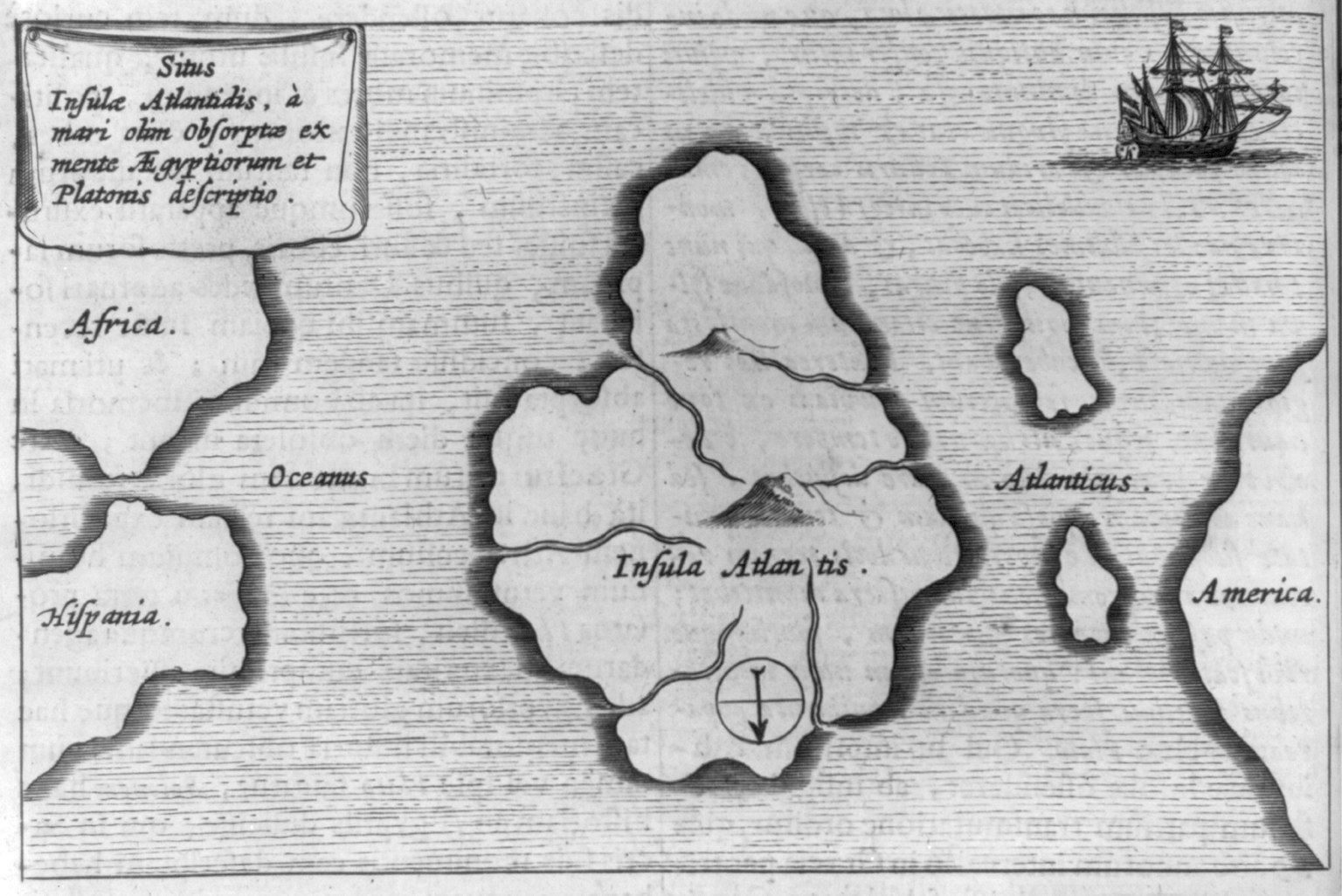
Situs Insulae Atlantidis: Athanasius Kircher's map of Atlantis, from Mundus Subterraneus
Kircher sets the island in mid-ocean between Hispania and America, its central peak and river valleys drawn straight from Plato's account, with south at the top of the sheet.
1665 · Athanasius Kircher · Wikimedia Commons
Public domain (plate dated 1665)
More cities to explore
 GreeceAthensExplore it in 430 BC · AD 130 · 1835
 GreeceThessalonikiExplore it in 1200 · 1900
 GreeceHelikeExplore it in 373 BC
 GreecePavlopetriExplore it in 1200 BC
Castles of Europe · Landmarks of Europe · create your own reconstruction.