Historic Cities · Greece
Thessaloniki through the ages
Thessaloniki is the second-largest city in Greece. It is the largest city of Northern Greece, with slightly over one million inhabitants in its metropolitan area, the capital of the geographic region of Macedonia, the administrative region of Central Macedonia and the Decentralized Administration of Macedonia and Thrace.

Thessaloniki in 1200
Byzantine Thessalonica
Thessalonica in 1200 stands as the Byzantine Empire's great second city, its stone walls rising from the Thermaic Gulf to the citadel on the heights. The walk moves from the harbour and seaside walls through the Via Egnatia, past the Rotunda and Hagia Sophia to Hagios Demetrios and the autumn fair where foreign traders gather.
A hard, compact skyline of thick stone walls and squat towers climbs directly from the blue Thermaic Gulf to the citadel above; domes and brick church roofs punctuate a dense town of narrow alleys and packed clay-tiled houses. Main streets are broad, paved bands of the Via Egnatia and the Agora, while the harbour shows low quays and wooden storehouses. Colours are ochres, baked brick reds, pale marble and the glint of metal at merchant stalls; constant movement of carts, sailors and cloaked traders animates every quay and gate.
The route: 21 streets, squares and views
Thermaic Gulf Approach → Skaptos Limen → Seaside Walls → Sea Gate → Arch of Galerius → Via Egnatia → Roman Forum (Agora) → Rotunda → Panagia Chalkeon → Hagia Sophia → …
Step inside, 13 interiors
Shipwright's Slip Hall · Imperial Mint Workshop · Rotunda's Mosaic Dome · Hagia Sophia Upper Galleries · Acheiropoietos Stone Nave · Silk Weaver's Loom Room · Covered Market Hall · Quay Warehouse Hold · Synagogue Prayer Hall · Saint Demetrios' Crypt · Marble Nave of Hagios Demetrios · Palace Staircase Hall · Citadel Audience Hall
Planned from the Wikipedia record: History of Thessaloniki.
Thessaloniki in 1900
Ottoman Salonica
Selânik at the turn of the century is an Ottoman Mediterranean port midway between tradition and modernisation: steamers and railway lines meet centuries of churches, mosques and a dominant Sephardic community. This walk follows the new quay and the busy city streets from the White Tower inward, past markets, tobacco stores, tramlines and the wooden houses of the upper town.
Against the Thermaic Gulf a low, long skyline of red tile roofs and pale-stucco facades is punctured by domes and numerous slender minarets. The waterfront is broad and flat with a gravel quay, gas lamps and tram rails; steamers lie at warehouses and masts glitter like a forest. Narrow streets inland open onto stone mosques, Byzantine monuments and dense markets; timber houses cling to the slopes of the Ano Poli above.
The route: 22 streets, squares and views
Thermaic Gulf Approach → White Tower Quay → Steamship Quays → Railway Terminus → Ladadika Warehouses → Tobacco Wharfs → New Port Works → Kordon Promenade with Trams → Bezesten Covered Market → Hamza Bey Mosque, Egnatia → …
Step inside, 14 interiors
Quay Customs Inspection Room · Railway Arrivals Hall · Tobacco Storehouse Chamber · Tobacco Sorting Hall · Merchants' Stone‑vaulted Alley · Hamza Bey Prayer Hall · Main Steam Chamber · Warm Bathing Room · Rotunda Dome Chamber · Byzantine Nave Chamber · Reliquary Chapel · Sephardic Synagogue Sanctuary · Butchers' Great Hall · Printing Press Floor
Planned from the Wikipedia record: History of Thessaloniki.
Its story
The story of Thessaloniki.
Cassander's Foundation and the Roman Via Egnatia
The town was founded around 315 BC by King Cassander of Macedon, on or near the site of the older town of Therma and other local villages, and named after his wife Thessalonike, a half-sister of Alexander the Great and a daughter of Philip II. It grew quickly, had its first walls by the 2nd century BC, and kept its own parliament as an autonomous part of the Kingdom of Macedon, though Pella remained the kingdom's capital until its fall.
The kingdom fell in 168 BC and Thessalonica, as it came to be called in Latin, passed to the Roman Republic; in 128 BC it was made capital of the Roman province of Macedonia, and Mark Antony granted it the status of a free city in 41 BC. Its living came from the Via Egnatia, the Roman road running from Dyrrhachium, now Durrës in Albania, to Byzantium. The Romans built it a spacious harbour, the Burrowed Harbour, which carried the city's trade as late as the 18th century.
About AD 50 Paul the Apostle reasoned from the Scriptures in the city's chief synagogue on three Sabbaths, convincing some Jews and Greeks; those who kept their faith banned him and raised a riot against him. Paul afterwards wrote to the church there; two letters under his name entered the Biblical canon as First and Second Thessalonians. The city acquired its patron saint in Demetrius, killed at a Roman prison on the site where the Church of St Demetrius later stood. Under the tetrarchy the city became the administrative capital of one quarter of the empire under Galerius, who commissioned an imperial palace, a hippodrome and a triumphal arch there.
Second City of the Empire, 379–1185
When the Prefecture of Illyricum was divided between the eastern and western empires in 379, Thessaloniki became capital of the new, reduced prefecture; the following year the Edict of Thessalonica made Christianity the state religion. In 390 a revolt killed the Gothic general Butheric, triggered by the imprisonment of a favourite local charioteer, and between 7,000 and 15,000 citizens were massacred in the hippodrome in reprisal, an act for which Theodosius I was temporarily excommunicated. Avars and Slavs besieged the city repeatedly in the 6th and 7th centuries, notably in 617 and in 676–678, and failed each time; many Slavs settled the hinterland. The brothers Cyril and Methodius, both born in the city, built the first literary language of the Slavs, Old Church Slavonic, most likely on the Slavic dialect of that hinterland.
In the 9th century the Byzantines moved the market for Bulgarian goods from Constantinople to Thessaloniki; Tsar Simeon I of Bulgaria invaded Thrace, defeated a Byzantine army and forced the market back. In 904 Saracens led by Leo of Tripoli seized the city, and after ten days of plunder the raiders left with sixty ships, four thousand freed Muslim prisoners and 22,000 slaves. The city recovered through the 10th, 11th and 12th centuries, holding a population of 150,000 by the mid-12th century and ranking second in the empire after Constantinople in wealth and size. Each October the fair of Saint Demetrius ran for six days outside the walls; Benjamin of Tudela recorded a Jewish community of at least five hundred when he visited in the 12th century. In 1185 Normans from the Kingdom of Sicily under Count Baldwin and Riccardo d'Acerra stormed and sacked the city, though their rule lasted less than a year.
Latin Kings, the Zealots, and the Ottoman Conquest of 1430
Thessaloniki passed out of Byzantine hands in 1204, when the Fourth Crusade took Constantinople. It became the Kingdom of Thessalonica, the largest fief of the Latin Empire, granted by Emperor Baldwin I to his rival Boniface of Montferrat. Theodore Komnenos Doukas, the Greek ruler of Epirus, seized it back in 1224 and crowned himself emperor; after his defeat at Klokotnitsa in 1230 its rulers became vassals of Tsar Ivan Asen II of Bulgaria, and the city was annexed by the Empire of Nicaea in 1246. In 1342 a religious quarrel between Bishop Gregory Palamas and the monk Barlaam turned into the Zealot movement, an anti-aristocratic party of sailors and the poor that governed the city as a near-independent republic until it was overthrown around 1350.
Thessalonica surrendered to the forces of Murad I after a siege of 1383–1387, and was returned to the Byzantines under the Treaty of Gallipoli in 1403 after Bayezid I's defeat at Ankara. Faced with renewed pressure, in 1423 the Despot Andronikos Palaiologos ceded the besieged city to the Republic of Venice in the hope it could be defended. Venice held it until Sultan Murad II took it by a three-day siege on 29 March 1430; contemporary reports estimated that about a fifth of the population was enslaved in the sack.
Selânik: the Sephardic City, 1478–1908
The 1478 census recorded 6,094 Christian Orthodox households against 4,320 Muslim ones, and no Jews at all. That changed after 1492, when the Alhambra Decree of Ferdinand and Isabella forced the Jews of Spain to convert or go into exile, with those accused of false conversion tortured and burned; nearly 20,000 Sephardic Jews reached Greece, and the Ottoman government (which some historians read as wanting to stop the Christian population dominating the city) invited them to settle. Ottoman archives for 1519 give 6,870 Muslims, 6,635 Christians and 15,715 Jews, 54 per cent of the population. Thessaloniki became the largest Jewish city in the world and the only Jewish-majority city in the world in the 16th century; its community called it la madre de Israel, the mother of Israel, and Judeo-Spanish was widely spoken. In the 1680s about 300 Sephardic families, followers of Sabbatai Zevi, converted to Islam and formed the sect known as the Dönmeh. Sephardic Jews, Muslims and Greek Orthodox remained the three principal communities for the next four hundred years, and most of the city's tradespeople were Jewish.
With the outbreak of the Greek War of Independence in 1821 and a rising in Chalkidiki under Emmanouel Pappas, the governor Yusuf Bey held more than 400 hostages at his headquarters and on 18 May ordered half of them slaughtered in front of him; he also ordered that any Greeks found in the streets be killed. The mulla of Thessaloniki, Hayrıülah, wrote that “every day and every night you hear nothing in the streets of Thessaloniki but shouting and moaning”. It took until the end of the century for the Greek community to recover. In June 1826 regular Ottoman troops destroyed the city's Janissary base, killing over ten thousand Janissaries.
The last Ottoman decades were a rebuilding era: the walls came down between 1869 and 1889, rail reached Central Europe by way of Belgrade in 1888 and Constantinople in 1896, and modern port works were built in 1896–1904. From the 1880s the city industrialised, much of it Jewish enterprise: the Italian-Jewish Allatini brothers built milling and other food industries, brickworks and tobacco-processing plants, and traders backed large-scale textile production in place of artisanal weaving. Bulgarian national activity also centred here: a Bulgarian boys' high school opened in 1880, and in 1893 part of the Bulgarian intelligentsia founded the revolutionary organisation later known as IMRO, whose anarchist associates bombed the Ottoman Bank and other buildings in 1903. The Young Turks launched their revolution from the city in 1908, ending the sultan's absolute power; among their number was Mustafa Kemal Atatürk, born in the city in 1881.
1912, the Great Fire, and the Refugee Capital
In the First Balkan War the Ottoman garrison negotiated separately with the advancing Greek and Bulgarian armies. It surrendered to the Greeks on the feast day of Saint Demetrius in November 1912, ending almost five centuries of Ottoman rule; the Bulgarian army arrived the following day, and the garrison commander Hasan Tahsin Pasha told its officials, “I have only one Thessaloniki, which I have surrendered”. The Austrian government proposed making the city a neutral internationalised territory of some 260,000 people that would be “neither Greek, Bulgarian nor Turkish, but Jewish”. King George I of Greece settled there to press Greece's claim and was assassinated in the city on 18 March 1913 by Alexandros Schinas. The Treaty of Bucharest of August 1913 settled the question in Greece's favour. In 1915 a large Allied expeditionary force made the city its base against pro-German Bulgaria, and in 1916 pro-Venizelist officers set up the Provisional Government of National Defence there against the king's government in Athens; the city has been called symprotevousa, the co-capital, ever since.
On 18 August 1917 fire destroyed most of the old centre, leaving about 72,000 people homeless out of a population of roughly 271,157, by the Pallis Report some 50,000 of them Jewish. Many synagogues, mosques and two churches were lost. The government forbade quick rebuilding so that a new plan could be prepared under the French architect Ernest Hébrard. Having lost homes and businesses, many Jews emigrated, to the United States, to Palestine and to Paris. Their places were taken by the population exchange that followed Greece's defeat in the Greco-Turkish War: over 160,000 Greeks deported from Asia Minor and East Thrace were resettled in the city, while about 20,000 of its Muslims were deported to Turkey. The Jewish share of the population fell to around a fifth, a minority for the first time since the 16th century, and the city was nicknamed the Refugee Capital and the Mother of the Poor. In May 1936 a mass strike by tobacco workers was put down on the orders of Ioannis Metaxas, then prime minister; the deaths of the protesters prompted Yiannis Ritsos to write Epitafios.
Occupation, the Ghetto, and the Destruction of Jewish Thessaloniki
Italian bombing killed 232 people, wounded 871 and damaged or destroyed over 800 buildings in November 1940 alone. The city fell to German forces in April 1941 and stayed under occupation until 30 October 1944.
The Germans forced the city's Jews into a ghetto beside the railway lines. The first deportation train left on 15 March 1943 for Auschwitz-Birkenau; accounts give the number sent there as 45,000 or approximately 50,000, and of those deported to Auschwitz only four per cent survived. Around 94 per cent of the city's remaining Jewish population was murdered. The Germans also destroyed the community's monuments, bulldozing the ancient Jewish cemetery of some 500,000 tombs and reusing the marble gravestones as building material for roads and new construction. A military camp in the city was converted into the Pavlos Melas concentration camp, holding resistance members and other anti-fascists to be killed or sent on to other camps.
The first Greek resistance group, Eleftheria, was formed in the city. On 30 October 1944, after fighting the retreating German army and the Security Battalions of Poulos, ELAS forces under Markos Vafiadis entered the city. A Jewish community of around 1,200 remains, and descendants of the city's Sephardic and Romaniote families live mainly in the United States and Israel. The Holocaust memorial in Eleftherias Square was built in 1997, on the square where Jewish residents had been rounded up for the trains.
Rebuilding, the 1978 Earthquake, and the Port
The city rebuilt quickly after the war, with rapid population growth and large-scale new industry through the 1950s, 1960s and 1970s, most of it without an overall plan and leaving traffic and zoning problems behind. On 20 June 1978 an earthquake of moment magnitude 6.5 damaged buildings across the city, and forty people were crushed to death when an apartment block collapsed in the central Hippodromio district.
The Palaeochristian and Byzantine monuments of Thessaloniki were inscribed on the UNESCO World Heritage list in 1988, and the city was European Capital of Culture in 1997. It is the second-largest city in Greece and the capital of the region of Central Macedonia, with 319,045 people in the municipality at the 2021 census and over a million in the metropolitan area. The Port of Thessaloniki, one of the largest in the Aegean, carries trade for the Balkan hinterland, and the Aristotle University, founded in 1926, is the largest in Greece. Line 1 of the Thessaloniki Metro opened in November 2024.
From the archive
Thessaloniki on paper: the old town as it was mapped.
A period plan or bird's-eye view of the old town, drawn between 1500 and 1850, the streets this page's reconstructions walk. Public domain, with its source named.
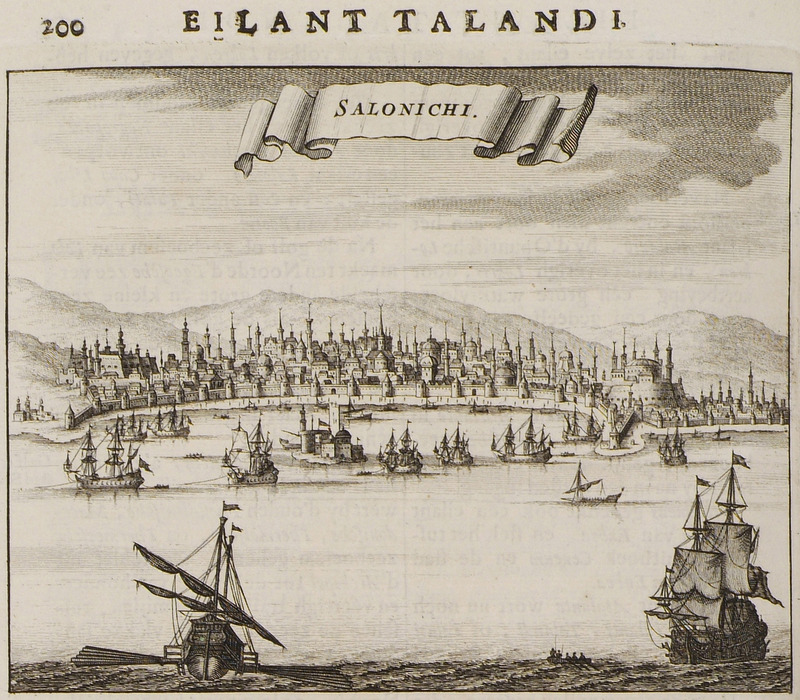
Prospect of Salonichi (Thessaloniki), from Olfert Dapper's Naukeurige Beschryving der Eilanden (1688)
Sea prospect showing the harbour frontage, continuous city walls and gates, clustered domes and minarets, and the fortress on the eastern headland.
1688 · Olfert Dapper · Wikimedia Commons
Public domain (plate dated 1688)
In this city
Landmarks of Thessaloniki, see each in its prime


Ships tied to Thessaloniki
- Greek cruiser Georgios Averof: Towed to Thessaloniki in 2017, where 130,000 people came aboard in 53 days
- HMHS Britannic: Her 30 dead are remembered on the Mikra Memorial at Thessaloniki
More cities to explore
 BulgariaPlovdivExplore it in AD 200 · 1870
 GreeceHelikeExplore it in 373 BC
 GreeceAthensExplore it in 430 BC · AD 130 · 1835
 GreeceAtlantisExplore it in 9600 BC
Castles of Europe · Landmarks of Europe · create your own reconstruction.