Historic Cities · Greece
Athens through the ages
Athens is the capital and largest city of Greece. A significant coastal urban area in the Mediterranean, Athens is also the capital of the Attica region and is the southernmost capital on the European mainland. With its urban area's population numbering over 3.6 million, it is the eighth-largest urban area in the European Union (EU).

Athens in 430 BC
Periclean Athens
Athens stands at the height of Pericles' building programme: the Parthenon crowns the Acropolis while the grand Propylaea rises on its western approach. The city's public life is loud and visible: assembly at the Pnyx, philosophers in the Agora's painted stoas, potters and kilns in the Kerameikos, and triremes filling Piraeus below the Long Walls.
A single rock, the Acropolis, dominates a low, crowded city of white marble temples and ochre-tiled houses. The Parthenon gleams high above scaffolding and cranes at the Propylaea; bronze statues catch the sun. Streets are narrow and dusty, where lime-whiteed public colonnades and painted stoas meet ragged clay-roofed dwellings. Smoke from pottery kilns and the scent of sea air from Piraeus mix along the Long Walls.
The route: 22 streets, squares and views
Piraeus Harbour Approach → Long Walls Road → Piraean Gate → Mouseion Hill → Pnyx → Hill of the Nymphs → Dipylon Gate → Kerameikos Potters' Quarter → Stoa Poikile (Painted Porch) → Royal Stoa and Tholos → …
Step inside, 15 interiors
Trireme Shed · Gatehouse Guardroom · Museion Sanctuary Chamber · Nymphs' Stone Shrine · Potter's Workshop and Kilns · Painted Colonnade Hall · Tholos Prytaneis Hall · Cella of Hephaestus · Prytaneion Hearth Room · Skene Dressing Room · Roofed Odeon Auditorium · Pinakotheke and Central Passage · Cella of the Great Athena · Erechtheion Inner Chambers · Pompeion Storeroom
Planned from the Wikipedia record: Classical Athens.
Athens in AD 130
Hadrian's Athens
This is Athens at the height of Roman patronage: Hadrian has finished the colossal Temple of Olympian Zeus and set his new manifest presence in stone across the city. The walk moves from the outer approach through the markets, philosophy groves and public streets to the Acropolis and a wide summit view, showing monuments, everyday trade and schools of philosophy under Roman peace.
The skyline is a jumble of low white marble buildings, terraced houses and olive‑studded groves, pierced by the gleaming Corinthian columns of the newly completed Olympieion and punctuated by the flat mass of the Acropolis. Streets are narrow, paved or earthen, shaded by colonnades and plane trees; tile roofs and ochre plaster catch the sun while porticoes and stoas provide cool shade for philosophers, merchants and students.
The route: 22 streets, squares and views
Coastal Approach from Peiraeus → Peiraic Gate → Dipylon Gate → Panathenaic Way → The Agora Market → Stoa of Attalos → Roman Agora → Tower of the Winds → Hadrian's Library → Arch of Hadrian → …
Step inside, 12 interiors
Covered Pottery Hall · Colonnaded Merchant Shops · Imperial Baths Caldarium · Octagonal Clock Chamber · Library Peristyle Court · Library Reading Hall · Triumphal Vaulted Passage · Cella and Column Forest · Palaestra Cold Bath Room · Covered Philosophers' Exedra · Orchestra and Lower Cavea · Propylaea Central Hall
Planned from the Wikipedia record: History of Athens.
Athens in 1835
Othonian Athens
Athens in 1835 is a tiny, unruly capital in the first years of King Otto's reign: a village of a few thousand where ancient ruins, Ottoman houses and new Bavarian plans collide. The walk moves from the seaside approach past imperial arches into the rock and lanes around the Acropolis, where excavations, shepherds and itinerant travellers rub shoulders with lime and scaffolded building sites.
Low, sun-baked hills stitch the town together: the Acropolis sits like a pale island of marble above a welter of red-tiled Ottoman houses, crumbling Classical columns and newly laid neoclassical foundations. Narrow, dusty lanes thread markets, kafeneia and potters' yards; the sky often washes the stone pink in late afternoon. Scaffolds, lime-white façades and Bavarian surveying flags begin to puncture the old skyline.
The route: 22 streets, squares and views
Phaleron Road Approach → Arch of Hadrian → Temple of Olympian Zeus → Royal Palace Site → Panepistimiou Avenue → Hadrian's Library → Roman Agora → Tower of the Winds → Monastiraki Square → Tzisdarakis Mosque → …
Step inside, 13 interiors
Palace Carpenters' Workshop · Collegiate Lecture Hall · Hadrian's Library Courtyard · Roman Agora Covered Bazaar · Octagonal Timekeeper Chamber · Inn Backroom and Lending Library · Tzisdarakis Mosque Prayer Hall · Potter's Kiln and Workshop · Theatre Skene Mid-Rehearsal · Propylaea Inner Colonnade · Erechtheion Cella amid Scaffolds · Kafeneion Beneath the Rock · Kapnikarea Church Nave
Planned from the Wikipedia record: History of Athens.
Its story
The story of Athens.
Synoikismos, Solon and the Reforms of Cleisthenes
Athens is named for the goddess Athena, though modern scholars generally agree the goddess took her name from the city rather than the reverse. During the first millennium BC Athens brought the other towns of Attica under its rule, a process called synoikismos, the bringing together into one home, which created the largest and wealthiest state on the Greek mainland and, with it, a large class of people the nobility excluded from political life. Social unrest was widespread by the seventh century BC. The Areopagus appointed Draco to draft a strict new code of law, and when that failed gave Solon a mandate for a new constitution in 594 BC. Solon forbade the enslavement of Athenian citizens for debt, broke up large landed estates, freed up trade, and divided the citizens into four classes by wealth and capacity for military service; the poorest, the Thetai, who were the majority, could vote in the Assembly for the first time, though only the upper classes could hold office.
The settlement did not end the class conflict, and after twenty years the popular party under Peisistratos seized power. He kept Solon's constitution while ensuring that his family held every office of state. His sons ruled less adeptly: Hipparchus was assassinated in 514 BC in a private dispute, and Hippias, having turned to open dictatorship, was overthrown in 510 BC. Cleisthenes then replaced the four traditional tribes with ten new ones that had no class basis and functioned as electorates, each sending fifty members to the Boule that governed day to day. The Assembly was open to all citizens and served as both legislature and supreme court, most offices were filled by lot, and the ten generals were elected. With a few brief interruptions the system held for 170 years.
The Persian Wars, the Delian League and the Age of Pericles, 499–431 BC
In 499 BC Athens sent a small force to support the Ionian Greeks of Asia Minor against Persian rule, an intervention that contributed to two Persian invasions of the mainland. The first landed at Marathon in 490 BC, where an Athenian army under Miltiades repelled it. Before the second, Themistocles persuaded the assembly to spend the revenues of newly discovered silver at Laurion on warships rather than distribute them to citizens. When Xerxes invaded in 480 BC the population was evacuated to Troezen in the Peloponnese; the Persians took the deserted city and burned the buildings on the Acropolis. Later that year the Athenian-led fleet caught the Persians in the narrows off Salamis and inflicted heavy losses, and in 479 BC the army Xerxes had left behind was beaten at Plataea.
Out of the war came the Delian League, formed to carry the fight on against Persia and soon the basis of Athenian power across the Aegean. Pericles used the tribute paid by the League's members to build the Parthenon and the other great monuments of the classical city, which he called "the school of Hellas". The dramatists Aeschylus, Sophocles and Euripides, the philosophers Socrates, Plato and Aristotle, the historians Herodotus and Thucydides and the sculptor Phidias all lived in Athens in the golden age that ran from the end of the Persian Wars to the Macedonian conquest, and the political satire of the comic poets carried real weight with public opinion.
Defeat by Sparta and the Loss of Independence, 431–146 BC
Resentment at Athenian hegemony brought on the Peloponnesian War in 431 BC, which set Athens and its increasingly rebellious overseas empire against a coalition of land powers led by Sparta. Sparta held the land and Athens the sea until the disastrous Sicilian Expedition, and the war ended in defeat after the Battle of Aegospotami broke Athenian naval supremacy. The loss was blamed on democratic politicians and brought the Spartan-backed rule of the Thirty Tyrants, until Thrasybulus restored the democracy in 403 BC and declared an amnesty. Athens fought Sparta again in the indecisive Corinthian War and built a Second Athenian League, but at Chaeronea in 338 BC Philip II defeated an alliance including Athens and Thebes, forced them into a confederation and effectively limited Athenian independence.
Alexander's conquests made the traditional city-state obsolete. Athens stayed wealthy and culturally brilliant but was no longer a leading power, and after Alexander's death in 323 BC it became a piece in other men's wars: Cassander took the Piraeus, leaving the city without a source of supplies, and secured Athens itself in 316 BC. Rome then absorbed the whole peninsula. Athens allied with Rome in the Second Macedonian War, of which Livy observed that "words are the only weapons that the Athenians have left", and when the Achaean League was defeated and dissolved in 146 BC Greece was divided into the Roman provinces of Macedonia and Achaea.
Sacked, Refortified and Ruled from Elsewhere, 88 BC–1458
During the First Mithridatic War Athens was held by Aristion, a tyrant installed by Mithridates VI, and in 88–85 BC the Roman general Sulla levelled most of its fortifications and homes after besieging the city and the Piraeus. Rome then granted Athens the status of a free city on account of its widely admired schools, and Hadrian put up a large number of civic buildings there. The city was sacked in 267 AD and all its public buildings burned, after which the quarter north of the Acropolis was hastily refortified.
From the early fourth century the eastern empire was governed from Constantinople, and many of Athens's works of art were taken away to adorn the new imperial city. As the empire became Christian, monuments including the Parthenon and the Erechtheion were converted into churches and Athens became a provincial town, though it remained a centre of Neoplatonist learning whose pupils included Basil of Caesarea and the emperor Julian. The sack by the Heruli in 267 and by the Visigoths under Alaric I in 396 dealt heavy blows to its fabric, and Athens was thereafter confined to a small fortified area covering a fraction of the ancient city. Justinian I banned the teaching of philosophy by pagans in 529, generally taken to mark the end of the ancient history of Athens.
Archaeology shows rapid, sustained growth from the eleventh century to the end of the twelfth: the agora, deserted since late antiquity, was built over, the town became an important producer of soaps and dyes, and Venetian and other traders working the Aegean ports were drawn in. That prosperity ended with the Fourth Crusade's conquest in 1204, after which Latins ruled for two and a half centuries. Under the Burgundian De la Roche dukes a bell tower known as the Frankish Tower was added to the Parthenon and the Acropolis was fortified, though Thebes replaced Athens as the ducal capital. The Catalan Company took the city in 1311 and held it until 1388; the Florentine Nerio I Acciajuoli then took it, and his descendants ruled until the Ottoman conquest of 1458.
A Country Town Under the Sultan, 1458–1833
Athens was captured in 1458 by Mehmed II in person, who was struck by its ancient monuments and issued a firman forbidding their looting or destruction on pain of death; the Parthenon was converted into the city's main mosque. Under Ottoman rule Athens was stripped of importance and its population fell sharply, leaving what one historian has called a "small country town". Gunpowder was stored in the Parthenon and the Propylaea; lightning destroyed the Propylaea in 1640, and on 26 September 1687, during the Morean War, a shot from Francesco Morosini's besieging Venetians blew up the magazine in the Parthenon and left the building largely as it now appears. The Venetians held Athens for six months, both they and the Ottomans looting the temple.
The city recovered much of its prosperity in the eighteenth century. Its Greek population had considerable self-government under a council of primates drawn from the leading families and the metropolitan bishop, and taxation was light. English visitors in the 1760s reported about 10,000 inhabitants, roughly four-fifths of them Christian, and a Turkish community settled since the conquest whose relations with their Christian neighbours were friendlier than elsewhere. The town lived chiefly by pasture rather than agriculture, and exported leather, soap, grain, oil, honey and wax, mostly to Constantinople and France.
The peace broke in 1752–53, when a pasha killed notables who protested at his abuses and was besieged on the Acropolis by the populace until the governor of Negroponte restored order, imprisoned the metropolitan bishop and fined the Greek community heavily. During the Orlov Revolt of 1770 the Athenians stayed cautious, and it was only the intervention of the tax farmer Ismail Agha that spared the city reprisals; it paid an indemnity instead. His successor Hadji Ali Haseki extorted large sums and seized property over twenty years of on-and-off rule until his execution in 1795. Between 1801 and 1805 Lord Elgin, the British ambassador to the Ottoman Empire, had fifty pieces of sculpture removed from the Parthenon and the Erechtheion. A Greek insurgency captured Athens in 1822, the Ottomans retook it in 1826 with the Acropolis holding out until June 1827, and the monuments again suffered badly. Ottoman forces withdrew in March 1833, leaving a town of an estimated 400 houses around the Acropolis in the Plaka.
Capital of a New Kingdom, 1834–1922
Athens was chosen in 1834 to replace Nafplio as the capital of the new Greek kingdom, largely for historical and sentimental reasons; the war of independence had reduced it to a town of some four to five thousand people in a loose scatter of houses at the foot of the Acropolis. Otto of Bavaria, proclaimed king in 1832, commissioned Stamatios Kleanthis and Eduard Schaubert to draw up a city plan; theirs was a triangle set between the Acropolis, the ancient cemetery of Kerameikos and the new royal palace, laid out to make the continuity between the modern and the ancient city plain. The public buildings followed over the next sixty years (the university in 1837, the National Gardens in 1840, the National Library in 1842, the royal palace that now houses parliament in 1843, the Zappeion in 1878 and the Academy in 1885), and in 1896 Athens hosted the first modern Olympic Games.
The city's second period of explosive growth came out of catastrophe. After the Greco-Turkish War and the Asia Minor Catastrophe of 1922, more than a million Greek refugees expelled from Asia Minor were resettled in Greece under the population exchange with Turkey. Suburbs such as Nea Ionia and Nea Smyrni began as refugee settlements on the edge of Athens, and the population of the city doubled.
Occupation, Famine and the Modern Metropolis
Athens was occupied by the Axis during the Second World War and suffered terrible privations in its later years, the Great Famine falling heavily on the city. Several resistance organisations operated inside Athens, EAM being the main one. Liberation was followed by the Dekemvriana, heavy fighting in the city between communist forces and government forces backed by the British, and then by the Greek Civil War. Once the civil war was over the population boomed through the 1950s and 1960s as people moved in from the villages and the islands to find work.
Greek entry into the European Union in 1981 brought a flood of investment and worsening environmental problems; pollution was corroding the marble of the monuments and traffic vibration weakening ancient foundations, and those problems were the main reason Athens failed to win the 1996 centenary Olympics. The city and the government then built a new airport and metro system and restricted cars in the centre, and Athens was awarded the 2004 Summer Olympics. In 2008 the killing of a fifteen-year-old student by an officer set off riots that began in the city. Athens is the capital and largest city of Greece and the capital of the Attica region; the municipality held 643,452 people in 2021 and the urban area more than 3.6 million, and the city contains two UNESCO World Heritage Sites, the Acropolis and the medieval Daphni Monastery.
From the archive
Athens on paper: the old town as it was mapped.
A period plan or bird's-eye view of the old town, drawn between 1500 and 1850, the streets this page's reconstructions walk. Public domain, with its source named.
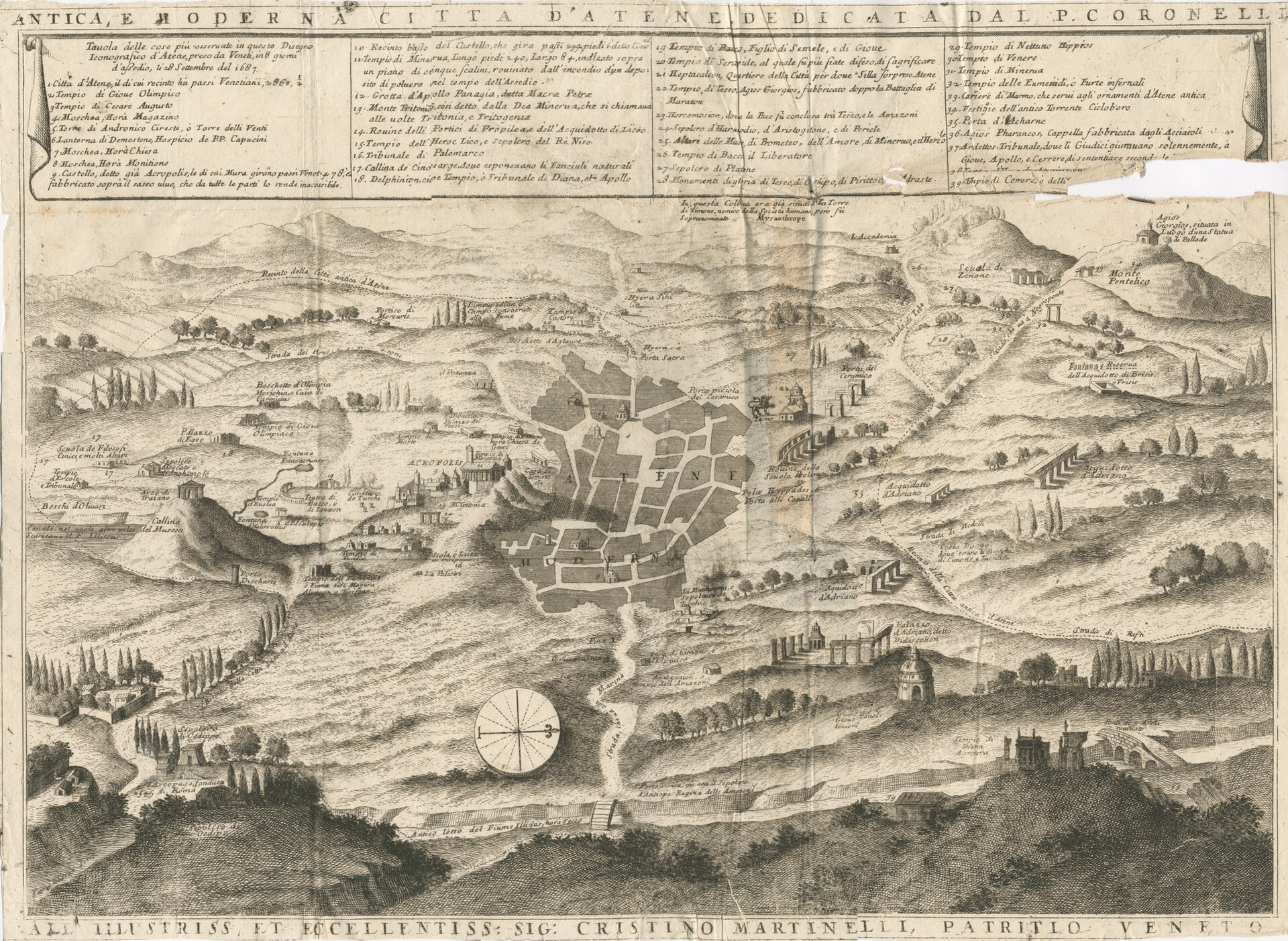
Antica e moderna città d'Atene, from Vincenzo Coronelli's Atlante Veneto
Detailed bird’s‑eye plan showing the Acropolis, enclosed town blocks and streets, surrounding hills and several ancient temples.
1688 · Vincenzo Coronelli · Wikimedia Commons
Public domain (plate dated 1688)
In this city
Landmarks of Athens, see each in its prime


Ships tied to Athens
- Greek cruiser Georgios Averof: Carried the Greek government-in-exile home to liberated Athens in October 1944
More cities to explore
 GreeceHelikeExplore it in 373 BC
 GreeceMonemvasiaExplore it in 1300
 GreeceThessalonikiExplore it in 1200 · 1900
 GreeceAtlantisExplore it in 9600 BC
Castles of Europe · Landmarks of Europe · create your own reconstruction.