Historic Cities · Bulgaria
Plovdiv through the ages
Plovdiv is the second-largest city in Bulgaria and the most populous city in the Bulgarian part of the historic region of Thrace, located 144 km southeast of the capital Sofia. It had a population of 329,489 as of 2024 and 540,000 in its greater metropolitan area.

Plovdiv in AD 200
Roman Philippopolis
Philippopolis in AD 200 is a prosperous provincial capital of Roman Thrace, built across three steep hills and spilling into the fertile Hebrus (Maritsa) plain. The walk shows the city’s public monuments (theatre, stadium, forum and basilica) the circuit walls and gates, and the colonnaded streets that link workshops, markets and river quays.
A compact Roman skyline of pale ashlar, battered city walls and red-tiled roofs perched on three rocky hills, set against the blue silhouette of the Rhodope mountains. Broad colonnaded avenues and packed flagstone streets thread between stone public buildings: a semicircular marble theatre, a long sunk stadium, and a rectilinear forum. Light is bright and Mediterranean; hillsides bear terraces of workshops and storehouses, the plain below shows wagons and grazing horses.
The route: 21 streets, squares and views
Hebrus Plain Approach → Via Militaris Approach → Porta Orientalis → Cardo Maximus → The Forum → Great Basilica → Macellum Market → Decumanus Maximus → Stadium South Curve → Stadium Colonnade → …
Step inside, 14 interiors
Gatehouse Guardroom · Basilica Law Hall · Macellum Central Hall · Merchant's Triclinium · Athletes' Changing Room · Covered Portico Gallery · Vaulted Audience Corridor · Stage Building Dressing Rooms · Odeon Council Chamber · Aqueduct Settling Chamber · Heated Caldarium · Acropolis Shrine Chamber · Bronze Smith's Shop · River Granary Chamber
Planned from the Wikipedia record: Plovdiv.
Plovdiv in 1870
Revival Plovdiv
Plovdiv in 1870 is a prosperous Ottoman-era market city where an emerging Bulgarian bourgeoisie builds painted Revival houses on the hills while mosques, churches and new schools remain neighbours. The walk moves from the Maritsa and its bridge through Kapana's craft lanes, the central bazaar and river quays, then up the Old Town to hilltop views over the seven hills.
Low syenite hills cluster behind a broad, slow Maritsa, the town a tight tangle of tiled roofs, plastered two- and three-storey houses with wooden overhanging oriels, narrow cobbled lanes and the dark stone of older fortifications. Minaret silhouettes and church belfries punctuate the skyline; markets, caravanserais and riverside warehouses give the centre a compact commercial scale, warm colours of ochre, brick red and painted white facades, and persistent dust in sunlit streets.
The route: 22 streets, squares and views
South Bank of the Maritsa → Stone Bridge over Maritsa → Hisar Kapia (Fortress Gate) → Kapana Quarter → Bezisten (Covered Bazaar) → Dzhumaya Mosque → Church of the Virgin Mary → St Cyril and Methodius School → Central Market Square → River Quay Warehouses → …
Step inside, 14 interiors
Dyer's Workshop · Bezisten Merchant Hall · Main Prayer Hall · Church Nave and Iconostasis · Schoolroom of St Cyril · Covered Meat Hall · Quay Loading Shed · Han Coffee Room · Synagogue Prayer Hall · Silk Merchant Showroom · Painted Reception Salon · Grammar School Study · Tobacco Counting Room · Rose Oil Press Room
Planned from the Wikipedia record: History of Plovdiv.
Its story
The story of Plovdiv.
The Hill Fort, Philip's City and Roman Trimontium
Plovdiv grew on a group of syenite hills above the Maritsa on the Upper Thracian Plain. Fine pottery and everyday objects recovered on Nebet Tepe show a settlement established there by the end of the 4th millennium BC and inhabited continuously afterwards, and the Thracian town, a fort of the local Bessi tribe, was established between the 2nd and the 1st millennium BC. Philip II of Macedon took it in 342 BC and deposed the Odrysian king; the name Philippopolis is first recorded by Polybius in the 2nd century BC. The Celts destroyed the city, most likely in the 270s BC, and Philip V of Macedon conquered it in 183 BC.
The Roman general Marcus Lucullus seized the city in 72 BC, though it was soon restored to Thracian control; the emperor Claudius incorporated it for good in 46 AD, and the Romans called it Trimontium, the Three Hills. The Via Militaris, the most important military road in the Balkans, ran through it, and the city was the largest and most important centre of the province of Thrace. The stadium, built under Hadrian, could seat up to 30,000, and the city had a theatre, baths, shrines and a developed water supply and sewerage. The Goths under Cniva looted the city in 250 after the Battle of Philippopolis, with 100,000 dead or taken captive according to Ammianus Marcellinus; recovery took a century, and it was destroyed again by Attila's Huns in 441–442 and by the Goths of Theodoric Strabo in 471.
Border Fortress Between Bulgaria and Byzantium, 681–1344
The Slavs had fully settled the area by the middle of the 6th century, apparently without fighting: no records of attacks survive. With the establishment of Bulgaria in 681, Philippopolis became an important Byzantine border fortress. Khan Krum captured it in 812 and the region was fully incorporated into the Bulgarian Empire in 834 under Khan Malamir. Dualist doctrines spread from the city into Bulgaria and formed the basis of the Bogomil heresy, and Paulician heretics were transported from Syria and Armenia to be settled there as military colonists on the frontier. Accounts place the Byzantine reconquest in 969, 970 or 971; around that time the city was sacked by Sviatoslav I of Kiev, who impaled 20,000 of its people.
Byzantine rule was broken by the Third Crusade, when the army of Frederick Barbarossa took the city, and again by the Latin Empire in 1204; Kaloyan of Bulgaria occupied it twice before his death in 1207, and in 1208 his successor Boril was defeated by the Latins at the Battle of Philippopolis. Under Latin rule it was the capital of the Duchy of Philippopolis, governed by Renier de Trit and later by Gerard de Strem, until Ivan Asen II conquered the duchy in 1230. Byzantium recovered it, and in 1344 the city and eight others were surrendered to Bulgaria by the regency for John V Palaiologos, as the price of Ivan Alexander's support in the Byzantine civil war.
Filibe: Ottoman Rebuilding and the Aba Trade
The date of the Ottoman conquest is told two ways: one account has the city seized in 1364 by Lala Shahin Pasha, another that it did not fall until after the Battle of Maritsa in 1371, when the Bulgarian garrison abandoned it and the inhabitants, led by their metropolitan, surrendered without resistance. Refugees settled at Stanimaka. The Ottomans called the city Filibe; it was the centre of the Rumelia Eyalet until Sofia replaced it in 1443, and a sanjak centre thereafter, latterly within the Edirne Vilayet until 1878. During the Ottoman Interregnum, Musa Çelebi took the city in 1410, tore down its walls, killed many of its inhabitants and drove others out.
With its fortifications gone the town lost its military value, and in the middle of the 15th century the Ottomans rebuilt it as a commercial place: the Djumaya mosque west of the three hills, a new bridge over the Maritsa with the Karshiyaka quarter forming beyond it, and a large imaret founded near the bridge by the beylerbey Şahabeddin Pasha. The district of hans and markets between bridge and mosque remained the city's trading centre until the end of Ottoman rule and was largely destroyed in the 20th century. From the early 15th century to the end of the 17th the population was predominantly Muslim, alongside Bulgarian, Greek-speaking, Armenian and Paulician communities and a smaller group of Ragusan merchants; a large number of Sephardic Jews settled in the 16th century and a compact group of Armenians arrived from Galicia in the 17th, while the Paulicians took up Catholicism or lost their identity.
In the 18th century the city established itself as a leading economic centre of the Balkan interior on the back of aba cloth and other textile production. The kardzhali disorders at the end of the century drove refugees into it, Bulgarians from Thrace, Greeks from Epirus and Thessaly. Its population was predominantly Turkish in 1738; migration from the surrounding Bulgarian and Greek villages, with wealthy Greek, Vlach and Bulgarian merchant families, carried the Orthodox share past half by the middle of the 19th century.
The School, the Liturgy and the Church Struggle, 1836–1878
The liberalisation that followed the Gülhane edict of 1839 concentrated aba production into larger enterprises and produced trading houses with business running from Manchester to Calcutta; Mihalaki Gümüşgerdan opened the first textile factory in 1845. The Bulgarian, Armenian and Greek communities led that process, and the houses the wealthier citizens built survive in the architectural reserve of the Old Town.
The first Bulgarian school opened in 1836, and modern secular education began in 1850 with the St Cyril and Methodius school, which expanded into a grammar school in 1868. On 11 May 1858 the day of Saints Cyril and Methodius was celebrated for the first time (later a national holiday, now kept on 24 May), and in the same year the Christmas liturgy was served in Bulgarian in the Church of the Virgin Mary for the first time since the 14th century. The struggle for church independence centred on the city under Nayden Gerov, Dr Valkovich and Joakim Gruev; the Greek community's refusal to allow Bulgarian services in some churches led to the removal of the pro-Greek metropolitan Chrysanthos and to physical clashes. After the Bulgarian Exarchate was separated in 1870 the city had two Orthodox metropolitans, Bulgarian and Greek, until 1906, and Greek schooling remained substantial: eight Greek institutions were active in 1880.
A committee of the Internal Revolutionary Organisation was formed in 1869, and the plans for the April Uprising of 1876 provided for setting a great fire in Plovdiv to spread panic, but the attempt burned only a few shops. After the rising was crushed, many people from the rebel villages were brought to Plovdiv, where some were tried and many were hanged in the streets. On 17 January 1878 a dragoon squadron under Captain Aleksandr Burago crossed the river on a reconnaissance, panicked the Ottoman forces and held the city for several hours.
Capital of Eastern Rumelia and the Unification of 6 September 1885
Under the Treaty of San Stefano of 3 March 1878 Plovdiv was chosen as capital of the restored country and seat of the Provisional Russian Administration, which sat there from May to October. Great Britain and Austria-Hungary refused the treaty, and the Congress of Berlin divided the newly liberated country, separating the autonomous province of Eastern Rumelia with Plovdiv as its capital, holding the governor-general, the provincial assembly, the central courts and the military command. The Russian census of 1878 counted about 24,000 inhabitants, 45.4 per cent Bulgarians, 23.1 per cent Turks and 19.9 per cent Greeks; by 1 January 1885 the figure was 33,442, including 2,168 Jews and 1,061 Armenians.
In the spring of 1885 Zahari Stoyanov formed the Secret Bulgarian Central Revolutionary Committee in the city to campaign for unification with the principality. On 5 September several hundred armed rebels from Golyamo Konare, now Saedinenie, marched on Plovdiv; during the night of 5–6 September, led by Danail Nikolaev, they took control and removed the governor-general Gavril Krastevich from office, and a provisional government under Georgi Stranski announced universal mobilisation. After the Serbs were defeated in the Serbo-Bulgarian War, Bulgaria and Turkey agreed that the principality and Eastern Rumelia would share a government, parliament, administration and army. The sixth of September is kept as Unification Day and as the day of Plovdiv.
Tobacco, Refugees and Bombing, 1888–1944
The railway was extended to Sofia in 1888, and in 1892 the city hosted the First Bulgarian Fair with international participation, the ancestor of the International Fair Plovdiv. A large fire destroyed much of the Kapana craft quarter in 1904. Turkish emigration from the city continued, and in 1906 anti-Greek pogroms broke out with casualties on both sides; the Greek churches were taken over by the Bulgarian Exarchate and a large part of the Greek population left.
After the Balkan Wars some 8,000 refugees arrived from Macedonia and Eastern Thrace, first housed in unused public buildings and then founding the quarters of Kyuchuk Paris, Borislav and Kirpich Mahala; further waves followed after the First World War, and several older neighbourhoods are still called Belomorski or Vardarski after the districts their people came from. The population reached 85,000 in 1926 and 106,000 in 1939. Electrification began in 1927, and the Chirpan earthquake of 1928 destroyed a third of the city's building stock. By 1939 the city held over 16,000 craftsmen and over 17,000 factory workers, mainly in food and tobacco.
During the Second World War the tobacco industry expanded along with the export of fruit and vegetables, while other sectors were hit hard by the collapse of international trade. In March 1943 Plovdiv was a principal centre of resistance to the deportation of the Jews: 1,500 people were arrested in the city and released a day later after the intervention of the metropolitan of Plovdiv, Kiril, later Bulgarian Patriarch, and other prominent public figures. Early in 1944 British and American aircraft bombed the city; the first heavy raid, on 17 April, was followed by large fires.
Nationalisation, the Combines and the Capital of Culture, 1944–2021
After the coup of 9 September 1944 the city was caught in the violence of the communist takeover: the People's Court alone sentenced 328 people to death in Plovdiv and hundreds more to long prison terms, and many residents were deported or sent to camps. Industry was nationalised in 1946–1947 and merged, ending competition within each sector, while the craft trades were folded into state-controlled cooperatives. A university was founded in 1945. Most of the Jews left the city after the foundation of Israel in 1948, as did most of the Turks and Greeks.
Under the People's Republic large plants were built in and around the city (non-ferrous metals, textiles, electrical apparatus, tobacco and fork-lift trucks among them), and the first trolleybus line opened on 6 April 1956. The population reached 264,000 by 1970, and mass construction through the 1960s and 1970s formed the modern residential complexes. In the 1970s and 1980s many of the ancient remains were excavated and the Old Town, a preservation site of Bulgarian Revival architecture, was fully restored.
The city hosted specialised exhibitions of the World's Fair in 1981, 1985 and 1991, and in that period became the birthplace of Bulgaria's movement for democratic reform, which by 1989 had gathered enough support to enter government. After the collapse of the planned economy a number of the industrial complexes closed, though production of lead, zinc, machinery, electronics, motor trucks, chemicals and cosmetics continued. Plovdiv joined the UNESCO Global Network of Learning Cities in 2016 and was European Capital of Culture in 2019, sharing the title with Matera. The census of September 2021 recorded 319,612 residents, making it the second-largest city in Bulgaria and the administrative centre of Plovdiv Province.
From the archive
Plovdiv on paper: the place as it was mapped.
A period map that sets the place down, drawn between 1500 and 1850, the ground this page's reconstructions walk. Public domain, with its source named.
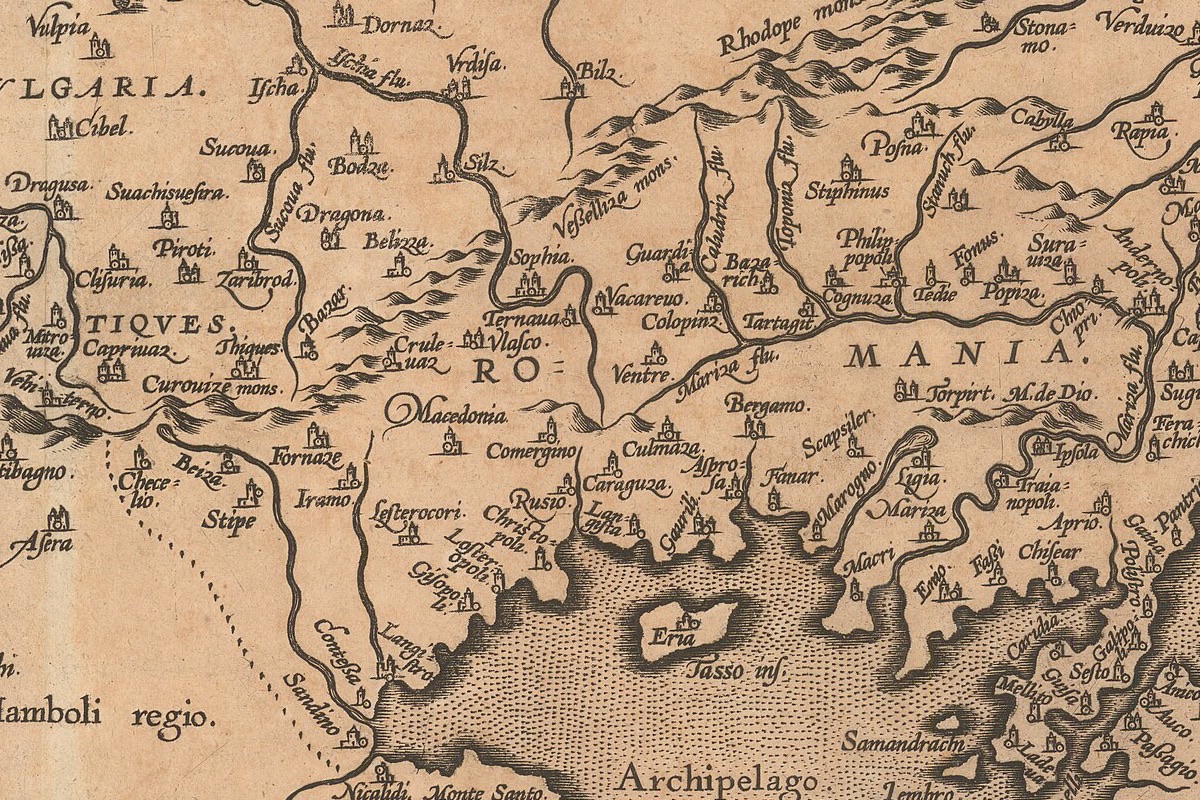
Philippopoli on Gastaldi's map of Romania, the old Thrace
Philippopoli stands with a walled-town symbol on the Mariza between Sophia and Adrianopoli, on the Ottoman road across Rumelia that the city's plain carried.
1584 · Giacomo Gastaldi · Wikimedia Commons
Public domain (plate dated 1584)
More cities to explore
 GreeceThessalonikiExplore it in 1200 · 1900
 NetherlandsUtrechtExplore it in 1400 · 1700
 EnglandLondonExplore it in AD 200 · 1390 · 1600 · 1885
 FranceParisExplore it in 1250 · 1670 · 1789 · 1889
Castles of Europe · Landmarks of Europe · create your own reconstruction.